

On this page
Mitosis, often called equational division, is the process where a single parent cell divides into two genetically identical daughter cells. But why do cells divide in the first place, and what makes this process so fundamental to life?
The significance of mitosis goes far beyond just splitting a cell. It is the engine behind growth, the mechanism for tissue repair, and the way a cell keeps its internal management efficient. If you want to review the full cell cycle, you can explore the Fermi Concept Library to walk through each phase at your own pace.
Why is the nucleo-cytoplasmic ratio important?
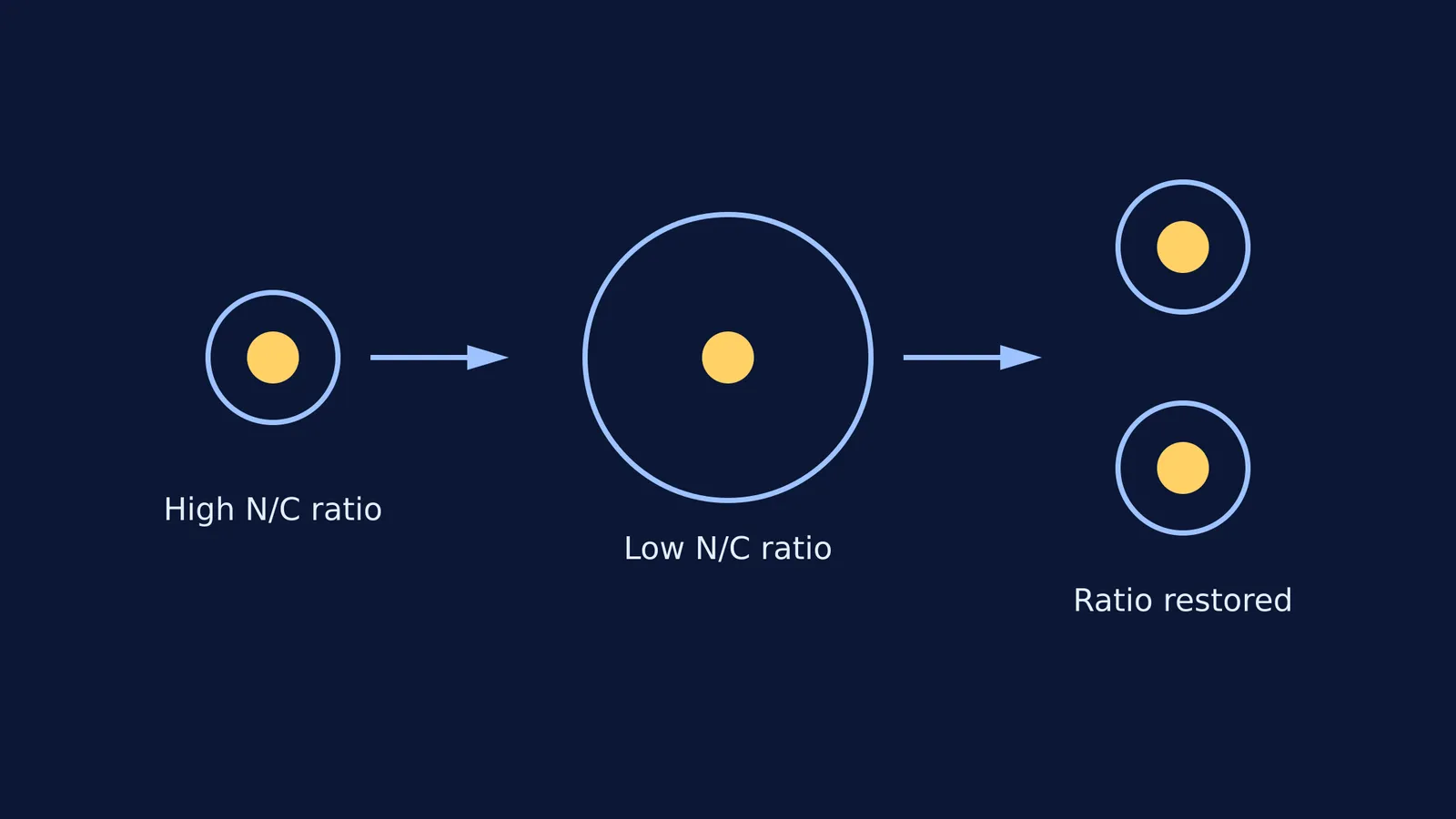
A cell cannot grow forever without consequences. The nucleus acts as the control centre, managing the metabolic activities of the entire cytoplasm. As a cell grows during interphase, its cytoplasmic volume increases significantly, but the physical size of its nucleus, and the DNA instructions within it, remains mostly constant.
This differing rate of growth disturbs the internal balance. In 1903, the German zoologist Richard Hertwig formulated the Kern-Plasma-Relation, or the nucleocytoplasmic ratio. Hertwig proposed that there is a fixed, functional relationship between the volume of the nucleus and the volume of the cytoplasm. He argued that when the cytoplasm becomes too vast for a single nucleus to govern efficiently, this creates a state of tension. This critical point triggers the cell to divide. By splitting the large parent cell into two smaller ones, mitosis restores a high nucleo-cytoplasmic ratio, ensuring the nucleus can effectively control the new cell. This concept remains one of the earliest mathematical explanations for why cells regulate their size through division.
How does mitosis help in growth and meristem activity?
The growth of any multicellular organism is driven by mitosis. You began life as a single-celled zygote; successive mitotic divisions multiplied that single cell into the many cells that make up your body today. This repeated division is what allows organisms to build complex tissues and organs over time.
In plants, growth works a bit differently. Plants grow continuously throughout their lifespan because of apical, intercalary and lateral meristems. These specialised tissues, including the lateral cambium, are regions of active, relentless cell division. Mitosis in the apical meristems adds length to the roots and shoots, while mitosis in the lateral cambium adds girth to the stem. This ensures the plant can constantly reach for light and nutrients and structurally support its increasing size.
How does mitosis repair our bodies?
Your body is constantly experiencing wear and tear. Mitosis is the cellular repair crew. When tissues are damaged or naturally age, dividing cells step in to replace them. This process is essential for healing wounds and maintaining the integrity of healthy tissues.
Some of the most active sites of mitotic replacement in the human body include:
The upper layer of the epidermis (skin), which sheds continuously as we interact with the environment.
The cells lining the gut, which endure a harsh digestive environment and require rapid turnover.
Blood cells, such as red blood cells, which are constantly manufactured in the bone marrow to replace old ones. To understand the different types of cells involved, you can read about the formed elements of blood.
Why is keeping the chromosome number constant essential?
Unlike meiosis, which halves the genetic material to create sperm or eggs for reproduction, mitosis is an equational division. It ensures that the chromosome number remains strictly constant from one generation of somatic cells to the next. The two daughter cells receive an exact, identical copy of the parent cell's DNA. This precision is vital for maintaining genetic stability across all the tissues of a multicellular organism, ensuring that a skin cell divides to produce another fully functional skin cell without losing any genetic instructions. To understand how these chromosomes are structured before division, you can revise the chromosome types by centromere position.
While we typically associate mitosis with diploid (2n) cells, it can also happen in haploid (n) cells. Lower plants, certain fungi, and some social insects like male honeybees rely on haploid mitosis to survive and grow. Whether diploid or haploid, the fundamental rule holds: mitosis clones the genetic complement perfectly, keeping the biological instructions completely intact across every new cell division.


