

On this page
Civil engineers need the density of soil grains before they can work out how much empty space a soil holds or how fast it will settle under a building. Pharmacists and paint makers need the density of their powders too. You cannot hang a heap of sand from a balance and dip it in water, so labs use a small glass flask with a stopper: the specific gravity bottle, also called a density bottle or pycnometer. Four weighings on it give the relative density of the grains. The catch is that one tiny air bubble can spoil the answer.
Why can't you weigh sand in air and in water like a stone?
For a solid lump, you weigh it in air, then hanging in water, and the loss of weight is the weight of water it displaces. That method is worked in finding density by weighing in air and water. A powder cannot be hung from a thread. Grains fall apart, and water would have to fill every gap between them.
The way round it is the idea Al-Biruni used with his overflow vessel: measure the volume of water the solid pushes aside. The specific gravity bottle does that by weighing instead of catching the overflow.
What is a specific gravity bottle?
It is a small glass flask whose ground-glass stopper has a fine hole down its centre. You fill the bottle to overflowing and push the stopper in; the extra water escapes up the hole. Whatever you put in, the bottle then holds exactly the same volume every time. That fixed volume is the whole trick.
The Indian soil-testing standard, IS 2720 (Part 3/Section 1): 1980, uses two bottles of about 50 mL, a balance readable to 0.001 g and a test portion of 5 to 10 g of oven-dried soil.
How do four weighings give the relative density of a powder?
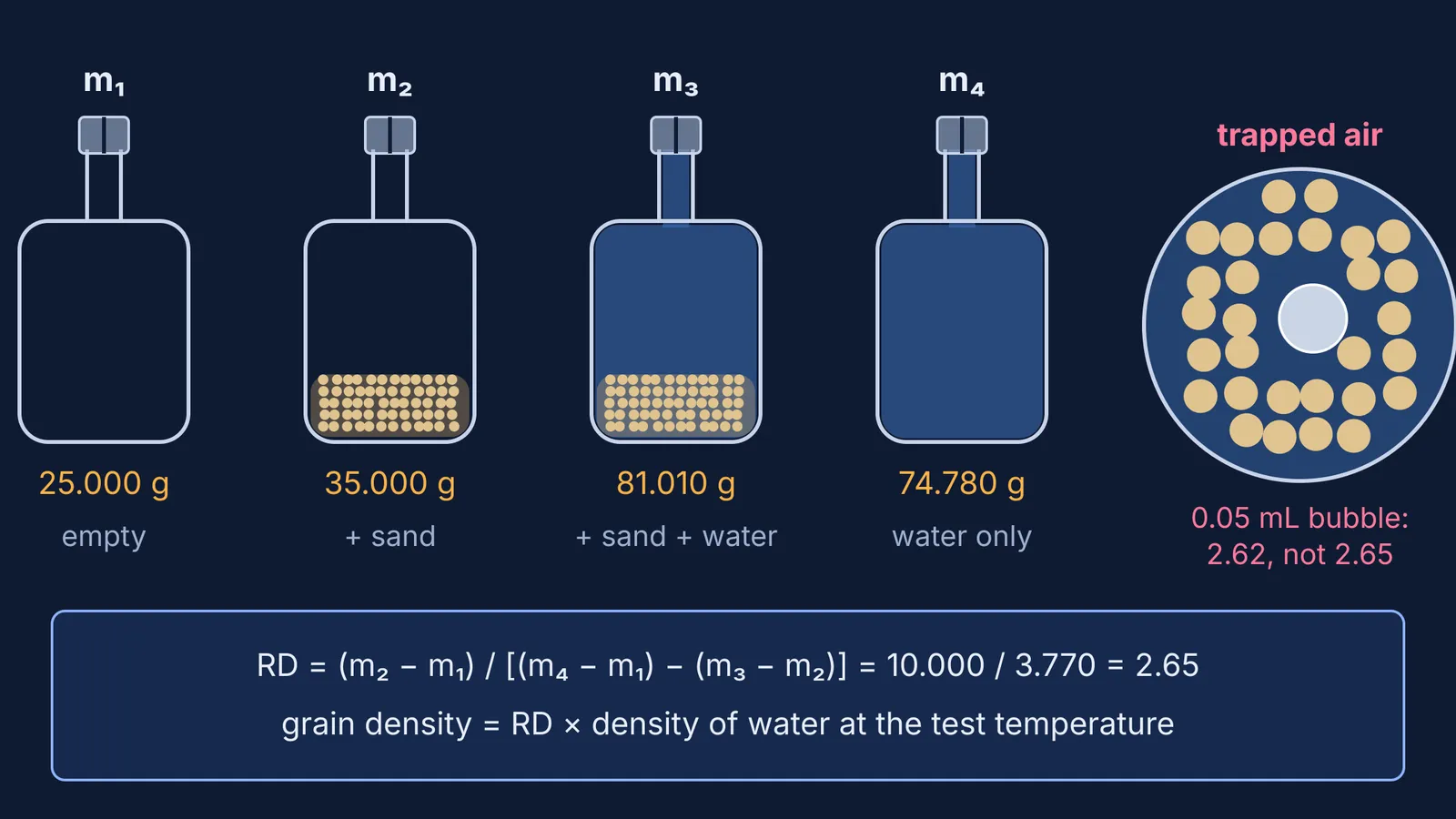
Weigh the bottle four times:
m₁: empty and dry, with its stopper.
m₂: with some dry powder inside.
m₃: with the powder and then water filled to the top, stopper in.
m₄: emptied, cleaned and filled with water only.
The powder's mass is m₂ − m₁. The bottle full of water holds water of mass m₄ − m₁. With powder inside, it holds water of mass m₃ − m₂. The difference, (m₄ − m₁) − (m₃ − m₂), is the mass of water pushed out by the grains, which is water occupying exactly the grains' volume. So:
Relative density = (m₂ − m₁) / [(m₄ − m₁) − (m₃ − m₂)]
This is the formula in clause 5.1 of IS 2720. It compares the grains with an equal volume of water, so the units cancel. Why relative density has no unit explains why that makes it a pure number.
Worked example: the relative density of sand
A lab at 30 °C records (illustrative readings): m₁ = 25.000 g, m₂ = 35.000 g, m₃ = 81.010 g, m₄ = 74.780 g.
Mass of sand. m₂ − m₁ = 35.000 − 25.000 = 10.000 g.
Water when full. m₄ − m₁ = 74.780 − 25.000 = 49.780 g.
Water alongside the sand. m₃ − m₂ = 81.010 − 35.000 = 46.010 g.
Water displaced by the sand. 49.780 − 46.010 = 3.770 g.
Relative density. 10.000 / 3.770 = 2.653, reported as 2.65.
That is the value IS 2720 itself quotes in a note: clean quartz and flint sands generally have a specific gravity close to 2.65.
Why does one trapped air bubble matter so much?
Suppose 0.05 mL of air stays stuck among the grains when you fill the bottle in step 3. That space should have held water, so m₃ comes out about 0.05 g light: 81.010 − 0.050 = 80.960 g.
Water alongside the sand: 80.960 − 35.000 = 45.960 g.
Water "displaced": 49.780 − 45.960 = 3.820 g.
Relative density: 10.000 / 3.820 = 2.618, about 1.3% low.
The bubble is counted as if it were sand, so the sand seems bigger and less dense. A bubble smaller than a pinhead shifts the answer in the second decimal place, which is the place the standard reports. IS 2720 says that the largest source of error in the test is the difficulty of removing all the air. It has the soil, just covered with water, put in a vacuum desiccator at about 20 mmHg for at least an hour, stirred, and evacuated again until no more air comes out, with gentle heating as an alternative. It also asks for two determinations and a repeat if they differ by more than 0.03.
Why does the water temperature matter?
Relative density compares the sand with water at the test temperature, and water's density changes with temperature. From the recommended table of Tanaka and co-workers in Metrologia (2001), water is about 0.99565 g/cm³ at 30 °C and 0.99652 g/cm³ at 27 °C.
Density of the sand grains. Multiply by water's density: 2.653 × 0.99565 = 2.641 g/cm³.
Correction to 27 °C. IS 2720 asks for results at 27 °C and corrects with G′ = KG, where K is water's relative density at room temperature divided by that at 27 °C. Here K = 0.99565/0.99652 = 0.99913, so G′ = 2.650.
The change is small, but it is in the same decimal place as the bubble error, which is why a careful lab keeps the bottle in a water bath.
What if the powder dissolves in water?
Salts and some soils dissolve or react, and some powders float. Then you use another liquid. IS 2720 suggests kerosene or white spirit for soils containing soluble salts. The formula gains one factor: multiply the right-hand side by the relative density of that liquid, measured separately at the same temperature. Any error in the liquid's density carries straight into the answer.
To work through more density and buoyancy sums step by step, try the Fermi Problem Library, whose solver explains the reasoning at each step. For a refresher on relative density itself, see the Concept Library.
Quick checklist
The stopper's fine hole makes the bottle hold the same volume each time.
Four weighings: empty, powder, powder plus water, water only.
Relative density = (m₂ − m₁) / [(m₄ − m₁) − (m₃ − m₂)].
The denominator is the mass of water with the same volume as the grains.
Trapped air makes the answer low; remove it under vacuum or by gentle heating.
Density = relative density × water's density at the test temperature.
Use kerosene for powders that dissolve, and know its density.


