

On this page
When Archimedes stepped into his bath in Syracuse, he realised that an immersed body displaces its own volume of water. Yet converting that insight into an exact laboratory measurement remained difficult for centuries. For small gemstones and intricate metalwork, measuring displaced volume with a graduated vessel produced large parallax and meniscus errors.
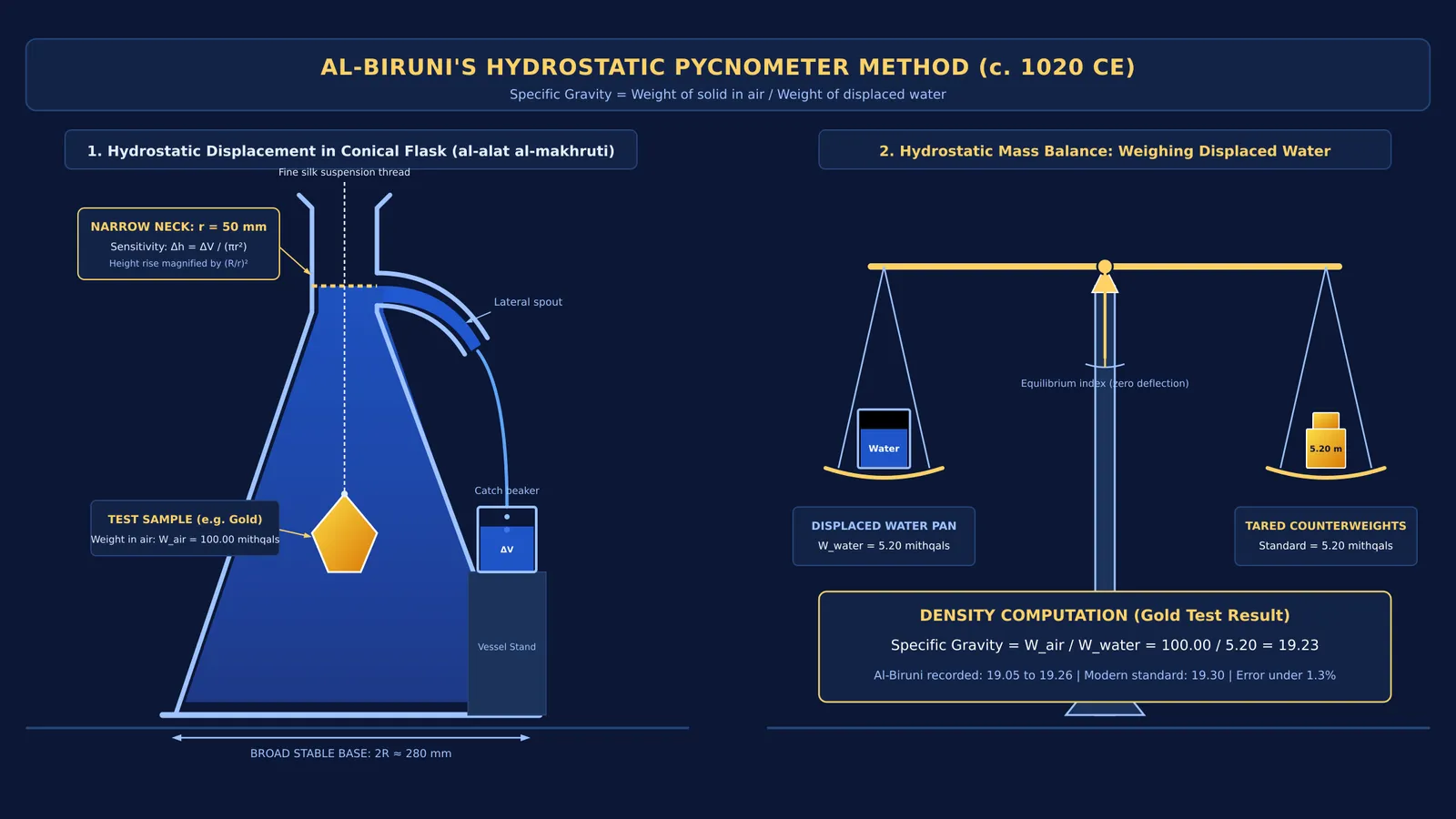
Around 1020 CE, the Persian polymath Abu al-Rayhan al-Biruni bypassed visual volume markings entirely. Instead of reading fluid heights on a cylinder, he designed a conical overflow flask—*al-alat al-makhruti*—and weighed the spilled liquid on a precision balance. His experimental method and density tables were recorded in his mineralogical treatise *Kitab al-Jamahir fi Ma'rifat al-Jawahir*, as documented by S. M. Razaullah Ansari in the Indian Journal of History of Science.
Al-Biruni's protocol followed four steps:
Fill the conical vessel with water until it overflows through a lateral spout into a collection cup.
Wait until dripping ceases completely to establish a repeatable fluid meniscus.
Lower the sample, previously weighed in air, using a fine silk thread that displaces negligible water.
Catch the displaced overflow in a tared pan and weigh it on a balance.
Because specific gravity compares a material's density to water, Al-Biruni calculated it as:
Specific gravity = Weight of solid in air / Weight of displaced water
Why did Al-Biruni use a conical vessel instead of a cylinder?
The conical shape was a deliberate design to maximize measurement sensitivity. In any vessel of cross-sectional area A, an added volume displacement ΔV raises the liquid level by:
Δh = ΔV / A
In a wide cylindrical beaker of radius R, the area A = πR² is large, so a small gem raises the water level by a fraction of a millimetre—too small to guarantee a clean overflow. Al-Biruni kept a broad base for stability but tapered the vessel upward to a narrow neck of radius r. Because r is much smaller than R, the cross-sectional area at the neck is tiny, magnifying the height rise Δh by (R/r)². Even a minor displacement forced an immediate overflow through the spout.
Al-Biruni also accounted for environmental variables. He observed that water density changes with temperature, noting measurable differences in displaced water weights between summer heat and winter cold. As documented by S. M. Razaullah Ansari in the Indian Journal of History of Science, Al-Biruni standardized his water source and recorded temperature conditions to minimize thermal density fluctuations. Modern students studying error propagation in measurement recognize this as eliminating systematic experimental bias.
How accurate were Al-Biruni's specific gravity values?
Al-Biruni tested 18 metals and minerals, comparing each against water and standard corundum. As analyzed by F. Ozcep in History of Geo- and Space Sciences and compiled by S. M. Razaullah Ansari in the Indian Journal of History of Science, his values match modern laboratory standards with remarkable precision:
Gold: 19.05 to 19.26 (modern standard: 19.30, error under 1.3%)
Mercury: 13.56 to 13.59 (modern standard: 13.55, error under 0.3%)
Lead: 11.32 to 11.35 (modern standard: 11.34, within 0.1%)
Copper: 8.72 to 8.83 (modern standard: 8.96)
Iron: 7.74 to 7.82 (modern standard: 7.87)
Tin: 7.31 to 7.32 (modern standard: 7.28)
Sapphire: 3.91 to 3.97 (modern standard: 3.99 to 4.00)
Emerald: 2.73 to 2.75 (modern standard: 2.68 to 2.78)
Quartz: 2.53 to 2.58 (modern standard: 2.65)
These values transformed gemology from visual appraisal into physical science. Previously, merchants identified gems by hue, allowing traders to sell red spinels or glass as rubies. Because specific gravity reflects intrinsic atomic packing, Al-Biruni showed that true ruby measures near 4.0, whereas spinel measures around 3.6 and quartz glass falls below 2.7. As Steven A. Walton details in Annals of Science, Al-Biruni's empirical measurements replaced classical folklore and stopped gemstone myths in the Islamic world. While early accounts of Archimedes and buoyancy relied on qualitative overflow, Al-Biruni established quantitative hydrostatics.
Worked example: how do you test a metal sample with Al-Biruni's formula?
Using the experimental weights documented by S. M. Razaullah Ansari in the Indian Journal of History of Science, consider an assayer testing a suspected gold ornament weighing 100.00 mithqals (about 425 grams) in air:
Measure weight in air: Record W_air = 100.00 mithqals on a balance.
Prime the vessel: Fill the conical flask with water until overflow ceases and the meniscus stabilizes.
Submerge the sample: Lower the ornament into the neck on a silk thread, catching all displaced water in a tared pan.
Weigh displaced water: The balance shows the displaced water weighs W_water = 6.45 mithqals.
Calculate specific gravity:
Specific gravity = W_air / W_water = 100.00 / 6.45 = 15.50
Pure gold has a specific gravity of 19.30, while silver is 10.49 and copper is 8.96. A result of 15.50 reveals that the ornament is not pure gold, but an alloy containing base metals. The assayer unmasks the fraud without damaging the artifact, just as students do when analyzing density ratios in a two-liquid manometer.
How can students master experimental hydrostatics today?
In competitive physics examinations, questions on fluid statics and buoyancy test whether you can balance forces systematically rather than plugging into remembered formulas. Visualising displaced volumes, pressure heads, and density differences is essential for solving complex fluid mechanics problems.
To explore how buoyant forces adapt when fluid density or immersion depth changes, examine interactive setups in the Fermi Simulation Lab. When practicing multi-step physics numericals, the Fermi Problem Library provides worked problems with a step-by-step solver that explains the reasoning rather than printing an answer.


