On this page
When PSLV leaves the pad at Sriharikota, its first stage is a solid motor, and LVM3 rides on two large solid strap-ons. These motors burn a composite propellant: ammonium perchlorate (AP) as the oxidiser, aluminium powder as a metal fuel, and a rubbery polymer binder such as HTPB that is also a fuel. The story of how India learned to make it is told in our post on Vasant Gowariker and India's first solid rocket propellants. Here we balance the equations and ask whether the oxidiser carries enough oxygen for the fuel. It does not, on purpose.
What is oxygen balance in a propellant?
Oxygen balance (OB) is a bookkeeping number. Imagine every atom ends in its fully oxidised product:
carbon → CO₂
hydrogen → H₂O
aluminium → Al₂O₃
nitrogen → N₂
chlorine → HCl
Then ask how much O₂ is left over (positive OB) or still needed (negative OB), as grams of O₂ per 100 g of the substance, quoted as a percentage.
Two warnings. Conventions differ: some books send chlorine to HCl, some to Cl₂, so always state yours (here, HCl). And OB does not predict the real exhaust, which comes from chemical-equilibrium calculations at the flame temperature. OB only tells you which side of "enough oxygen" a mixture sits on, and by how much.
How do you work out the oxygen balance of ammonium perchlorate?
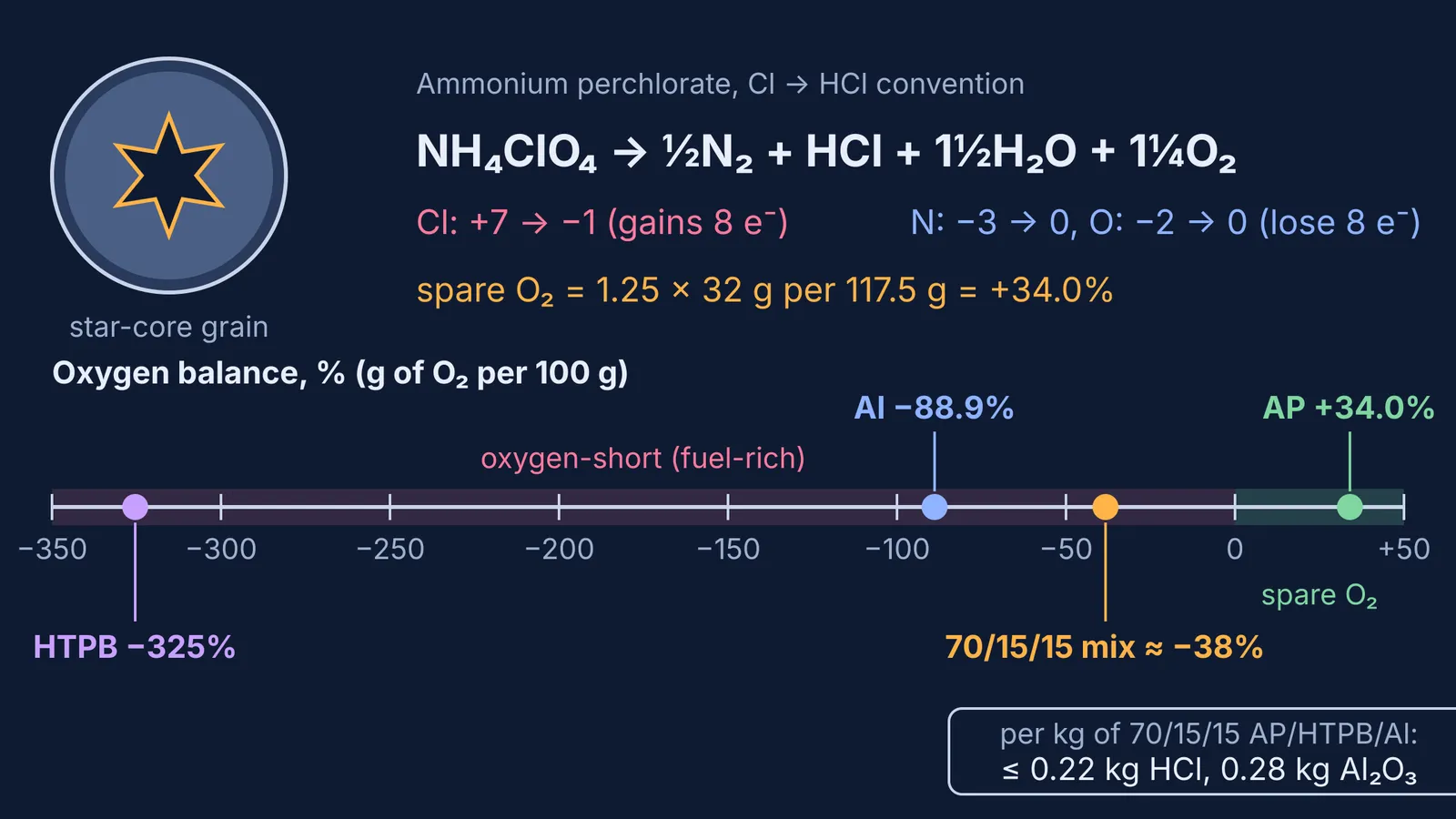
In NH₄ClO₄, N is −3, H is +1, Cl is +7 and O is −2. AP carries its own fuel (the N–H part) and its own oxidiser (perchlorate) in one salt. With our convention:
NH₄ClO₄ → ½N₂ + HCl + 3/2 H₂O + 5/4 O₂
Check it. N: 1 = 1. H: 4 = 1 + 3. Cl: 1 = 1. O: 4 = 3/2 + 5/2. It balances.
Count electrons. Chlorine goes +7 → −1, gaining 8. Nitrogen goes −3 → 0, losing 3, and the 5/2 oxygen atoms that become O₂ go −2 → 0, losing 5. Lost 3 + 5 = 8 = gained: an internal redox reaction.
The molar mass of AP is 117.49 g mol⁻¹. It releases 5/4 × 32.00 = 40.0 g of spare O₂ per mole, so
OB(AP) = +40.0 ÷ 117.49 × 100 = +34.0%
If you send chlorine to Cl₂ instead (NH₄ClO₄ → ½N₂ + ½Cl₂ + 2H₂O + O₂), only 1 mol of O₂ is spare and OB becomes +27.2%. Same molecule, different convention.
AP on its own is not very energetic. From standard enthalpies of formation (approximately −295.8 kJ mol⁻¹ for AP, listed on Wikipedia's ammonium perchlorate page, −92.3 for HCl(g) and −241.8 for H₂O(g)), the decomposition above releases about 159 kJ per mole, roughly 1.4 kJ per gram. Its job is to supply oxygen.
How much oxygen do aluminium and HTPB need?
Aluminium. 4Al + 3O₂ → 2Al₂O₃, so each mole of Al (26.98 g) needs 3/4 mol of O₂ (24.0 g).
OB(Al) = −24.0 ÷ 26.98 × 100 = −88.9%
This is where much of the energy comes from. With ΔfH(Al₂O₃) ≈ −1675.7 kJ mol⁻¹, burning aluminium releases about 31 kJ per gram of Al, more than twenty times what AP gives per gram on its own.
HTPB. Hydroxyl-terminated polybutadiene is a polymer of butadiene. Treat its repeat unit as C₄H₆ (54.09 g mol⁻¹). This is an approximation: real HTPB has OH groups at the chain ends and is cross-linked when it cures, so its true OB is slightly less negative.
2C₄H₆ + 11O₂ → 8CO₂ + 6H₂O
Check: C 8 = 8, H 12 = 12, O 22 = 16 + 6. Each C₄H₆ needs 5.5 mol O₂, which is 176.0 g.
OB(HTPB) = −176.0 ÷ 54.09 × 100 = −325%
Worked example: the oxygen balance of an AP/Al/HTPB mix
Published compositions for this family vary. Wikipedia's article on AP composite propellant gives roughly 70/15/15 AP/HTPB/Al for high-performance motors. Treat this as a generic textbook-style figure, not as ISRO's recipe; we have not found a public ISRO source for the composition of its motors.
List each OB. AP +34.0%, Al −88.9%, HTPB −325.4%.
Weight by mass fraction. OB is per 100 g, so mass fractions are the right weights. AP: 0.70 × 34.0 = +23.8. Al: 0.15 × (−88.9) = −13.3. HTPB: 0.15 × (−325.4) = −48.8.
Add. OB(mix) = 23.8 − 13.3 − 48.8 = −38.3%. Each kilogram of propellant is about 383 g of O₂ short of burning everything completely.
Compare with a binder-free mix. Without HTPB, the AP and Al balance exactly when 0.340 × (mass of AP) = 0.889 × (mass of Al). That gives a mass ratio of 2.61 : 1, or 72.3% AP and 27.7% Al. The binder that holds the powder together pushes the mix far to the oxygen-short side.
Upper bound on HCl. All the chlorine comes from AP. Per kg of mix: 0.70 × 36.46 ÷ 117.49 = 0.217 kg HCl at most (some chlorine leaves in other forms).
Alumina. Each 2 mol Al (53.96 g) gives 1 mol Al₂O₃ (101.96 g). Per kg: 0.15 × 101.96 ÷ 53.96 = 0.283 kg Al₂O₃.
Scale it. The Gowariker post records an Indian motor holding 200 tonnes of propellant. If that much had this generic composition, it would give up to about 43 t of HCl and about 57 t of Al₂O₃.
If you want more mixture and limiting-reagent problems worked through, the Fermi Problem Library has a step-by-step solver that explains the reasoning at each stage.
Why would a rocket propellant be fuel-rich on purpose?
Because the missing oxygen still gives useful products. Aluminium takes oxygen very strongly, so it ends up as Al₂O₃. Some carbon then leaves as CO instead of CO₂, and some hydrogen as H₂ instead of H₂O. These are lighter molecules (molar masses 28 and 2, against 44 and 18). At the same temperature, lighter gas molecules move faster, which helps the exhaust leave the nozzle faster. Adding more oxidiser to reach OB = 0 would also leave too little binder to hold the solid together.
Compare nitroglycerine in Alfred Nobel and the chemistry of dynamite, which decomposes with a little O₂ to spare, and the gunpowder in why firecrackers make a loud bang, a nitrate oxidiser with no metal fuel.
What comes out of a solid rocket motor?
The same Wikipedia article lists the exhaust as mostly water, carbon dioxide, hydrogen chloride and a metal oxide, usually Al₂O₃. Given the fuel-rich mix, you should also expect CO and H₂. The fine alumina particles make the thick white smoke you see at a launch. The HCl dissolves in moisture in the air to form hydrochloric acid, which is why the HCl figure in step 5 matters for the area around a launch pad.
AP and aluminium mixtures are hazardous materials, handled only in licensed facilities. Everything in this post is paper chemistry.
Quick checklist
Oxygen balance: g of O₂ spare (+) or needed (−) per 100 g, with C → CO₂, H → H₂O, Al → Al₂O₃, Cl → HCl.
AP +34.0%, Al −88.9%, HTPB (as C₄H₆) about −325%.
In AP, Cl goes +7 → −1 (8 e⁻ gained); N and O together lose 8 e⁻.
Weight by mass fraction: a 70/15/15 AP/HTPB/Al mix is about −38%.
Fuel-rich on purpose: lighter CO and H₂ in the exhaust.
Per kg of that mix: at most 0.22 kg HCl and about 0.28 kg Al₂O₃.