

On this page
On 21 February 1969, a small team at Thumba, near Thiruvananthapuram, developed and tested India's first composite solid rocket propellant. The batch weighed 350 grams, the ingredients were ground with a mortar and pestle and coffee grinders, and the whole activity happened in a 1,000 sq ft area, in a building with asbestos walls and roof, K. N. Ninan recalled to The News Minute in 2019. The man heading that team was Vasant Gowariker.
Who was Vasant Gowariker?
Gowariker was born in Pune on 25 March 1933 and died there on 2 January 2015 (Wikipedia). He took his master's and PhD in chemical engineering at the University of Birmingham, where he and F. H. Garner developed the Garner–Gowariker theory of heat and mass transfer between solids and fluids (The Hitavada).
Vikram Sarabhai recruited him from Britain to build rocket propellants. Ninan dates the recruitment to 1966 (The News Minute); The Hitavada says he joined the Thumba space centre as propellant engineer in 1967. He directed the Vikram Sarabhai Space Centre (VSSC) from 1979 to 1985, and later served as Secretary of the Department of Science and Technology and scientific adviser to Prime Minister P. V. Narasimha Rao (Wikipedia). He received the Padma Shri in 1984 and the Padma Bhushan in 2008 (The Hitavada).
Many people know him for weather, not rockets: our post on Gowariker's power regression monsoon model covers that side.
What did Gowariker do for ISRO's solid propellant?
He headed the Propellant Engineering Division at the Space Science and Technology Centre, the forerunner of VSSC, and later co-supervised Ninan's doctorate (K. N. Ninan, Wikipedia)).
The early work was trial and error. Rajaram Nagappa, who joined the centre in January 1967, describes it in an INAE article: ammonium perchlorate in a polyester resin binder, ground by hand with a pestle and mortar, mixed with an egg-beater and hand-rammed into thick steel tubes. He also notes that at one time three agencies were running formulation trials separately.
A tribute by Nikhil Narayanan on former ISRO scientist V. P. Balagangadharan's site says Gowariker's group started from cordite, tried various composite formulations, and chose hydroxyl-terminated polybutadiene (HTPB) as the standard. To make the resin in India, he set up the Propellant Fuel Complex, and an Ammonium Perchlorate Experimental Plant at Aluva made the oxidiser.
SLV-3 used solid motors in all four stages and put the Rohini RS-1 satellite into orbit on 18 July 1980, while Gowariker was VSSC director (Wikipedia); our post on A. P. J. Abdul Kalam and SLV-3 explains why it needed stages. Nagappa records that the PSLV booster, 2.8 m wide with 125 tonnes of propellant, was static-tested in October 1989, and a 3.2 m motor holding 200 tonnes followed in January 2010 (INAE).
What is a composite solid propellant made of?
A composite solid propellant is an oxidiser, usually ammonium perchlorate, held in a fuel binder, often with aluminium powder added for density and energy (INAE). The cured propellant has the consistency of hard rubber, around Shore hardness 70, Nagappa writes. HTPB is a polymer binder of this kind.
Why does the shape of the propellant grain matter?
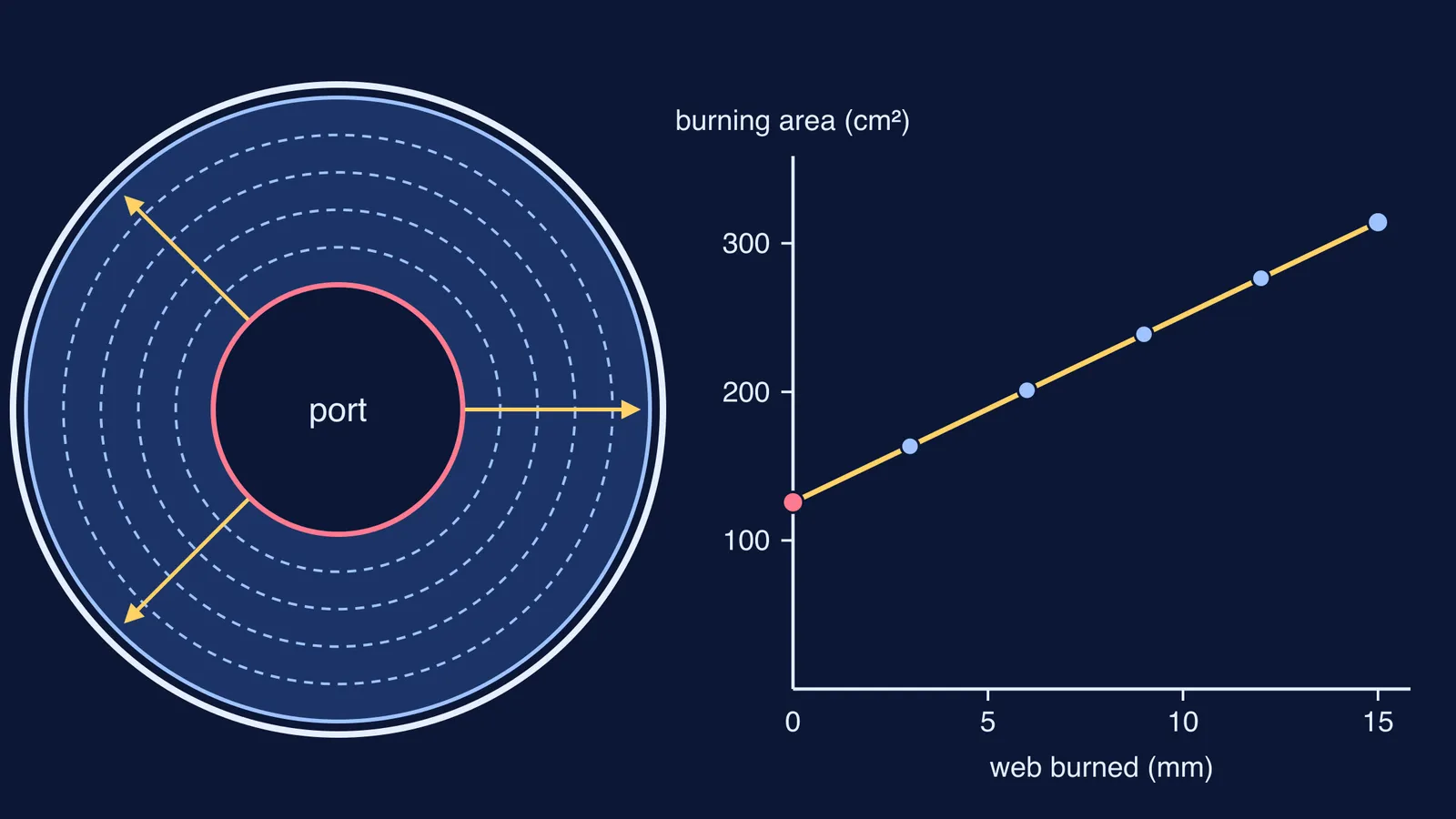
In a solid motor, the burning surface at any instant influences the chamber pressure and thrust, which is why grains are cast with star, wagon-wheel or slot-shaped cores (INAE). The centre's early test motor, the RH-00, used a thick steel tube 50 mm in diameter, drawn 200 mm long in Nagappa's figure. Here is an illustrative example: a round-hole grain filling a tube that size, ends sealed, burning only from the hole outward.
Start: hole radius 10 mm, length 200 mm. Burning area A = 2π × 10 × 200 ≈ 12,570 mm², about 126 cm².
Propellant burns outward at the same rate everywhere.
End: after 15 mm has burned, the radius is 25 mm and A = 2π × 25 × 200 ≈ 31,420 mm², about 314 cm².
The area grows 2.5 times, in a straight line with distance burned, so pressure and thrust tend to climb as the motor burns.
A star-shaped core changes that curve, letting designers choose a thrust profile.
What can you take from the Thumba propellant story?
Measure with what you have: until pressure and thrust instruments were installed, burn time timed with a stopwatch was the only thing the team could measure, per Nagappa's INAE article.
Plan for failure: early motors had notched tie rods designed to break and release pressure, because overpressure was common.
Build the missing piece: Gowariker set up plants to make resin and oxidiser in India.
If burn-back is hard to picture, the Fermi Simulation Lab has interactive simulations for ideas that are easier to see than read. For the chemistry underneath, the Fermi Concept Library covers concepts across physics, chemistry, biology, mathematics and computing.
ISRO's solid boosters trace back to a 350-gram batch ground by hand.


