On this page
Light an anaar and you get a fountain of sparks. Light a sutli bomb and you get a bang that rattles windows. The difference is where the gas goes, and how fast.
What happens inside a firecracker when you light it?
The classic filling of a banger is gunpowder, also called black powder: sulfur and charcoal as fuel, mixed with potassium nitrate as the oxidiser, as the Open University's chemistry of fireworks explains. The standard recipe is 75% potassium nitrate, 15% charcoal and 10% sulfur by mass (gunpowder overview).
Gunpowder deflagrates, which means it burns very fast but below the speed of sound, rather than detonating like a high explosive (gunpowder overview). A simplified equation is:
10 KNO3 + 3 S + 8 C → 2 K2CO3 + 3 K2SO4 + 6 CO2 + 5 N2
Only solids go in. Eleven molecules of gas come out for every 21 particles of solid, along with a lot of heat.
Worked example: how much gas from one gram of powder?
Mass of the left side: 10 × 101.1 + 3 × 32.07 + 8 × 12.01 ≈ 1,203 g.
That mass gives 11 mol of gas, so 1 g gives 11 ÷ 1,203 ≈ 0.0091 mol.
One mole of ideal gas fills 22.7 litres at 0 °C and 100 kPa (NIST value). So 1 g of powder makes about 0.0091 × 22.7 ≈ 0.21 litres of gas, even after it cools.
Now trap it. Suppose a casing holds 0.5 g of powder with about 1 cm³ of space. Using pV = nRT at 0 °C: p ≈ 0.0046 × 8.314 × 273 ÷ 0.000001 ≈ 10 million pascals.
Normal air pressure is 101,325 Pa (NIST value), so that is roughly 100 times atmospheric pressure, before counting the heat.
These are rough numbers with made-up casing sizes, but the point stands: a pinch of solid suddenly wants far more space.
Why does the casing matter so much?
The casing of a banger is designed so the burning happens in a confined space, which is why it goes off with a loud bang (Open University). Pressure climbs until the paper gives way and all the squeezed gas escapes at once. A fountain works the other way: its gas leaves steadily as it forms, so pressure never builds into one burst.
How does a burst become the sound you hear?
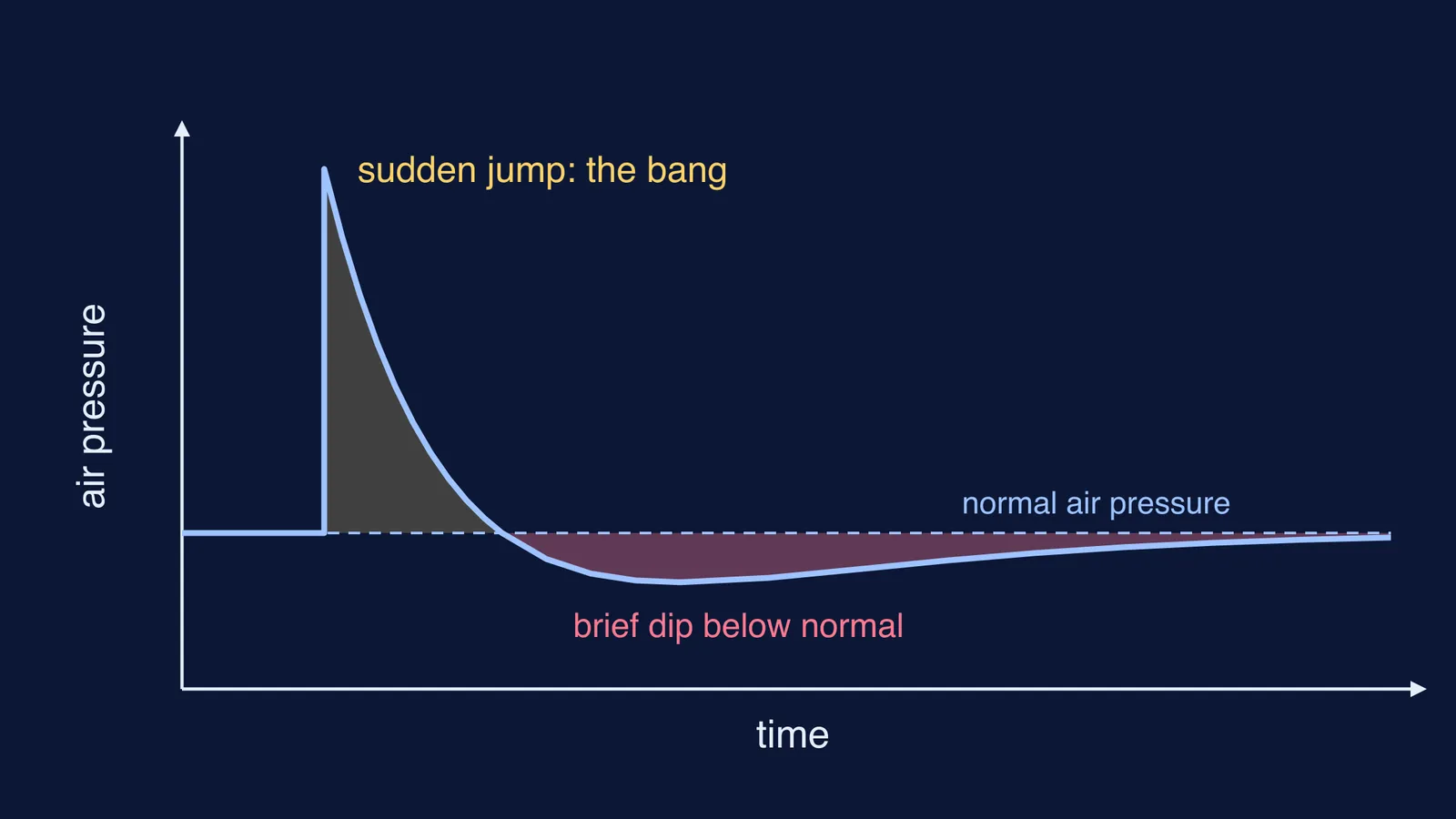
Sound is a travelling change in air pressure. When the casing bursts, the gas rushes out and slams into the still air around it, squashing it into a thin shell of high pressure that races outward. Behind that shell the air overshoots and briefly drops below normal. The simplest blast wave, called the Friedlander waveform, has exactly this shape: a sudden jump, a quick fall, then a shallow dip (blast wave overview), as the diagram above shows.
Your eardrum gets one hard push, then a pull: a bang, not a tone. In a 2021 study in Shock Waves, Kirschman and colleagues measured four consumer firecrackers and one bottle rocket at 75 to 300 mm. Peak pressures varied widely, but some trials topped 100 kPa, enough to suggest a risk of blast injury (Kirschman et al., 2021). That is about the pressure of the entire atmosphere, added for an instant.
Light outruns sound, which is why you see fireworks before you hear the bang.
If the push-and-pull of a pressure wave is hard to picture, the Fermi Simulation Lab has interactive simulations for ideas that are easier to see than to read.
How loud is a firecracker allowed to be in India?
Under the Environment (Protection) Rules, 1986, as amended in 1999 and 2006, the manufacture, sale or use of firecrackers louder than 125 dB(AI) or 145 dB(C)pk at 4 metres from the point of bursting is prohibited (noise standards for firecrackers).
For joined crackers, each one's limit drops by 5 log10(N) dB, where N is the number joined (same source). For a ladi of 1,000:
log10(1,000) = 3
5 × 3 = 15 dB lower
each cracker in the ladi is allowed 125 − 15 = 110 dB(AI)
How do you explain the bang in an exam answer?
Use this five-step chain:
Fast reaction: oxidiser and fuel react in a split second.
Gas: solids turn into a large volume of hot gas.
Confinement: the casing traps the gas, so pressure rises sharply.
Burst: the casing fails and the gas shoves the surrounding air.
Wave: a pressure pulse travels outward to your eardrum.
If one link feels shaky, whether combustion, gas laws or longitudinal waves, look it up in the Fermi Concept Library, where every concept in physics and chemistry has its own lesson.
The same chemistry also explains why firecrackers burn in different colours, and the noise limits are part of the story of what green crackers are and how they differ.