

On this page
Why is there a delay between seeing and hearing fireworks?
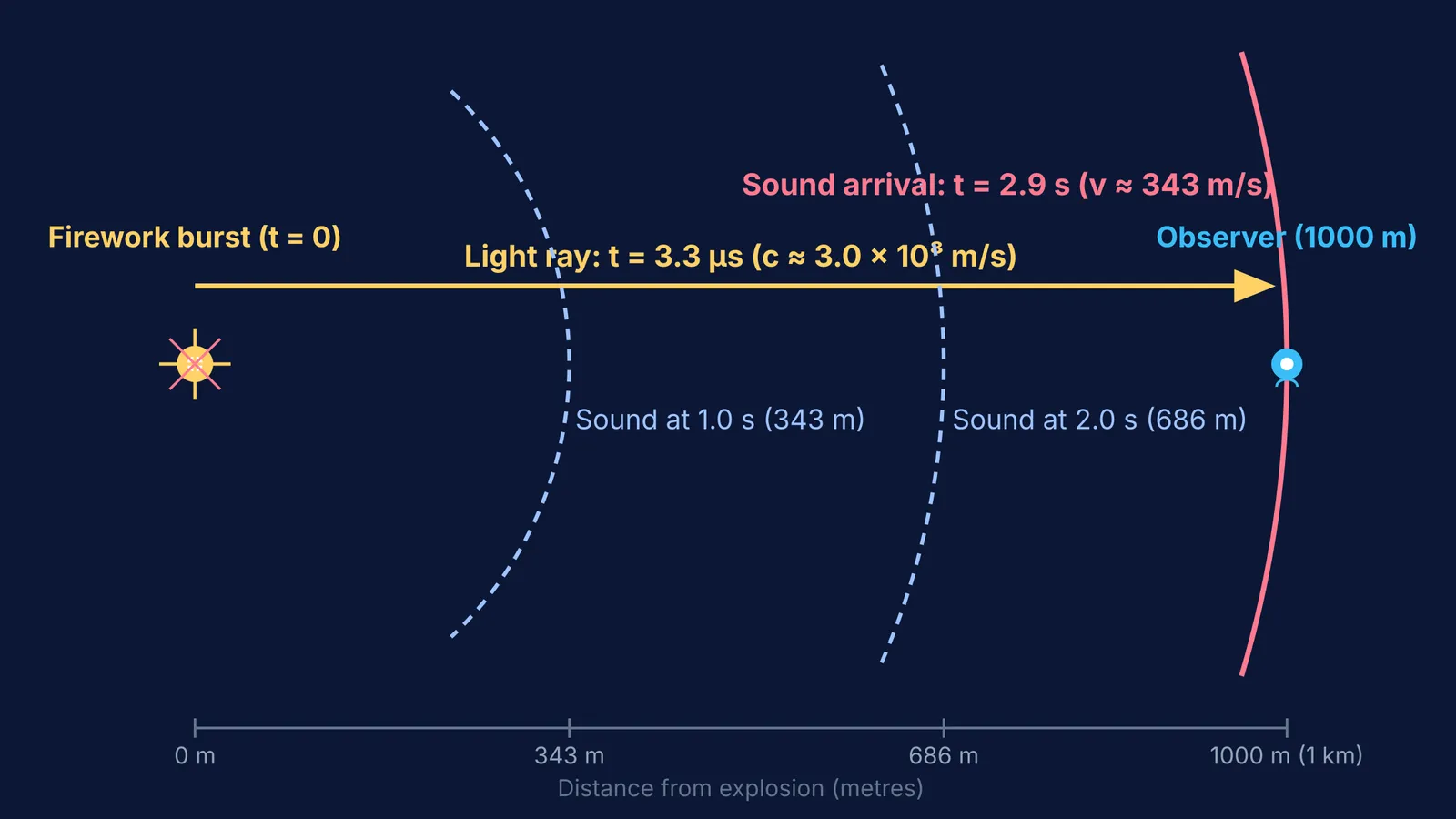
When an aerial firework bursts in the night sky, vibrant sparks blossom outward in an instant, but the accompanying thud arrives noticeably later. That lag is not an illusion of the senses. Both the flash of light and the acoustic shock wave originate at the exact same instant when the shell explodes. The delay occurs entirely because light and sound travel through air at drastically different speeds, a foundational concept taught in the NCERT Class 9 Science textbook.
Light is an electromagnetic wave that requires no material medium. As defined in the SI Brochure from the BIPM and the NIST Reference on Constants, Units, and Uncertainty, the speed of light in vacuum is fixed at exactly 299,792,458 metres per second. In air, light slows down by less than 0.03%, meaning the flash from a firework 1 kilometre away reaches your eyes in roughly 3.3 microseconds—effectively instantaneous to human vision.
How much faster is light than sound in air?
Sound, by contrast, is a mechanical wave that propagates through matter as alternating compressions and rarefactions of air molecules. According to acoustic measurements published by Owen Cramer in the Journal of the Acoustical Society of America, the speed of sound in dry air at 20 °C is approximately 343 metres per second. Comparing these propagation velocities reveals that light travels roughly 874,000 times faster than sound in everyday room-temperature air—nearly a million times faster.
To put that disparity in perspective, light covers 300,000 kilometres in a single second, enough to circle the Earth more than 7 times. Sound in ambient air requires nearly 3 seconds to cross a single kilometre, as detailed in measurements of acoustic velocity in Cramer's study. When watching fireworks from a distance, the visual signal arrives almost immediately, while the physical pressure wave takes seconds to travel across town.
Understanding this enormous speed difference can be challenging from static equations alone. The Fermi Simulation Lab offers interactive simulations for ideas that are easier to see than to read, allowing students to watch electromagnetic and acoustic wavefronts propagate across virtual terrain in real time.
How does Class 9 physics explain sound propagation?
In the school curriculum, this phenomenon anchors the study of mechanical waves. In our Class 9 sound guide on waves, echoes and hearing, students learn that sound requires a material medium to transfer vibrational kinetic energy from particle to particle. The NCERT Class 9 Science textbook notes that the speed of sound in air is approximately 331 metres per second at 0 °C and rises to 344 metres per second at 22 °C, increasing by approximately 0.6 metres per second for every 1 °C rise in temperature.
Because sound depends on collisions between oscillating molecules, its velocity is bounded by molecular thermal motion. In higher classes, this insight leads to Laplace's correction to the speed of sound and the relationship between displacement and pressure waves in sound. As air warms, molecules move faster, transmitting compressions more rapidly. Yet even at 25 °C, where sound reaches 346 metres per second in NCERT acoustic tables, sound remains nearly a million times slower than light.
How do you calculate how far away a firework exploded?
You can turn this physical delay into a practical tool for estimating distance during an evening display. Because the light transit time is negligible, the gap between seeing the flash and hearing the bang represents the transit time of the acoustic wave, governed by the formula d = v × t from the NCERT Science syllabus.
Suppose you watch a firework burst and count an elapsed delay of 4.5 seconds before the boom arrives. Assuming an evening air temperature of 22 °C where sound travels at 344 metres per second according to NCERT benchmark values:
Measure the time delay: t = 4.5 seconds.
Take the speed of sound in air: v = 344 metres per second.
Multiply speed by time: distance d = 344 × 4.5 = 1548 metres (approximately 1.55 kilometres).
Check with the 3-second rule: 4.5 divided by 3 gives 1.5 kilometres, matching the exact calculation within 3.2%.
Working through numerical applications like this helps students connect textbook definitions with real-world observations. The Fermi Problem Library provides worked problems with a step-by-step solver that explains the reasoning rather than printing an answer, guiding learners through kinematic calculations and unit conversions.
Does human reaction time create the flash-to-bang gap?
A common doubt among students is whether human perception might cause part of the observed delay. Research indicates that the opposite is true. In a comparative study of sensory response times published in the International Journal of Applied and Basic Medical Research, Aditya Jain and colleagues measured an average auditory reaction time of 140 to 160 milliseconds, compared to a visual reaction time of 180 to 200 milliseconds.
The human ear processes mechanical vibrations through cochlear hair cells in 8 to 10 milliseconds, whereas retinal photoreceptors take 20 to 40 milliseconds to convert photons into electrical impulses, as documented by Jain and colleagues. Biologically, your brain registers sound 30 to 50 milliseconds faster than sight. The multi-second delay experienced during fireworks is entirely physical, governed by the leisurely pace of acoustic waves in open air.


