

On this page
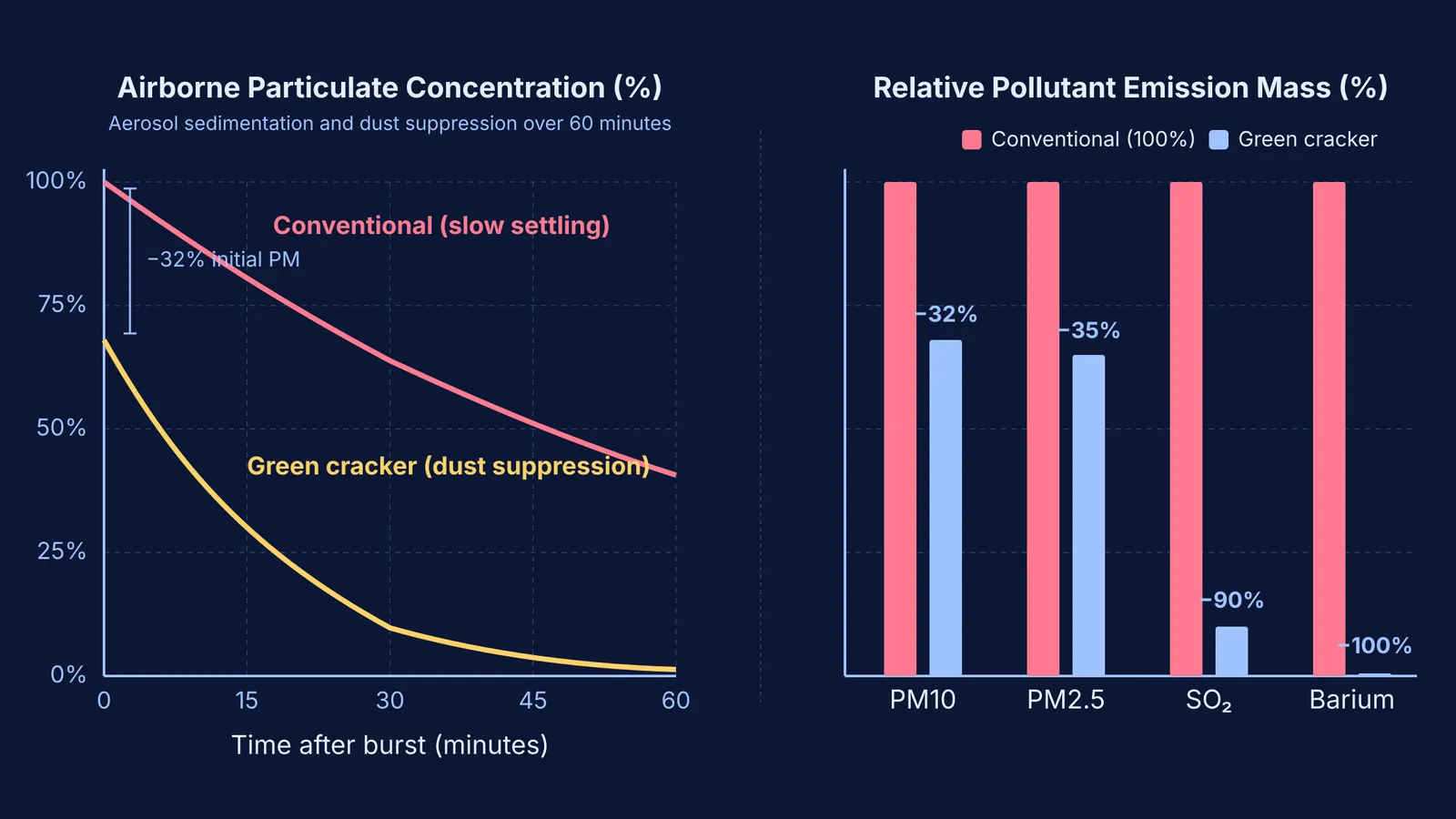
Green crackers are pyrotechnic devices engineered by CSIR-NEERI to suppress fine aerosol emissions and eliminate toxic heavy metals. According to the Press Information Bureau, green crackers cut particulate matter (PM10 and PM2.5) emissions by roughly 30% compared to conventional fireworks. Under Central Pollution Control Board regulations, individual crackers must cap noise levels at 125 decibels at 4 metres, down from traditional crackers that often reached 160 decibels. They are not zero-emission devices, but re-engineered chemical formulations that replace hazardous oxidisers, eliminate charcoal ash fillers, and release condensation nuclei that capture airborne smoke.
Every firework is an energetic oxidation-reduction system governed by combustion and flame chemistry. In a traditional firecracker, a solid fuel such as charcoal or aluminium powder reacts violently with an inorganic oxidiser like potassium nitrate or potassium perchlorate. Green crackers alter this combustion mechanism by substituting alternative electron acceptors, reducing metallic mass, and introducing dust-suppressing agents directly into the pyrotechnic matrix.
What is the chemistry behind SWAS, STAR, and SAFAL?
To address different pyrotechnic functions across sparklers, sound crackers, and aerial shells, CSIR-NEERI developed three patented formulations detailed by the Press Information Bureau:
SWAS (Safe Water Releaser): Eliminates potassium nitrate and sulfur. Upon ignition, it releases water vapour that rapidly condenses in the plume. These moisture droplets act as dust suppressants, agglomerating fine smoke nuclei so they fall as local dust instead of remaining suspended in the breathing zone, cutting particulate emissions by roughly 30% to 35%.
STAR (Safe Thermite Cracker): Replaces heavy barium oxidisers with facilitated thermite reactions using minimal fuel and functional additives. In the Journal of Hazardous Materials, Junghare and colleagues showed that thermite-driven formulations achieve an emissions reduction of about 70% while maintaining required acoustic performance.
SAFAL (Safe Minimal Aluminium): Conventional flash powders rely heavily on metallic aluminium powder, which burns above 2000 °C to produce dense clouds of aluminium oxide smoke. SAFAL restricts aluminium strictly to ignition flash powder and substitutes magnesium alongside mineral matrices, reducing particulate matter emissions by 35% to 40%.
How do green crackers differ from conventional fireworks?
The key difference between conventional fireworks and green crackers lies in elemental composition and particle fate. Conventional crackers historically used barium nitrate as both oxidiser and green flame emitter, alongside lead, antimony, and mercury compounds to stabilise flash rates. Certified green formulations ban these heavy metals entirely, relying on safer alkali salts or boron-doped compounds when coloration is needed.
Conventional fireworks also used charcoal ash and sawdust as inert fillers, which pulverise into airborne PM2.5 during an explosion. Green crackers replace ash with porous functional materials. A 2023 study in Environmental Pollution by Utkarsha Wankhede and CSIR-NEERI researchers showed that adding zeolites and iron oxides reduced airborne barium concentrations by 30% to 60%. The zeolite crystals bind metal cations at high temperatures, turning fine airborne fumes into denser particles that settle directly onto the ground.
Analyzing how solid oxidisers transfer oxygen to metallic fuels involves balancing redox reactions and computing reaction enthalpies. The Fermi Problem Library has worked problems with a step-by-step solver that explains the reasoning rather than printing an answer, helping students work through thermochemical reaction balances.
Can green crackers eliminate festive air pollution?
While green crackers represent an important chemical advance, they cannot make pyrotechnic smoke harmless. Even with the ~30% particulate reduction documented by the Press Information Bureau, roughly 70% of pyrotechnic aerosols still enter ambient air. During late autumn across northern India, calm weather and low mixing heights create persistent temperature inversions. When millions of firecrackers ignite over a compressed evening window, the accumulated smoke remains trapped near ground level, easily driving the Air Quality Index past severe thresholds.
Moreover, thermal combustion at high temperatures inevitably oxidises atmospheric nitrogen, forming nitric oxide and nitrogen dioxide even in sulfur-free formulations. You can review the structures and reactivity of nitrogen oxides to understand how thermal NOx forms whenever heat is released into open air. When complex combustion kinetics and atmospheric dispersion are difficult to visualize from static diagrams, the Fermi Simulation Lab provides interactive simulations for the ideas that are easier to see than to read.
How can you verify that a green cracker is genuine?
Counterfeit packaging has become common during the festive season. To ensure you purchase certified formulations that meet environmental standards, follow this verification checklist:
Identify the official logo: Look for the green fireworks emblem and the CSIR-NEERI mark printed on the packaging.
Confirm the PESO approval: Verify that the box prints an authorization code from the Petroleum and Explosives Safety Organisation.
Scan the QR code: Genuine products carry a unique QR code. Using the CSIR-NEERI Green QR Code mobile app, scan the code to verify the manufacturer name, product category, and certified emission test certificate.
Avoid joined cracker strips: The Central Pollution Control Board guidelines prohibit joined series of crackers (laris), as their combined noise and localized smoke volume exceed the 125-decibel regulatory ceiling.
For learners exploring the practical science behind environmental standards and combustion, the Fermi Concept Library covers every concept in physics, chemistry, biology, mathematics and computing, each with its own lesson and its place in the map.


