

On this page
Your textbook says that an SN1 reaction of a single enantiomer gives a racemic mixture, because the flat carbocation is attacked equally from both faces. That is the right model to learn, and it is the answer NCERT expects. Careful experiments, though, usually find a little more of the inverted product than the retained one. The reason is that the leaving group does not disappear the moment it leaves. For a short time it sits right next to the carbocation and gets in the way of one face.
What does the textbook say about SN1 stereochemistry?
NCERT's Haloalkanes and Haloarenes chapter says that SN1 reactions of optically active alkyl halides are accompanied by racemisation. The reasoning is covered in our post on SN1 and SN2 stereochemistry: inversion and racemisation:
The C–X bond breaks first, in the slow step.
The carbocation is sp² and flat, so it has lost its chirality.
The nucleophile can attack the top face or the bottom face.
Equal attack from both faces gives a 50 : 50 mixture with zero optical rotation.
Every step is correct for a carbocation that is truly free. The small correction is about step 3: the two faces are not always equally open.
Is the SN1 product really 50 : 50?
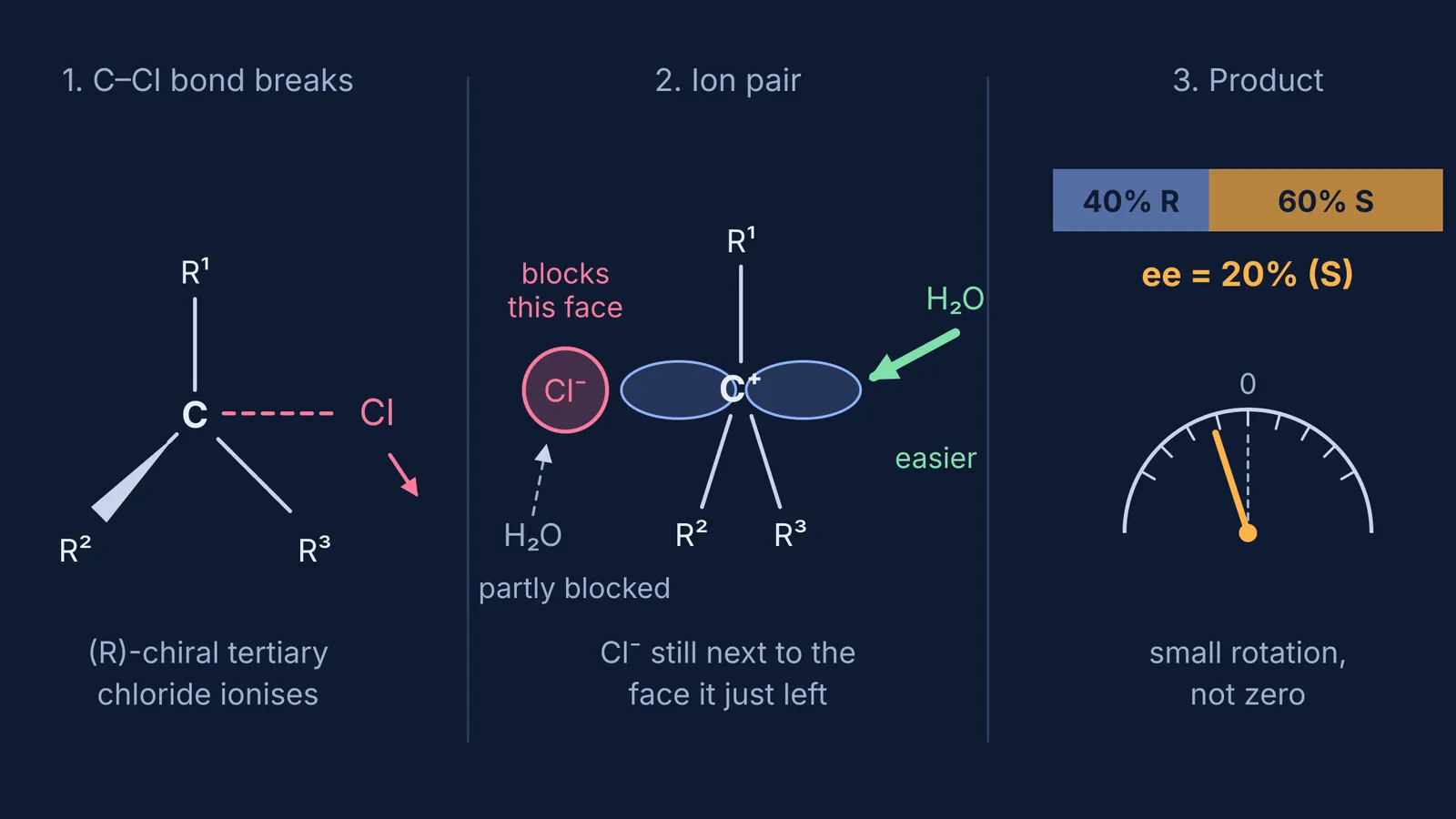
Often it is close, but not exactly. A clear textbook example is in John McMurry's Organic Chemistry. In the OpenStax edition of McMurry, section 11.4, the reaction of (R)-6-chloro-2,6-dimethyloctane with water gives an alcohol that is approximately 80% racemised and 20% inverted. The same section explains the result with ion pairs (its Figure 11.12).
So the textbook you learned from is not wrong. It describes the limiting case, a fully free carbocation. Real solvolyses sit somewhere between that limit and complete inversion, and most of them sit near the racemic end.
The exact split depends on the substrate, the solvent and the temperature, and other books quote other examples with other numbers. Treat "80 : 20" as one measured case, not a constant to memorise.
Why does the leaving group block one face?
When the C–Cl bond breaks, the chloride ion does not fly away at once. It is still touching the carbocation, held there by the attraction between opposite charges and by the cage of solvent molecules around both ions. This is an ion pair.
While the pair holds together, the chloride sits on the face of the carbon it has just left. A water molecule coming from that side finds the chloride in the way. A water molecule coming from the opposite side does not. If water captures the carbocation before the ions drift apart, back-side attack is more likely, and back-side attack means inversion.
Saul Winstein worked out this picture from rate and salt-effect experiments in the 1950s, for example in Winstein and co-workers, J. Am. Chem. Soc., 1956. In his scheme the ions pass through an intimate (contact) ion pair, then a solvent-separated ion pair, and only then become free ions. Only the free carbocation is attacked equally from both faces.
There can be a second cause in some cases. A secondary substrate in a water-rich solvent may react partly by SN2, with water as the nucleophile, and SN2 gives pure inversion. So a measured excess of inversion can come from ion pairing, from some SN2, or from both.
How does this compare with the SNi mechanism?
The same tight ion pair explains the opposite result in another reaction. When an alcohol reacts with SOCl₂ without a base, the chlorosulphite breaks into a carbocation and an anion held close together. The anion then delivers its chlorine to the front face it is sitting on, so the product keeps its configuration. That is the SNi mechanism with SOCl₂ and its retention.
Put the two side by side:
SNi: the anion in the pair attacks the front face. Result: retention.
SN1 with water: the anion in the pair blocks the front face, and water attacks the back. Result: a slight excess of inversion.
Worked example: from "partly inverted" to optical rotation
The arithmetic uses the ideas in our post on enantiomeric excess and specific rotation.
(a) Turn the measured result into a product ratio. Start with (R)-6-chloro-2,6-dimethyloctane. The OH takes the place of Cl and the priority order of the groups does not change, so inversion turns R into S.
The racemised part is 80% of the product. Half is R and half is S: 40% R and 40% S.
The inverted part is 20% of the product, all S.
Total: 40% R and 60% S.
Enantiomeric excess = 60 − 40 = 20%, in favour of S.
(b) Predict the rotation. Suppose the pure (S)-alcohol has specific rotation A. A racemic sample would read zero. This product reads 0.20 × A, a small rotation with the same sign as the pure (S)-alcohol. A strict 50 : 50 model predicts zero.
Now go the other way. A product's rotation is 12% of the pure inverted enantiomer's, with the same sign as that inverted enantiomer.
Optical purity = 12%, so ee = 12% for the inverted product.
Inverted fraction = (100 + 12) / 2 = 56%.
Retained fraction = (100 − 12) / 2 = 44%.
So the product is 56% inverted : 44% retained.
(c) Rank three substrates by how close they get to 50 : 50. Take a secondary alkyl chloride, a tertiary alkyl chloride and a tertiary benzylic chloride, each chiral at the carbon that loses Cl, reacting in water-rich solvent.
The tertiary benzylic cation is the most stable, because the charge spreads into the ring by resonance.
The tertiary alkyl cation is next, stabilised by three alkyl groups.
The secondary cation is the least stable, and the secondary substrate may also react partly by SN2.
A more stable cation lives longer, so the chloride has more time to move away before water arrives.
Expected order, closest to racemic first: tertiary benzylic > tertiary alkyl > secondary. This is a trend, not a set of numbers. The rule to remember: the longer the carbocation lives, the more racemic the product.
If problems like (b) are where you lose track of signs and percentages, the Fermi Problem Library has a step-by-step solver that explains the reasoning at each step.
What should you write in the exam?
For a one-line answer, SN1 gives racemisation. That is the NCERT statement, and it is what the marking scheme expects.
If a question gives a non-zero rotation for an SN1 product, do not call the data wrong. Explain it with the ion pair: the leaving group shields the face it left, so there is a slight excess of inversion.
Never write that SN1 gives retention. Retention needs a special route, such as SNi or neighbouring-group participation.
Quick checklist
Free, flat carbocation: attacked equally from both faces, racemic product.
Ion pair: the leaving group still blocks the face it left, so there is slight excess inversion.
McMurry's example: about 80% racemised and 20% inverted, which is 40% R : 60% S, ee 20%.
More stable, longer-lived carbocation: closer to 50 : 50.
In the exam, write "racemisation" unless the question gives data that asks for more.


