

On this page
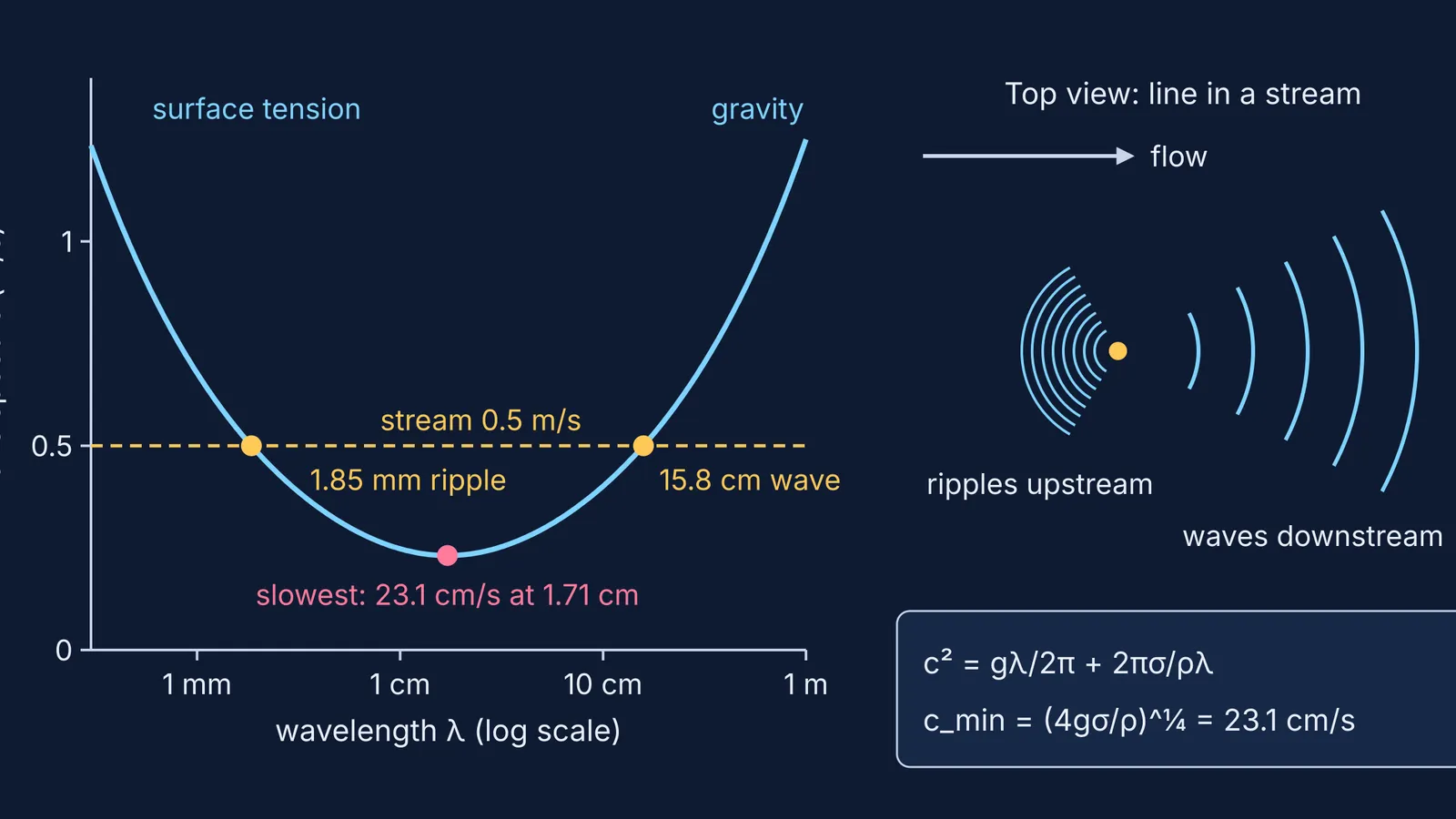
Drop a pebble in a pond and you see long, lazy waves and fine ripples. The long waves are pulled back by gravity, the fine ones by surface tension, and the two effects together put a floor under the speed of any wave on water. On clean water no small wave travels slower than about 23 cm/s. The same floor explains a pattern every angler has seen: a line held in a stream makes tiny ripples upstream and much longer waves downstream.
Why do water waves have a minimum speed?
When the surface is pushed out of shape, two things pull it flat again.
Gravity lifts the low parts and drops the high parts. It wins for long waves, and those waves get faster as they get longer. How that branch works for ocean swell, with c = √(gλ/2π), is covered in why the longest waves from a storm arrive first.
Surface tension acts like a stretched skin. A short, sharply curved wave has a strongly curved skin, so the restoring force is large. It wins for short ripples, and those get faster as they get shorter. At megahertz frequencies this branch sets the droplet size in ultrasonic humidifiers.
On deep water (depth more than about half a wavelength) the two restoring effects simply add in the square of the speed:
c² = gλ/2π + 2πσ/ρλ
Here σ is the surface tension and ρ the density. The first term grows with λ; the second falls with λ. A rising term plus a falling term must have a lowest point: the slowest wave.
What is the slowest wave on water, and how long is it?
Set the derivative of c² with respect to λ to zero: g/2π = 2πσ/ρλ². This gives
λ_min = 2π√(σ/ρg)
c_min = (4gσ/ρ)^¼
At this wavelength the gravity term and the surface tension term are exactly equal, each contributing half of c².
Worked example: clean water and soapy water
Take clean water at 20 °C: σ = 0.0728 N/m, ρ = 1000 kg/m³, g = 9.81 m/s².
Wavelength. σ/ρg = 0.0728/(1000 × 9.81) = 7.42 × 10⁻⁶ m². Its square root is 2.72 mm. Times 2π: λ_min = 1.71 cm.
Speed. 4gσ/ρ = 4 × 9.81 × 0.0728/1000 = 2.86 × 10⁻³ m⁴/s⁴. The fourth root is c_min = 0.231 m/s, or 23.1 cm/s.
Check the two terms. gλ/2π = 9.81 × 0.0171/6.283 = 0.0267 m²/s², and 2πσ/ρλ = 0.0267 m²/s². Equal, as expected. Their sum, 0.0535, has square root 0.231 m/s.
Soapy water. Detergent drops σ to about 0.030 N/m. Then λ_min = 1.10 cm and c_min = 18.5 cm/s. Since c_min goes as σ^¼, cutting σ by more than half lowers the floor by only 20%.
These figures match published values. A clean air–water interface is usually quoted as having its slowest wave at about 1.7 cm and 0.23 m/s (capillary wave, with references). Moisy and Rabaud, studying ripple wakes in a towing tank, use the same formula c_min = (4gσ/ρ)^¼ and quote about 22 cm/s for their water (Physical Review E, 2014, arXiv copy). Slightly lower is what you expect from tap water, whose surface tension is usually below the clean value.
The Kelvin wake post mentions in one line that surface tension takes over below about 1.7 cm. That number is λ_min.
Why does a fishing line in a stream make waves that stand still?
Hold a fishing line, or a twig, still in a stream flowing at speed U. The pattern around it does not drift away; it stays fixed to the line. A wave pattern can only stand still in flowing water if the waves move upstream through the water at exactly the speed the water carries them downstream. So the waves directly upstream and downstream of the line must have c = U.
With U = 0.5 m/s, look at the graph of c against λ. A horizontal line at 0.5 m/s cuts the curve twice, once on each side of the minimum. So there are two answers.
Worked example: U = 0.5 m/s
Write the condition. U² = gλ/2π + 2πσ/ρλ. Multiply through by λ: (g/2π)λ² − U²λ + 2πσ/ρ = 0.
Plug in. g/2π = 1.561 m/s², U² = 0.25 m²/s², 2πσ/ρ = 4.574 × 10⁻⁴ m³/s².
Solve the quadratic. λ = [0.25 ± √(0.0625 − 0.002856)]/3.122. The roots are λ = 15.8 cm and λ = 1.85 mm.
Which branch is which? For the 15.8 cm wave, the gravity term alone gives 0.497 m/s: a gravity wave. For the 1.85 mm wave, the surface tension term alone gives 0.497 m/s: a ripple.
Other speeds. At 0.3 m/s the pair is 5.2 cm and 5.6 mm. At 1.0 m/s it is 64 cm and 0.46 mm. The faster the stream, the further apart the two answers.
Slow streams. Below 0.231 m/s the horizontal line misses the curve entirely. No wave on clean water is that slow, so a small, still line makes no steady wave pattern at all.
Why are the ripples upstream and the long waves downstream?
The crests stand still, but the energy does not travel at crest speed. It travels at the group velocity, and here the two branches behave in opposite ways.
For gravity waves on deep water, the group velocity is half the phase velocity. The 15.8 cm wave has c = 0.50 m/s but carries energy at only 0.26 m/s through the water. The stream, at 0.5 m/s, sweeps that energy downstream. The long waves trail behind the line.
For pure ripples, the group velocity is 1.5 times the phase velocity. The 1.85 mm ripple has c = 0.50 m/s and a group velocity of 0.74 m/s. Its energy beats the current and runs upstream. The ripples sit in front of the line.
At the minimum itself, group and phase velocity are equal.
The general result comes from ω² = gk + σk³/ρ, with k = 2π/λ, as c_g = dω/dk.
If you want to see how two terms with opposite trends make a minimum, the Simulation Lab has interactive simulations for ideas that are easier to see than read.
When does the 23 cm/s rule not hold?
Shallow water. The formula assumes depth greater than about half the wavelength. In shallow water, gravity waves slow down and the curve changes.
Dirty or warm water. Surface tension falls with temperature and with oil or soap films. Real ponds rarely have the clean value, so their floor is somewhat lower.
Big disturbances. This is linear theory for a small disturbance. A large rock still churns up a messy patch.
Quick checklist
c² = gλ/2π + 2πσ/ρλ on deep water: gravity term plus surface tension term.
Minimum at λ = 2π√(σ/ρg) = 1.71 cm, speed (4gσ/ρ)^¼ = 23.1 cm/s for clean water.
At the minimum, the two terms are equal and group velocity equals phase velocity.
Gravity waves: c_g = c/2. Pure ripples: c_g = 3c/2.
A line in a stream needs c = U, which gives one ripple and one gravity wave; ripples go upstream, gravity waves downstream.
Below 0.23 m/s, a small obstacle makes no steady waves.


