

On this page
A storm south of Madagascar can send waves all the way to the Kerala coast. They arrive days later, on a calm, sunny morning, as long, smooth swells. The waves that arrive first have the longest periods, and over the next few days the period at the beach falls steadily. The reason is one formula from the physics of deep-water waves: their speed depends on the period, not on the depth of the sea.
Why do deep-water waves travel at different speeds?
A water wave is called a deep-water wave when the sea is deeper than about half its wavelength. The water particles move in circles that shrink with depth and have almost died out by that depth, so the sea floor does not affect the wave. (Stewart's physical oceanography text uses a quarter wavelength as the limit for 5% accuracy. Half a wavelength is the safer rule.)
For such waves, the linear wave theory in that text gives the crest speed c = g/ω, where ω = 2π/T. Written with the period T:
Crest speed: c = gT/2π, about 1.56T in m/s when T is in seconds.
Wavelength: λ = cT = gT²/2π, about 1.56T² in metres.
Group speed: c/2 = gT/4π, about 0.78T in m/s.
So a wave with twice the period moves twice as fast. Water waves are dispersive: waves of different periods separate, just as a prism separates colours of light. Shallow-water waves are the opposite limit. There the speed is √(gh) and depends only on the depth, which is why tsunami waves grow taller near the coast.
Why does the swell travel at half the crest speed?
A storm does not make one neat wave. It makes a jumble of waves of many periods. Waves of nearly the same period form groups: bands of high waves separated by calm patches. The energy travels with the group, not with the individual crests.
In deep water the group speed is exactly half the crest speed. If you could watch one group from a ship, you would see crests appear at the back of the group, run forward through it and die out at the front. Each crest outruns the energy that carries it.
This matters for timing. A swell reaches a beach when its energy arrives, so every travel-time calculation must use the group speed, gT/4π, and not gT/2π.
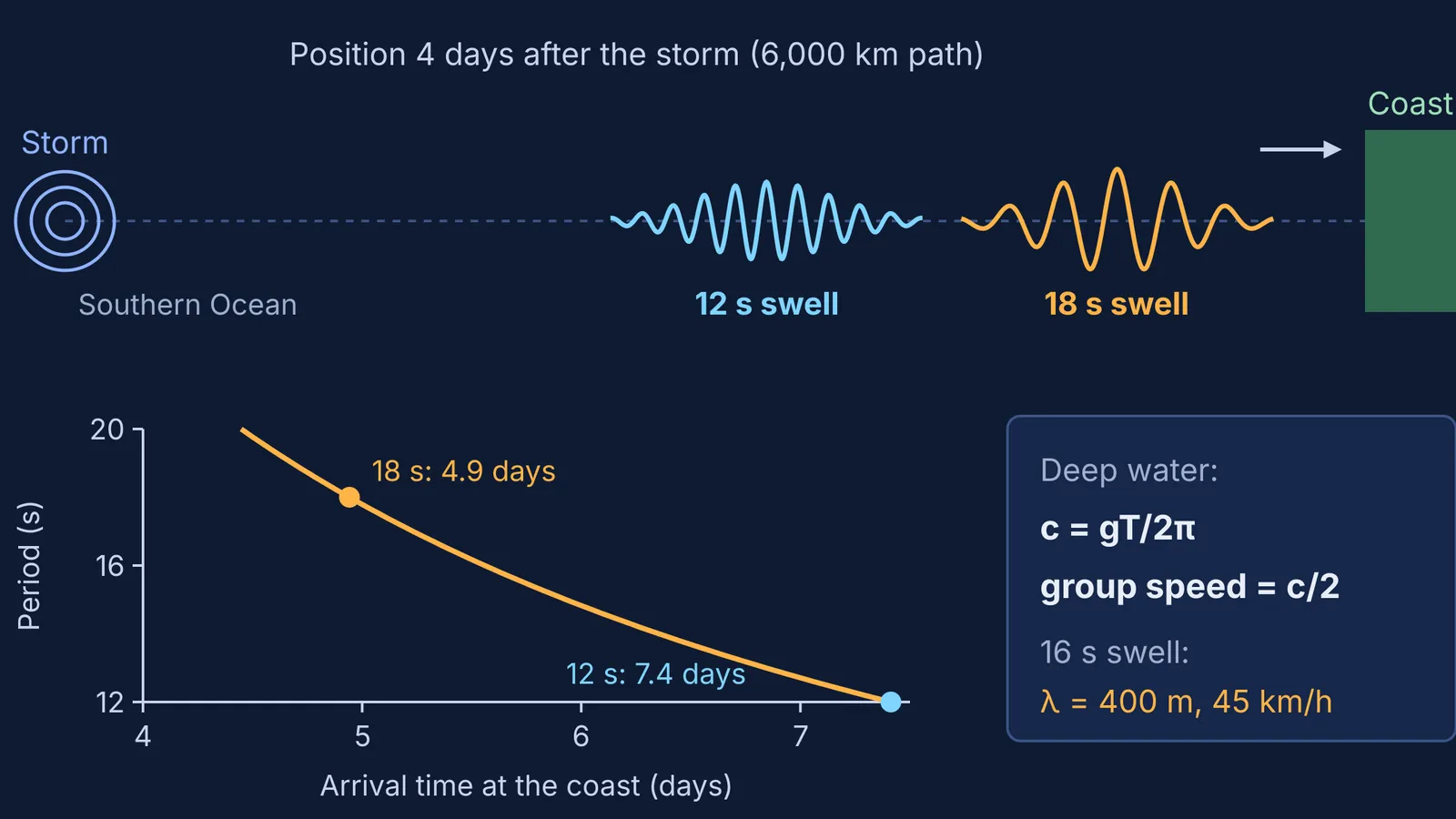
How fast does a 16 second swell travel?
Take g = 9.81 m/s² and T = 16 s.
Wavelength: λ = gT²/2π = 9.81 × 256 / 6.283 = 400 m.
Crest speed: c = λ/T = 400 / 16 = 25.0 m/s.
Group speed: c/2 = 12.5 m/s, which is 12.5 × 3.6 = 45 km/h.
The crests move at 90 km/h, but the energy, and so the swell, moves at 45 km/h. A cyclist could keep up with it.
Why do the longest waves from a far-off storm arrive first?
Suppose a storm 6,000 km away sends out swell of all periods at the same moment. The travel time is t = d / (gT/4π) = 4πd/(gT).
18 s waves: group speed = 9.81 × 18 / 12.566 = 14.05 m/s. Time = 6.0 × 10⁶ / 14.05 = 4.27 × 10⁵ s = 118.6 h, about 4.9 days.
12 s waves: group speed = 9.81 × 12 / 12.566 = 9.37 m/s. Time = 6.40 × 10⁵ s = 177.9 h, about 7.4 days.
Gap: 177.9 − 118.6 = 59.3 h. The short-period waves arrive about 59 hours after the long ones.
So the first sign of a distant storm is a long, low swell with a long period. Over the next two or three days the period at the beach drops: 20 s, then 18 s, 16 s, 14 s, 12 s. The period does not change on the way. It is set at the storm, and deep water only sorts the waves by period. The arrival pattern is the evidence.
How can you find a storm's distance from the swell period?
Run the formula backwards. If the period at the beach falls from T₁ to T₂ (T₁ > T₂) in a time Δt, then:
Δt = (4πd/g)(1/T₂ − 1/T₁), so d = gΔt / [4π(1/T₂ − 1/T₁)].
Worked example: the period at a buoy falls from 20 s to 18 s in 11.9 hours.
Convert time: Δt = 11.9 × 3600 = 42,840 s.
Bracket: 1/18 − 1/20 = 0.05556 − 0.05000 = 0.005556 s⁻¹.
Distance: d = 9.81 × 42,840 / (12.566 × 0.005556) = 6.02 × 10⁶ m, about 6,000 km.
Check the units: (m/s²)(s) / (s⁻¹) = m. Correct.
Stewart's text describes how wave records from pressure gauges in California were read this way, using the arrival times of different frequencies to locate the storms that made them.
If you want to check more dispersion and group-speed problems one step at a time, the Fermi Problem Library has a step-by-step solver that explains the reasoning.
When does a swell stop being a deep-water wave?
An 18 s swell has λ = 9.81 × 324 / 6.283 = 506 m. By the half-wavelength rule, it behaves as a deep-water wave only where the sea is deeper than about 253 m. As it crosses the continental shelf, the sea floor starts to slow it. In 20 m of water its speed is close to the shallow-water value √(gh) = √(9.81 × 20) = 14.0 m/s, about half its deep-water crest speed. The wave shortens, steepens and finally breaks, which is covered in why sea waves break near the shore.
Long-period swell matters on the Indian coast. The Indian National Centre for Ocean Information Services (INCOIS) issues swell surge (kallakadal) warnings for Kerala, south Tamil Nadu and Lakshadweep. In its August 2026 swell surge bulletin, INCOIS said that "high period swells from the southern Indian Ocean" had reached the south Tamil Nadu and Kerala coasts, confirmed by its wave rider buoys off Kozhikode, Kanyakumari and Tuticorin. For real alerts, follow the INCOIS hazard warnings page, not a calculation.
Sound can also cross whole oceans, but by a different route: see the SOFAR channel.
Quick checklist
Deep water means depth more than about λ/2. There the speed depends on period, not depth.
c = gT/2π, λ = gT²/2π, group speed = gT/4π = c/2.
Swell energy, and so its arrival, moves at the group speed.
Longer periods travel faster, so they arrive first and the period at the beach falls with time.
Travel time t = 4πd/(gT). Storm distance d = gΔt / [4π(1/T₂ − 1/T₁)].
The period is set at the storm and does not change in deep water.
Near the shore, depth takes over and the speed tends to √(gh).


