On this page
A duck paddling across a pond and a ship crossing a harbour both trail a V of waves. The ship is twenty times faster, yet the two V's have the same angle, close to 39°. The waves inside the V are very different, though: about 16 cm apart behind the duck and 64 m apart behind the ship. Both facts come from deep-water dispersion and the difference between phase velocity and group velocity.
What is a Kelvin wake?
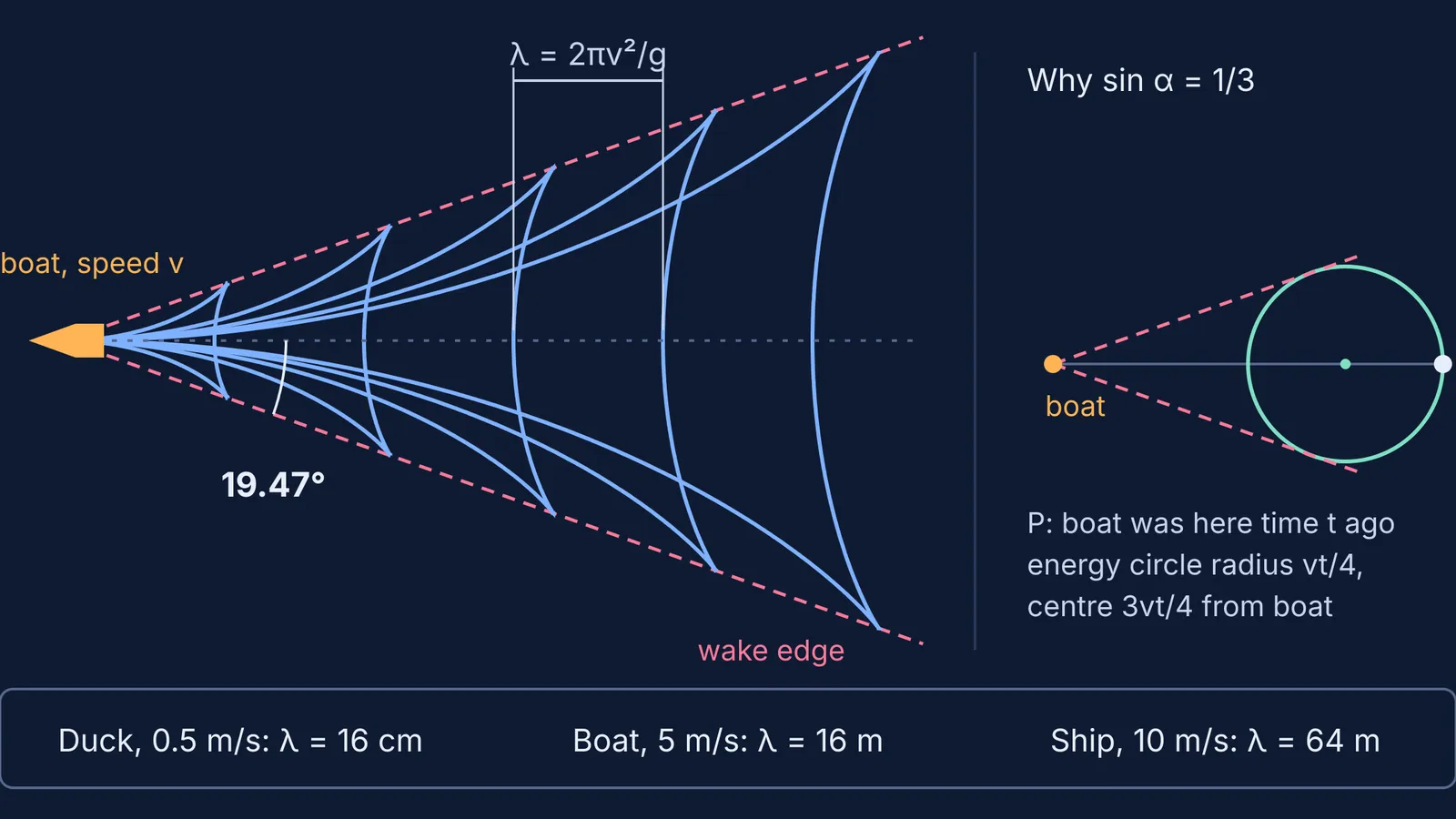
The Kelvin wake is the V-shaped pattern of waves behind anything moving steadily across deep water. Lord Kelvin worked it out in the 19th century. It has two families of waves:
Transverse waves, curved crests running across the track behind the boat, roughly at right angles to its path.
Diverging waves, short crests along each arm of the V, slanting outwards.
The two families meet along the edges of the V. Kelvin's result is that, in deep water, each edge makes an angle of 19.47° with the track, so the whole V is 38.94° wide. The striking part is that this angle does not depend on the boat's speed or size.
Why does the wave pattern travel with the boat?
Seen from the boat, the wake looks frozen, so each wave crest must keep pace with the boat.
For the transverse waves behind the boat, the crests run straight across the track, so their phase speed must equal the boat's speed v. A wave travelling at angle θ to the track only needs to keep pace with the boat's speed in its own direction, so its phase speed is v cos θ.
In deep water, a wave's phase speed depends on its wavelength: c = √(gλ/2π). Setting c = v for the transverse waves gives:
λ = 2πv²/g
So the wavelength grows with the square of the speed. The deep-water speed rule, and why long waves outrun short ones, is covered in why the longest ocean swell waves arrive first, so it is not derived again here.
Why is the wake angle always 19.47°?
The key fact is that the energy of deep-water waves travels at the group velocity, which is half the phase velocity. A wave pattern can only appear where its energy has reached.
Pick a point P on the track where the boat was a time t ago. The boat is now a distance vt ahead.
At P the boat made waves going in all directions θ. A wave in direction θ has phase speed v cos θ, so its energy moves at half that, (v cos θ)/2.
After time t, that energy is a distance (vt cos θ)/2 from P, in direction θ.
Points at distance D cos θ from P in direction θ all lie on a circle of diameter D through P. Here D = vt/2, so the energy from P sits on a circle of radius vt/4, whose centre is vt/4 from P towards the boat.
The centre of that circle is 3vt/4 from the boat. The widest the wake can be is set by the line from the boat that just touches the circle: sin α = (vt/4)/(3vt/4) = 1/3.
So α = sin⁻¹(1/3) = 19.47°. The time t cancelled and so did v.
Every earlier point on the track gives a bigger circle, but the same tangent angle. That is why the V has straight edges and a fixed angle. The waves along the edges themselves travel at 35.3° to the track, where cos²θ = 2/3.
How long are the waves behind a duck and a ship? A worked example
Use λ = 2πv²/g for the transverse waves and g = 9.81 m/s².
Duck at 0.5 m/s. λ = 2π × 0.5²/9.81 = 1.571/9.81 = 0.16 m, about 16 cm. The period is λ/v = 0.16/0.5 = 0.32 s.
Boat at 5 m/s. λ = 2π × 25/9.81 = 16.0 m.
Ship at 10 m/s. λ = 2π × 100/9.81 = 64.0 m. The period is 64.0/10 = 6.4 s.
Check the ship's wave. A 64.0 m wave has phase speed √(9.81 × 64.0/2π) = √100 = 10.0 m/s, matching the ship. Its energy travels at half that, 5.0 m/s.
The angle. For all three, α = 19.47° and the V is 38.9° wide. Doubling the speed from 5 to 10 m/s quadruples the wavelength (16 m to 64 m) but leaves the V unchanged.
The width of the wake. At a distance d behind the boat, the wake is 2d tan 19.47° = 0.707d wide. So 100 m behind the ship, the V is about 71 m across; 1 m behind the duck, about 71 cm.
Units check: v²/g has units (m²/s²)/(m/s²) = m.
How is a ship's wake different from a sonic boom cone?
A supersonic plane drags a Mach cone whose half-angle μ obeys sin μ = c/v, where c is the speed of sound. The faster the plane, the narrower the cone; see Mach number and the sonic boom cone. Sound in air is not dispersive: every wavelength travels at the same speed, so its energy moves at the phase speed.
Deep-water waves are dispersive. A faster boat simply makes longer waves that travel faster, and the geometry rescales without changing shape. That is why a 39° wake has no Mach-like dependence on speed in Kelvin's theory. The energy carried off in these waves is the wave-making drag that a bulbous bow is designed to cut, which is covered in why big ships have a round bulb under the bow.
Is the wake angle always exactly 19.47°?
Treat 19.47° as the classical result, with three limits.
Deep water only. The result needs the depth to be more than about half the wavelength. The ship's 64 m waves need water deeper than about 32 m. In shallower water the wave speed depends on depth and the angle changes with speed.
Tiny ripples are different. Below about 1.7 cm, surface tension, not gravity, controls the waves, and their group velocity is faster than their phase velocity.
Fast boats look narrower. In 2013, Rabaud and Moisy measured wakes in aerial images and found that fast boats leave narrower wakes, with the angle shrinking with speed above a hull Froude number U/√(gL) of about 0.5. Their explanation is that a hull of length L cannot make waves much longer than itself. Others questioned the result, partly because most images were taken in shallower water near shore, as Physics World reported. For exam purposes, Kelvin's 19.47° is the answer expected.
Phase and group velocity are easier to see moving than on paper; the Simulation Lab has interactive simulations for ideas like this.
Quick checklist
Kelvin wake: a V of half-angle sin⁻¹(1/3) = 19.47°, full width 38.9°.
The pattern is steady with the boat, so transverse waves have phase speed v.
Deep water: c = √(gλ/2π), and group velocity is c/2.
Transverse wavelength λ = 2πv²/g: 16 cm at 0.5 m/s, 64 m at 10 m/s.
The wake angle does not depend on speed; a Mach cone does.
Valid for deep water and gravity waves; fast hulls can show narrower wakes.