

On this page
Two of India's bears make a useful contrast. The sloth bear lives in forests and grasslands throughout India, and India is one of the range countries of the Asiatic black bear, often called the Himalayan black bear (Animal Diversity Web, sloth bear; International Association for Bear Research and Management). Only one of these two sleeps through winter, and the main reason appears to be food, not just cold.
Do bears in India hibernate?
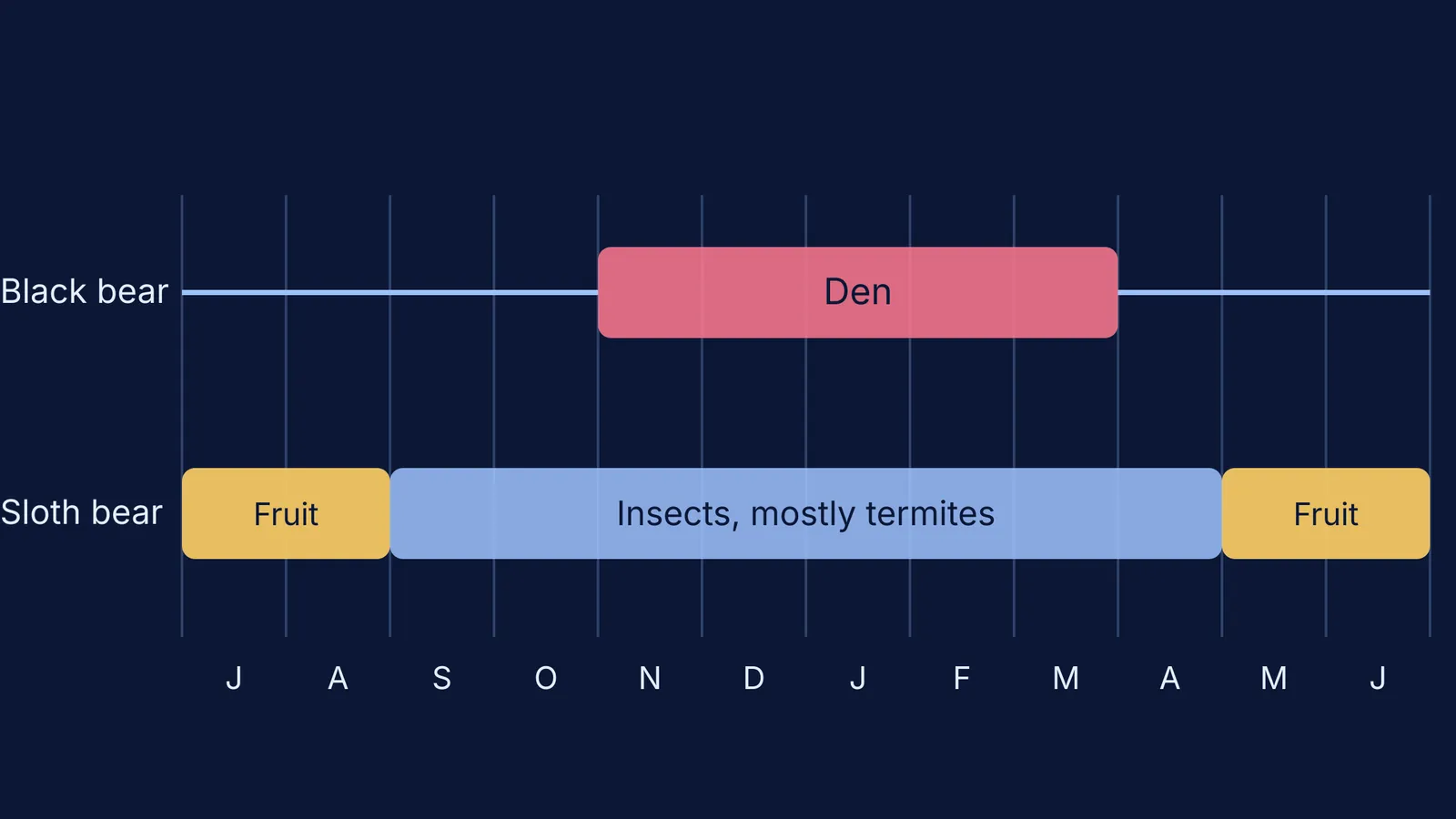
Some do. Of the two bears here, only the black bear hibernates. Asiatic black bears in Dachigam National Park, Kashmir, were historically reported to hibernate from November to March, a period of around 130 days, according to a 2015 Mongabay report drawing on wildlife biologist Lalit Sharma, a member of the IUCN-SSC Bear Specialist Group (Mongabay, 2015).
The sloth bear does not hibernate, though it does have a period of inactivity during the rainy season (Animal Diversity Web).
Why does the Himalayan black bear hibernate?
Because its food runs out. In temperate forests, Asiatic black bears rely in autumn on hard mast (nuts) from oak, walnut, hazelnut, beech and pine to build fat reserves (International Association for Bear Research and Management). They store fat in late summer to use during the winter months, live at higher elevations in summer and move lower in winter (Animal Diversity Web, Asiatic black bear).
The same species behaves differently in warm places. Japan's Biodiversity Center notes that in northern latitudes, where food becomes unavailable in winter, both sexes hibernate, while in the tropics Asiatic black bears generally do not, except females giving birth (ESABII species database).
The Kashmir bears appear to show this too. Reports from the years before 2015 found the Dachigam hibernation period reduced to about 40 days, which researchers link to less snow in the Kashmir Valley (Mongabay).
Bear hibernation is also unusual. A 2011 study in Science found that hibernating black bears cut their metabolic rate to 25% of normal while their body temperature drops only slightly (Tøien et al., Science). Those bears were American black bears from Alaska (ScienceDaily).
Why doesn't the sloth bear hibernate?
Because its food never disappears for long. Sloth bears are the only bears specifically adapted to feed on insects, especially termites and ants (Joshi, Garshelis and Smith, Journal of Mammalogy, 1997).
In that study, in Chitwan National Park, Nepal, insects made up over 90% of sloth bear diets from September to April, with termites at 50% or more. From May to August, when fruit is available and flooding makes lowland termite colonies harder to reach, the bears relied heavily on fruit (Joshi et al., 1997).
Insects carry it through eight months and fruit fills the rest, so a sloth bear does not seem to face a hungry season long enough to need hibernation.
Sloth bears do use dens, but for a different reason: mothers give birth in protected dens and stay there for 2 to 3 months (International Association for Bear Research and Management, sloth bear). That is denning for cubs, not hibernation.
How can you predict whether an animal hibernates?
Try this three-question check on any animal.
Does its main food disappear for months at a time?
Can it store enough fat beforehand to last that gap?
Is staying put cheaper than moving to where food is?
If all three answers are yes, expect hibernation. If the first answer is no, expect year-round activity.
Worked example, Himalayan black bear in Kashmir:
Food gap: yes, nuts are gone and snow covers the ground in winter.
Fat store: yes, it fattens on autumn nuts.
Stay put: yes, it moves lower but still cannot find enough food.
Prediction: hibernates. Fewer snowy months should mean a shorter sleep, which matches the reported drop to about 40 days (Mongabay, 2015).
Worked example, sloth bear in the plains:
Food gap: no, insects (mostly termites) carry it from September to April and fruit fills May to August.
Prediction: stays active.
To separate hibernation from summer dormancy, read our explainer on hibernation vs aestivation in animals.
How does this fit into your biology syllabus?
This comparison links two school biology ideas: warm-blooded animals spend energy to stay warm, and animals adapt to their habitat. Our guide to cold-blooded vs warm-blooded animals covers the first, and how polar bears and camels adapt to extreme climates covers the second.
If hibernation, torpor and adaptation blur together, the Fermi Concept Library gives every biology concept its own lesson and its place in the map, so you can see how they connect. Fermi's AI tutor checks understanding as it goes, so you can try the three-question check on a new animal.
Next time you read that an animal hibernates, ask first what it eats in winter.


