

On this page
Ask a classroom whether sharks lay eggs and you will usually get a confident yes, because "fish lay eggs" is one of the first facts we learn about animals. For sharks the real answer is "it depends on the shark", and true-or-false statements in biology turn on exactly that gap.
Do sharks lay eggs or give birth?
Both, depending on the species. The NCERT Class 11 Biology chapter Animal Kingdom says of the cartilaginous fishes (Class Chondrichthyes, which includes sharks): "They have internal fertilisation and many of them are viviparous." It lists *Scoliodon* (dog fish), *Pristis* (saw fish), *Carcharodon* (great white shark) and *Trygon* (sting ray) as examples.
All sharks have internal fertilisation, and the young hatch or are born as smaller versions of the adult with no larval stage, according to the Florida Museum of Natural History. What differs is where the embryo grows and how it is fed.
Live birth is widespread. A 2020 paper in *Scientific Reports* by Nakaya, White and Ho notes that viviparity prevails in every chondrichthyan order except two, Heterodontiformes and Chimaeriformes, whose members all lay eggs.
What are the three ways sharks reproduce?
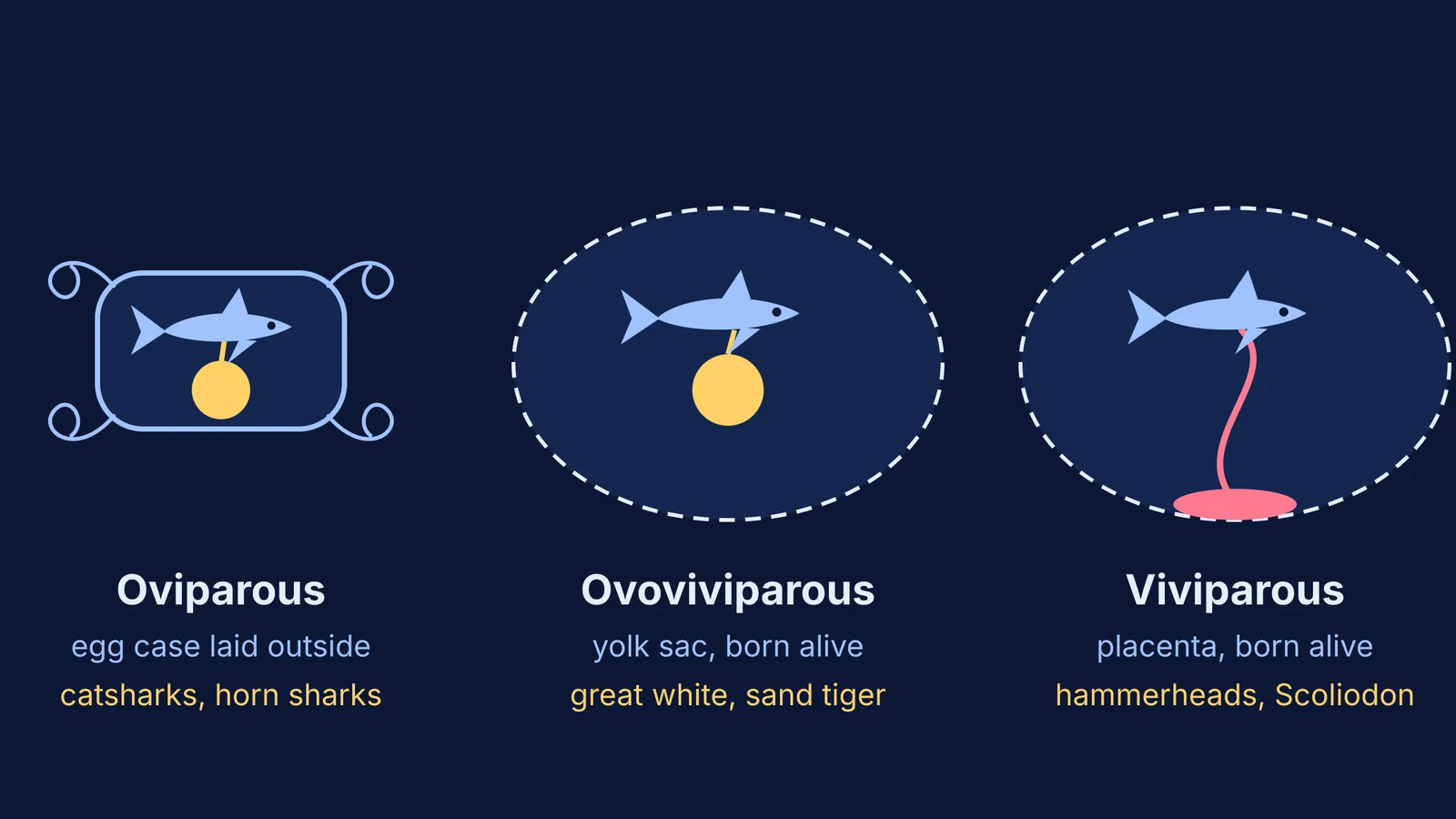
Oviparous: the egg is laid outside. An oviparous shark lays eggs that develop and hatch outside the mother's body, with no parental care after laying (Florida Museum). The egg sits in a tough, leathery case often called a "mermaid's purse". NOAA Fisheries names catsharks and zebra sharks as egg-layers, and the Shark Trust notes that horn sharks lay large spiral-shaped eggs that wedge firmly between rocks.
Even egg-laying has variations. Nakaya and colleagues found that every pregnant Sarawak swellshark they examined held one egg case in each oviduct, keeping it there until the embryo had grown to a sizable length, a new mode of oviparity.
Ovoviviparous: the egg hatches inside the mother. In ovoviviparous sharks the eggs hatch inside the womb and the pups are born alive, but there is no placenta: the pups live on a yolk sac (NOAA Fisheries). NOAA gives great white sharks and cookiecutter sharks as examples. This is also called aplacental viviparity, and the Florida Museum says the term ovoviviparity is rarely used today.
Some of these embryos find extra food. In sand tiger sharks, the two largest embryos eat the other embryos in the litter.
Viviparous: the pup is fed through a placenta. In placental viviparity there is a true connection between maternal and embryonic tissue (Florida Museum). NOAA Fisheries says the pups of viviparous sharks live on a placenta until birth, and lists bull sharks and hammerhead sharks as examples.
NCERT's own example, *Scoliodon*, belongs here too. John Wourms described it in 1993 in a paper titled Maximization of evolutionary trends for placental viviparity in the spadenose shark, Scoliodon laticaudus. In India, a study of spadenose sharks off the Gujarat coast in the north-eastern Arabian Sea found 8 to 19 embryos per pregnant female, with a mean of 10 (Sen and colleagues, *Journal of Applied Ichthyology*, 2018).
Litter sizes and pregnancies vary hugely. NOAA Fisheries reports that a blue shark can give birth to as many as 135 pups in one litter, and that a spiny dogfish can be pregnant for up to 24 months.
If you want the general vocabulary first, read our explainer on oviparous vs viviparous animals.
Why is "all fish lay eggs" a false statement?
Because the NCERT textbook says otherwise. In the same chapter, cartilaginous fishes are "many of them" viviparous, and even bony fishes (Class Osteichthyes) are described as "mostly oviparous", with fertilisation "usually external". "Many", "mostly" and "usually" leave room for exceptions; "all" does not.
The split between the two fish classes matters here, so it helps to have the differences between cartilaginous and bony fish clear in one place.
How do you check a statement about fish reproduction?
Use three quick steps:
Circle the quantifier: all, many, mostly, usually, only.
Name the class: Chondrichthyes or Osteichthyes. NCERT treats them differently.
Find one counter-example from NCERT's list before you mark "true".
Here is how that plays out on five practice statements:
"All fishes are oviparous." False: many Chondrichthyes are viviparous.
"Chondrichthyes show internal fertilisation." True: NCERT states it directly.
"Fertilisation is always external in Osteichthyes." False: NCERT says "usually".
"All sharks give birth to live young." False: catsharks and horn sharks lay eggs.
"*Scoliodon* is viviparous." True: it has a placental connection.
If a statement trips you up because a term like "viviparous" or "notochord" feels fuzzy, the Fermi Concept Library gives every biology concept its own lesson and its place in the map. For practice, the Fermi Problem Library has worked problems with a step-by-step solver that explains the reasoning rather than printing an answer.
The same NCERT section holds another often-misread line, that sharks must swim constantly to avoid sinking because they lack an air bladder, which we unpack in do sharks die if they stop swimming?


