

On this page
Look at the underside of a male shark and you will see two firm rods running back from the pelvic fins. These are claspers. The University of Iceland shark lab run by Steven Campana describes them as "modified pelvic fins used for sperm delivery" (Campana lab, shark reproduction). They are how male sharks and rays place sperm inside the female, so her eggs are fertilised inside her body.
What are claspers in male sharks?
A clasper is a rod stiffened by cartilage that grows from the rear, inner edge of each pelvic fin in male cartilaginous fish. A 2015 Nature Communications paper by Katherine O'Shaughnessy, Randall Dahn and Martin Cohn states that today "only male chondrichthyans possess claspers, which extend from posterior pelvic fins and function as intromittent organs" (O'Shaughnessy et al., 2015). An intromittent organ is one that is placed inside the female to deliver sperm.
Your NCERT textbook says the same thing in one line, under Class Chondrichthyes: "In males pelvic fins bear claspers" (NCERT Class 11 Biology, Chapter 4: Animal Kingdom). Its examples are *Scoliodon* (dog fish), *Pristis* (saw fish), *Carcharodon* (great white shark) and *Trygon* (sting ray), so claspers belong to rays as well as sharks.
The name comes from an old idea: according to PBS NOVA, Aristotle thought claspers were used to clasp the female during mating.
How do claspers transfer sperm?
The steps below come from PBS NOVA and the Campana lab:
The male passes one of his two claspers over his cloaca, which forces semen into a groove along the clasper.
He rotates that clasper so it points forward and inserts it into the female's cloaca. The pair meet face to face.
In sharks, organs called siphon sacs contract and use seawater currents to carry the sperm packets (spermatophores) out along the clasper groove.
So only one clasper goes in at a time. A long-term study of a captive male whale shark at the Okinawa Churaumi Aquarium in Japan saw a whitish fluid, which may have been semen, come out through the clasper grooves once the claspers had finished lengthening (Matsumoto et al., 2019).
Why do claspers mean sharks fertilise internally?
An organ built to put sperm inside the female only makes sense if fertilisation happens inside her. NCERT links the two facts directly for Chondrichthyes: "They have internal fertilisation and many of them are viviparous" (NCERT, Chapter 4). For bony fish (Osteichthyes), which have no claspers, the same chapter says "Fertilisation is usually external" and that they are mostly oviparous.
The Campana lab notes that most sharks bear live young but some lay eggs, so internal fertilisation does not always mean live birth. For the full comparison with frogs and bony fish, see our post on internal vs external fertilisation, with examples.
Claspers are also very old: the 2015 paper calls them "the earliest known vertebrate copulatory organs", linked to the evolution of internal fertilisation in Devonian placoderms, an extinct group of armoured fish (O'Shaughnessy et al., 2015).
How can you tell a male shark from a female?
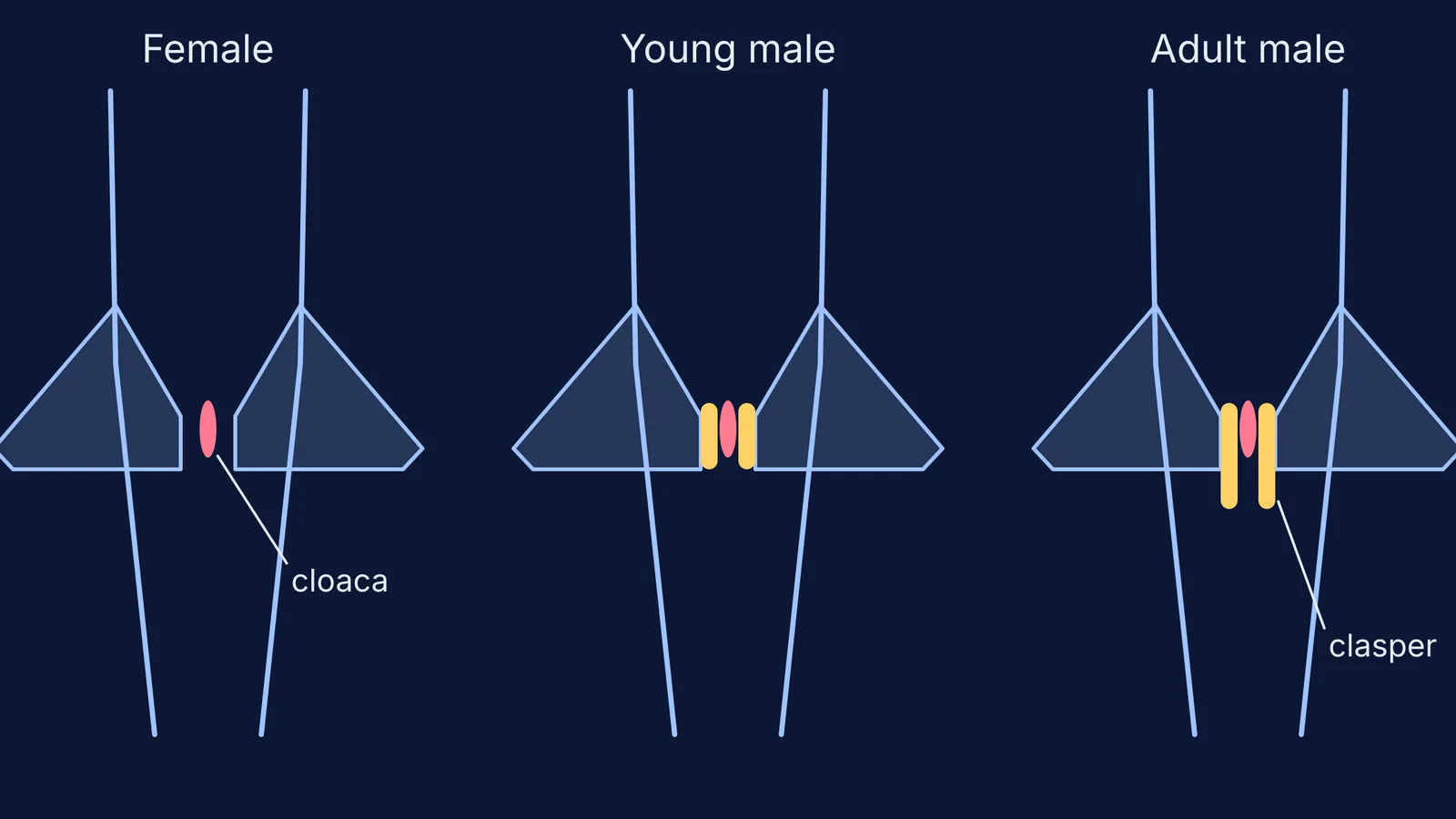
The Campana lab puts it simply: "The presence or absence of these claspers make it very easy to differentiate males from females" (Campana lab). Here is a three-step check you can use on a photo, a museum specimen or a dog fish at a market in Kochi or Mumbai:
Turn to the underside and find the pair of pelvic fins in front of the tail. The cloaca opens between them.
Look along the inner edges of those fins. Two rod-like claspers mean male. None means female.
Compare the clasper tips with the rear edge of the pelvic fins. Biologists use clasper lengthening and calcification (hardening) as signs of sexual maturity. In the whale shark study, claspers counted as "short" while their tips sat level with the rear edge of the pelvic fins, and as "elongating" while they grew out past it (Matsumoto et al., 2019).
Step 3 matters because a young male's claspers are short and easy to miss. The captive whale shark's claspers only began to lengthen when it was 8.5 m long, the changes were complete in 11 months, and it was over 20 years old when it matured, according to Matsumoto et al., 2019.
How do exam questions test claspers?
Try this one:
Statement I: In Chondrichthyes, the pectoral fins of males bear claspers.
Statement II: Chondrichthyes show internal fertilisation.
Statement I is false, because claspers are on the pelvic fins. Statement II is true. Remember one chain: claspers, pelvic fins, males only, internal fertilisation, many viviparous. For bony fish, flip it: no claspers, fertilisation usually external, mostly oviparous.
If you keep mixing up which class does what, the Fermi Concept Library gives every biology concept its own lesson and its place in the map. For practice, the Fermi Problem Library has worked problems with a step-by-step solver that explains the reasoning rather than printing an answer.
Next, see the rest of the shark body plan in shark features: cartilage, placoid scales and no air bladder, or compare the two fish classes in cartilaginous vs bony fish.


