On this page
Many slips in this chapter are small swaps: one division for another, one count for another, one fruit word for another. Below are eight beliefs that sound right and are false, each checked against NCERT's Class 12 Biology book, Chapter 1 (2026-27 reprint), with the section number. The NEET (UG) 2026 syllabus lists the chapter first under Unit 6, Reproduction.
Each item ends with a quick check (answer in brackets) and a habit. If you have not yet studied the chapter end to end, start with our plan for preparing sexual reproduction in flowering plants for NEET.
Which division makes which cell?
"Male gametes are made by meiosis, straight from the pollen mother cell."
Why it tempts: in humans, the word gamete sits right next to meiosis, so students carry that link over.
What NCERT says (1.2.1, 1.2.3): meiosis in the pollen mother cell gives a tetrad of microspores, which mature into pollen grains, the male gametophytes. The two male gametes come later, when the generative cell divides by mitosis, either before shedding or inside the growing pollen tube.
Check: a plant has 2n = 22. Give the chromosome number of a pollen mother cell, a microspore, a generative cell and a male gamete, and mark the one meiotic step. (22, 11, 11, 11; only pollen mother cell to tetrad is meiosis.)
Habit: write "meiosis" on exactly one arrow of the male pathway, never on the last one.
"Monosporic means the ovule makes one megaspore."
Why it tempts: "mono" seems to count megaspores produced.
What NCERT says (1.2.2): the megaspore mother cell still forms four megaspores by meiosis. In most flowering plants one stays functional and three degenerate; "monosporic" means the embryo sac grows from that single megaspore.
Check: a flower bud holds 40 pollen mother cells and 40 megaspore mother cells. How many pollen grains, and how many functional megaspores? (160 and 40, with 120 megaspores degenerating.)
Habit: count products of meiosis first, then subtract the ones that die.
Which numbers get swapped?
"A bilobed anther has two pollen sacs."
Why it tempts: two lobes look like two chambers.
What NCERT says (1.2.1): a typical anther is bilobed and dithecous, so each lobe has two thecae, and a transverse section shows four microsporangia, two in each lobe.
Check: a flower has five stamens with typical anthers. How many microsporangia does it carry? (20.)
Habit: multiply lobes by two before you count sacs.
"A 3-celled pollen grain holds a vegetative cell, a generative cell and one male gamete."
Why it tempts: students add one cell to the 2-celled grain instead of replacing one.
What NCERT says (1.2.1): pollen of more than 60 per cent of angiosperms leaves the anther with just a vegetative and a generative cell. In the remaining species, mitosis of the generative cell before shedding gives two male gametes, so the three cells are the vegetative cell plus those two gametes.
Check: one species sheds pollen 2-celled, another 3-celled. How many male gametes does each pollen tube release into a synergid? (Two in both; in the 2-celled grain the generative cell divides inside the tube.)
Habit: in a 3-celled grain, the generative cell is gone, not joined.
Where does each fusion happen?
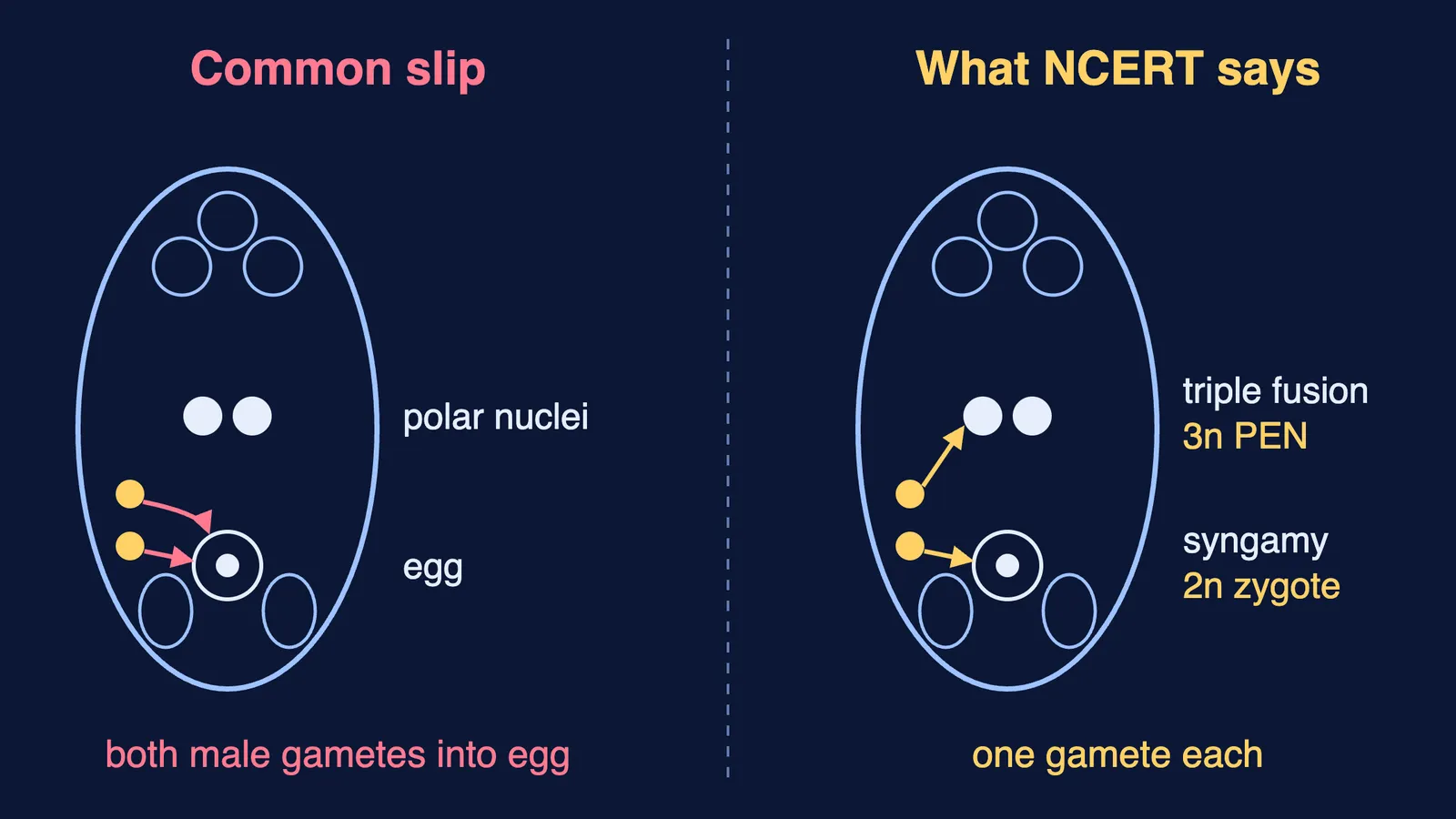
"Both male gametes fuse with the egg; triple fusion is the egg plus two gametes."
Why it tempts: "triple" sounds like three partners meeting at the egg, and the egg is the only female gamete students picture.
What NCERT says (1.3): the pollen tube releases two male gametes into a synergid. One fuses with the egg (syngamy, giving the diploid zygote). The second gamete joins both polar nuclei of the central cell (triple fusion, giving the triploid primary endosperm nucleus).
Check: how many nuclei take part in double fertilisation in one embryo sac, and how many of them are male? (Five: egg, two polar nuclei and two male gametes; two are male.)
Habit: give each male gamete its own partner before you name a product.
"In water-pollinated plants, water carries the male gametes to the egg, as it does in ferns."
Why it tempts: NCERT itself mentions water carrying male gametes in lower plants, so the two ideas merge.
What NCERT says (1.2.3): in algae, bryophytes and pteridophytes, water carries male gametes. In Vallisneria, water currents carry pollen grains (or male flowers) to the female flowers; that is pollination. The gametes still reach the egg through a pollen tube.
Check: fill both blanks. In a pteridophyte, water carries ___; in Vallisneria, water carries ___. (Male gametes; pollen grains.)
Habit: ask what is travelling, pollen or gamete, before naming the event.
Which seed and fruit words get mixed up?
"A false fruit is a fruit without seeds."
Why it tempts: "false" sounds like "not a real fruit", which students link to seedless fruit.
What NCERT says (1.4.3): a false fruit is one where the thalamus also contributes tissue, as in apple, strawberry and cashew. A fruit formed without fertilisation is parthenocarpic, like banana, and such fruits are seedless. Our post on false fruits and parthenocarpy sets the two side by side.
Check: a fruit has no seeds. Is it therefore a false fruit? (No. "False" is about the thalamus; seedlessness is about fertilisation.)
Habit: "false" asks which floral part; "parthenocarpic" asks whether fertilisation happened.
"The seed coat and the fruit wall are the same layer."
Why it tempts: both are outer coverings.
What NCERT says (1.4.3): the integuments of the ovule harden into the seed coats, while the ovary wall forms the pericarp, or fruit wall.
Check: in a mustard pod, which flower part forms the pod wall and which forms each seed coat? (Ovary wall gives the pericarp; integuments give the seed coats.)
Habit: trace every covering back to its flower part before you name it.
What should you do with these?
Cover the "What NCERT says" lines, read only the wrong beliefs, and say the fix aloud. Then redo each check with new numbers: a different 2n, a different stamen count. When you miss one in a mock, write the wrong belief in your own words in a slips notebook.
Not sure which of these slips are yours? Fermi's AI tutor works out what you already know and builds a plan for the session.