

On this page
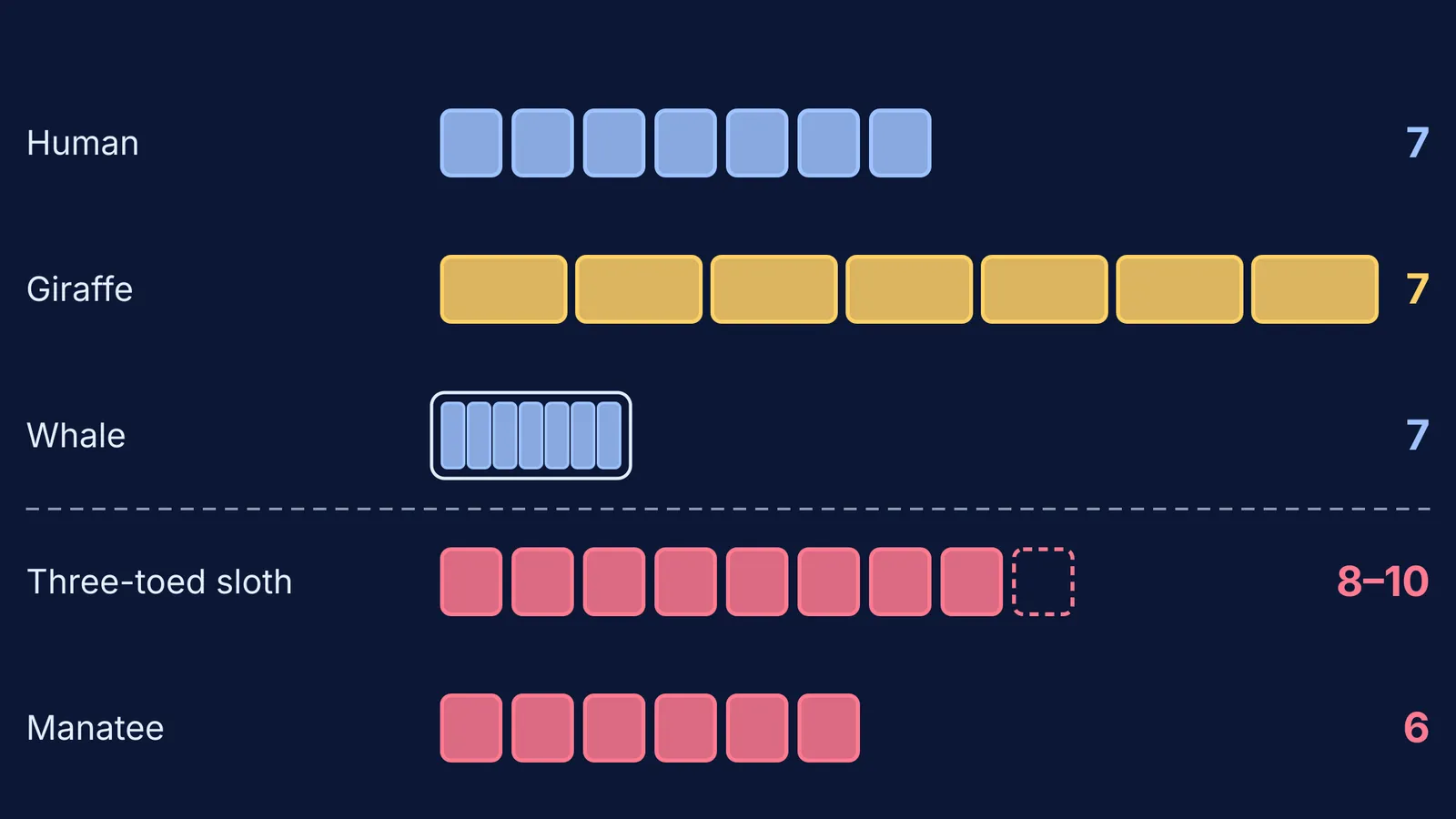
Stretch your neck and count: you have seven cervical vertebrae, the bones between your skull and your ribcage. A giraffe, with its towering neck, has the same seven. A whale, which looks as if it has no neck at all, has seven too. This sameness is one of the oddest rules in anatomy, and the reason behind it involves genes, cancer and two slow-moving animals that broke the rule.
Does a giraffe have more neck bones than humans?
No. A giraffe and a human each have seven neck vertebrae; the giraffe's are simply far longer. Varela-Lasheras and colleagues, writing in EvoDevo in 2011, put the rule plainly: "Mammals as a rule have seven cervical vertebrae, except for sloths and manatees." The same paper contrasts the stiff giraffe neck of "seven very long vertebrae" with a swan's neck of 22 to 25 vertebrae.
That contrast is the clue. In other four-limbed vertebrates (tetrapods), such as birds, the number of neck vertebrae varies a great deal, so a long neck can be built by adding bones. Mammals almost never do that; they make each bone longer or shorter instead.
Whales show the other extreme. According to the Quebec marine-education site Baleines en direct, in most whales and dolphins "the seven cervical vertebrae are compressed and sometimes fused to stabilize the head in the water", while belugas and narwhals keep some flexibility. For the full set of clues that make a whale a mammal, see our post on why a whale is a mammal, not a fish.
Why do almost all mammals have exactly seven neck vertebrae?
The main explanation comes from biologist Frietson Galis. In a 1999 paper in the Journal of Experimental Zoology, she proposed that the count is held in place by a developmental constraint. The Hox genes that help set where the neck ends and the chest begins also act in the nervous system and in cell growth, so a change in neck count tends to come with neural problems, stillbirths and early childhood cancer.
Biologists call one gene affecting several traits pleiotropy. The 2011 EvoDevo paper summarises the human evidence: changes in the number of cervical vertebrae occur in roughly 7.5% of conceptions, yet "virtually all individuals die before the age of reproduction", and cervical ribs were associated with about a 120-fold increase in childhood cancer rates (Varela-Lasheras et al., 2011).
So the rule is not that seven is the perfect number for a neck. It is that changing the number is costly, so natural selection keeps removing the changes.
Why are sloths and manatees allowed to break the rule?
Three-toed sloths have 8 to 10 ribless neck vertebrae, and a 2010 PNAS study of sloth skeletal development found that the extra ones behind the seventh ossify the way chest vertebrae do, so the authors read them as thoracic bones without ribs. Manatees go the other way: they "have only 6 cervical vertebrae, instead of the 7 seen in most other mammals", according to the University of Michigan's Animal Diversity Web. Two-toed sloths go the same way: in the specimens examined for the 2011 EvoDevo paper, only the first five or six vertebrae had a neck shape and no ribs.
What these animals share, that paper argues, is a slow life. Low metabolic rates go with low DNA damage and "presumably" low cancer rates, and low activity makes skeletal abnormalities less harmful. With the costs reduced, the rule could bend. The authors found no skeletal abnormalities in specimens of related species with a normal count, but always found them in animals of those species with an unusual count, as in many of the dugongs they examined (Varela-Lasheras et al., 2011).
How should you answer this in a biology exam?
A question like "Why do a giraffe and a human have the same number of neck vertebrae?" tests whether you can connect anatomy to evolution. A strong answer makes four moves:
State the fact: both have seven cervical vertebrae; the giraffe's are much longer.
Name the idea: the vertebrae are homologous structures, inherited from a common ancestor and changed in length, not number.
Explain why the number stays fixed: genes that set the count also affect other systems, so changes are usually harmful and are selected against.
Give the exceptions and their logic: sloths and manatees, slow animals with low metabolic rates, have a different count.
A common slip is the Lamarckian answer, that giraffes stretched their necks and passed the stretch on. Our post on Darwin vs Lamarck and the giraffe's neck shows how to avoid it. To see where the seven sit in the whole human column, read vertebral column regions: 33 vertebrae, and why the neck has 7.
If homology or pleiotropy still feels shaky, the Fermi Concept Library gives each biology concept its own lesson and shows its place in the map, so you can see how it connects to evolution and genetics.
Next time you see a giraffe, count to seven.


