On this page
If you are revising the skeleton for a Class 11 test or NEET-UG, two numbers about the backbone cause most of the confusion: 33 and 26. Both are correct; they count different things. Here are the regions, a memory hook, and the answer to a favourite trick question: how many neck bones does a giraffe have?
How many vertebrae are in each region of the vertebral column?
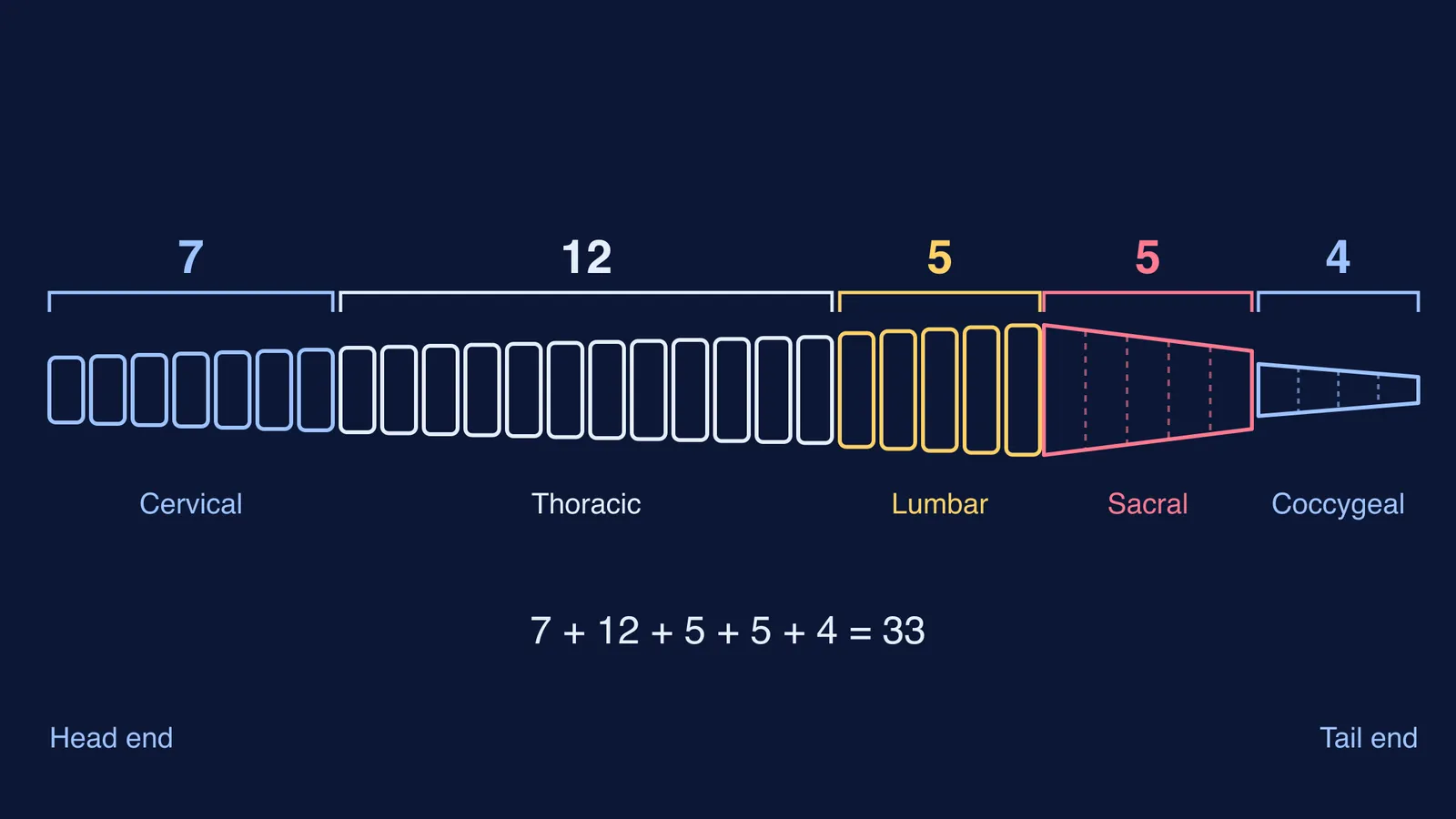
The vertebral column first develops as a series of 33 vertebrae, according to OpenStax Anatomy and Physiology 2e. From head to tail, the regions are:
Cervical (neck): 7 vertebrae, numbered C1 to C7
Thoracic (chest): 12 vertebrae, T1 to T12
Lumbar (lower back): 5 vertebrae, L1 to L5
Sacral: 5 vertebrae that fuse into a single bone, the sacrum
Coccygeal: 4 small vertebrae that fuse into the coccyx, or tailbone
The same textbook names the first two neck vertebrae: C1 is the atlas, which supports the skull, and C2 is the axis, the pivot your head turns on. The US National Cancer Institute's SEER training module on the axial skeleton lists the adult column as 7 cervical, 12 thoracic and 5 lumbar vertebrae, plus one sacrum and one coccyx.
The thoracic vertebrae are where the ribs meet the spine, so this chapter connects to true, false and floating ribs. For where the column sits in the whole skeleton, see our post on counting axial and appendicular bones.
Why do some books say 26 vertebrae and others 33?
The number 33 counts the vertebrae as they develop; 26 counts the separate bones in an adult. OpenStax puts it as 33 vertebrae reduced to 24, plus the sacrum and coccyx. Here is the arithmetic:
Start with 33 vertebrae: 7 + 12 + 5 + 5 + 4.
The 5 sacral vertebrae fuse into one sacrum: 33 − 5 + 1 = 29.
The 4 coccygeal vertebrae fuse into one coccyx: 29 − 4 + 1 = 26.
In an exam, read the question for its key word. "Vertebrae" in a developing body points to 33. "Bones of the adult vertebral column" points to 26.
Do giraffes have more neck vertebrae than humans?
No. A University of Tokyo release from February 2016 puts it plainly: the giraffe neck, like the human one, basically consists of just seven bony cervical vertebrae.
According to the release, Megu Gunji and Hideki Endo dissected giraffe carcasses donated by zoos around Japan. In their Royal Society Open Science paper, they report that the giraffe's first thoracic vertebra is similar in shape to the seventh cervical vertebra of typical ruminants and moves more freely than the other thoracic vertebrae. The release adds that this vertebra, the eighth counted from the skull, helps enlarge the reachable space of the head and neck in adult giraffes by about 50 cm. The count stays at seven; one chest vertebra does a neck job. How the heart pushes blood up that long neck is a separate story: how a giraffe pumps blood to its head.
Why do almost all mammals have seven neck vertebrae?
Mammals are tightly constrained in their number of cervical vertebrae, and their necks differ through the shape of each vertebra rather than the count, as a 2018 study in BMC Evolutionary Biology by Böhmer and colleagues explains. Other animals are freer: the same paper lists 14 cervical vertebrae in a chicken and 17 in a goose.
That paper names manatees and sloths as the only mammals that break the "rule of seven". Two-toed sloths have five to eight cervical vertebrae, three-toed sloths have eight to ten, and manatees have six.
One influential explanation comes from Frietson Galis. In a 1999 paper in the Journal of Experimental Zoology, Galis proposed that the count is held in place by developmental constraints. Hox genes are involved in building both the skeletal axis and the nervous system, and changes in Hox expression that alter the neck count are associated with neural problems, early childhood cancer and stillbirths.
A follow-up EvoDevo study by Varela-Lasheras, Galis and colleagues examined the skeletons of sloths and manatees. Specimens with unusual counts showed other skeletal abnormalities, and the authors suggest that these animals' low metabolic and activity rates weaken the selection that normally keeps the count fixed.
A 10-minute self-check before your biology test
Write 7, 12, 5, 5, 4 from memory and add them to 33.
Turn 33 into the adult count of 26, showing the two fusions.
Name C1 and C2 and say what each does.
Say which two regions are fused in an adult, and into which bones.
Explain in two sentences why a giraffe has seven neck vertebrae, and name the two mammal exceptions.
If a step trips you up, the gap is usually in the concept rather than the number. The Fermi Concept Library has a lesson for every concept in biology, each with its place in the map. For practice questions, the Fermi Problem Library has worked problems with a step-by-step solver that explains the reasoning rather than printing an answer.