On this page
Every rib starts at the backbone. What changes is the front end, and that one detail gives you the three textbook names. Ask "how does this rib reach the sternum?" and you can rebuild the classification in an exam hall.
What is the difference between true, false and floating ribs?
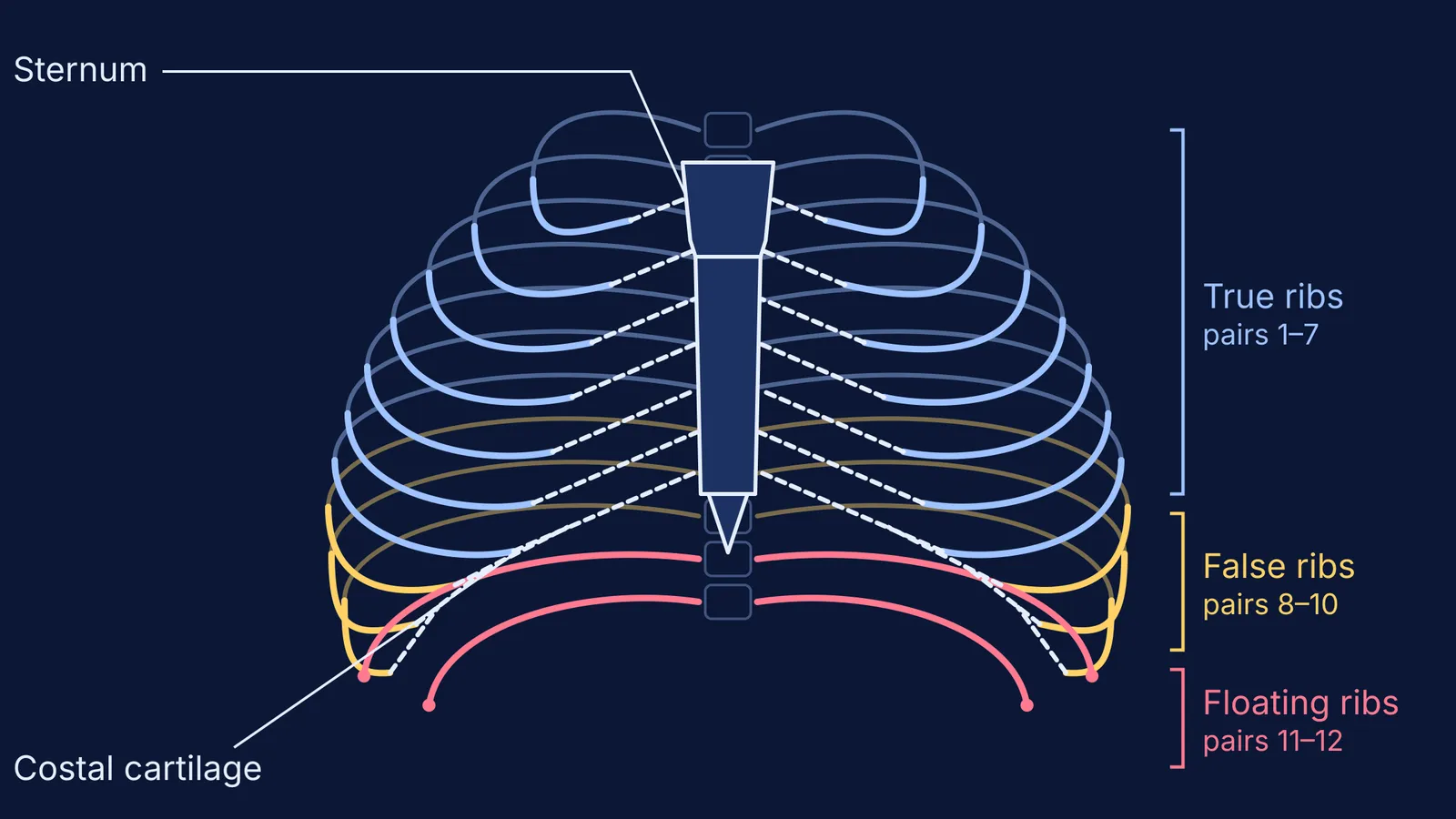
According to the NCERT Class 11 Biology chapter Locomotion and Movement, there are 12 pairs of ribs, each a thin flat bone connected at the back to the vertebral column and at the front to the sternum. The three groups differ only in that front connection:
True ribs (pairs 1–7): attached at the back to the thoracic vertebrae and connected at the front to the sternum with the help of hyaline cartilage.
False ribs (pairs 8–10): they do not articulate directly with the sternum but join the seventh rib with the help of hyaline cartilage. NCERT also calls them vertebrochondral ribs.
Floating ribs (pairs 11–12): they are not connected at the front, which is why they are called floating.
NCERT adds that each rib has two articulation surfaces at its back end, so ribs are called bicephalic, and that thoracic vertebrae, ribs and sternum together form the rib cage.
Why do some textbooks say there are five pairs of false ribs?
Some anatomy textbooks count differently. OpenStax Anatomy and Physiology (section 7.4, The Thoracic Cage) calls ribs 8–12 false ribs, because none of their cartilages attach directly to the sternum. The last two, 11 and 12, are also called floating ribs; their small cartilages end in the muscles of the side of the abdominal wall.
The anatomy is the same; only the grouping differs. In OpenStax, floating ribs are a subset of false ribs (five false pairs, two of which float). In NCERT, the groups are separate (three false pairs, two floating). OpenStax also notes that each cartilage of ribs 8–10 attaches to the cartilage of the next higher rib, so the chain reaches the sternum through rib 7.
If your exam is set from the NCERT textbook, write "false ribs = 8th, 9th and 10th pairs".
How does the rib cage protect the heart and lungs?
OpenStax states it plainly: the thoracic cage protects the heart and lungs. Each rib meets the spine at two points: its head meets the body of its own thoracic vertebra (and, to a lesser degree, the one above), and a bump called the tubercle meets the transverse process of the same vertebra. Those two contact points fit NCERT's description of ribs as bicephalic.
The NCERT chapter Breathing and Exchange of Gases describes the full box: the thoracic chamber is formed at the back by the vertebral column, at the front by the sternum, at the sides by the ribs and below by the dome-shaped diaphragm, and is anatomically air-tight. To compare the materials involved, see our post on how cartilage differs from bone.
How do the ribs move when you breathe?
The same breathing chapter explains that any change in the volume of the thoracic cavity is reflected in the lungs. Contracting the diaphragm increases the chamber's volume in the antero-posterior axis. Contracting the external intercostal muscles, between the ribs, lifts the ribs and sternum and increases the volume in the dorso-ventral axis. Lung pressure falls below atmospheric pressure and air flows in. When these muscles relax, the diaphragm and sternum return to their normal positions and air is pushed out. NCERT puts a healthy person's breathing rate at 12–16 times a minute on average.
The front ends are worth a second look here. The Locomotion and Movement chapter describes cartilage as having a slightly pliable matrix, unlike bone's very hard one, and it is this cartilage that links the true and false ribs to the sternum. For the full sequence, see our explainer on the mechanism of inspiration and expiration.
A 30-second way to sort any rib
Ask three questions about the rib's front end, in this order:
Does its own cartilage reach the sternum? If yes, it is a true rib (pairs 1–7).
Does its cartilage join the cartilage of the rib above instead? If yes, it is a false or vertebrochondral rib (pairs 8–10 in NCERT).
Does it have no front attachment? Then it is a floating rib (pairs 11–12).
Worked practice, using NCERT labels:
Rib 2: own cartilage reaches the sternum, so true. OpenStax adds that it attaches at the sternal angle, where the manubrium meets the sternum's body.
Rib 9: cartilage joins the rib above, so false (vertebrochondral).
Rib 12: no front attachment, so floating. In OpenStax's system it is also a false rib.
"How many pairs of false ribs?" NCERT: 3. OpenStax: 5.
If a label still feels shaky, the Fermi Concept Library covers every concept in biology, each with its own lesson and its place in the map. Then read how fibrous, cartilaginous and synovial joints differ, asking the same "what connects to what" question.