

On this page
Most infections leave you better protected next time. Dengue can do the opposite. The WHO dengue fact sheet puts it plainly: "Individuals who are infected for the second time are at greater risk of severe dengue." The reason is a quirk of antibodies, and it is also why dengue vaccines are so tricky to design.
Why is a second dengue infection more dangerous?
Dengue is caused by four serotypes of the same virus, as WHO notes. Your first infection leaves antibodies shaped to that serotype. A different serotype later is recognised only partly.
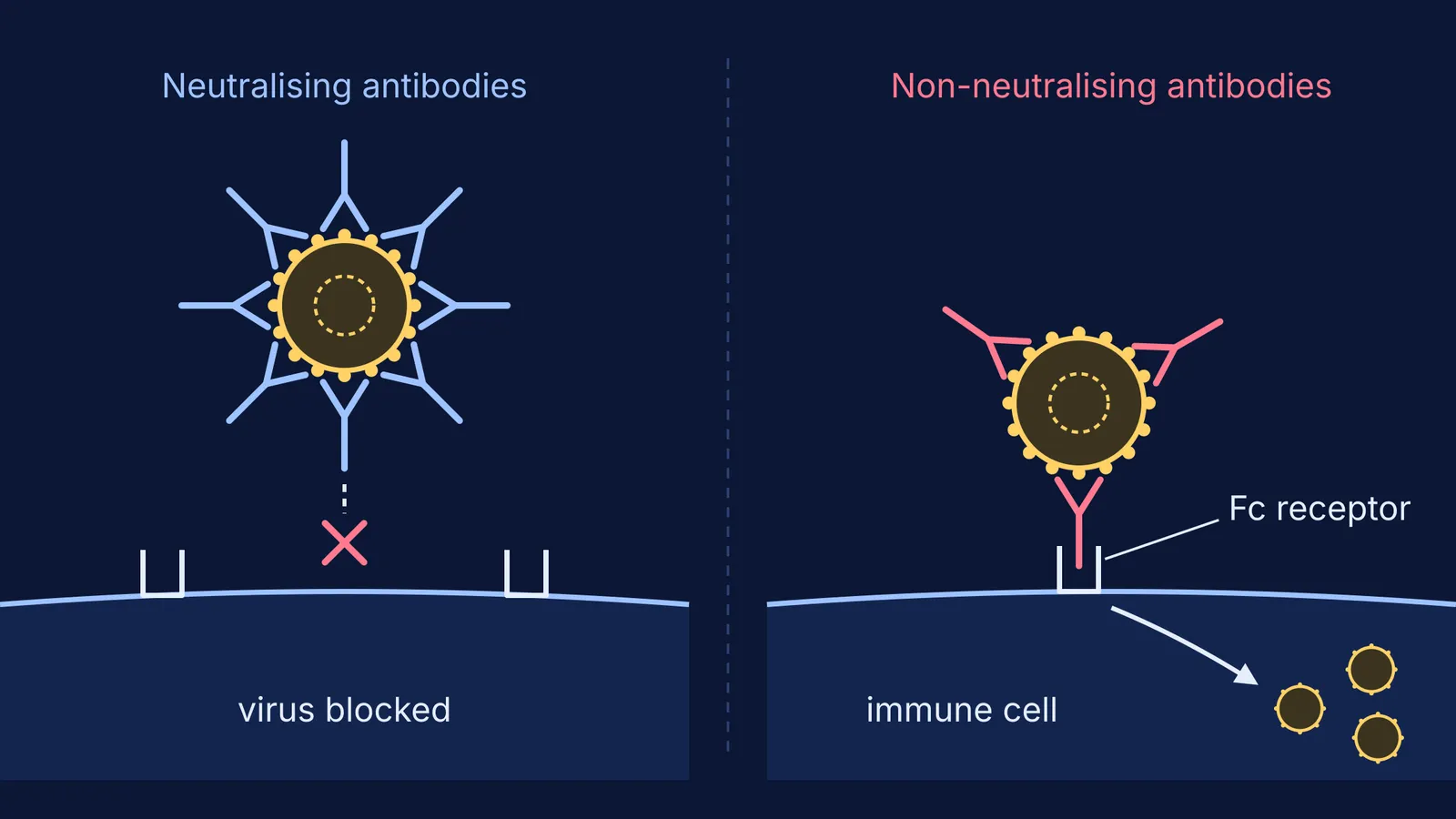
Antibody-dependent enhancement (ADE) is when antibodies bind a virus without neutralising it and help it infect cells instead of stopping it (Katzelnick et al., Science, 2017). In the full text of that paper, antibodies from an earlier serotype "bind but do not neutralize" the new one, and Fc receptors then help the virus into immune cells.
How do non-neutralising antibodies help dengue enter cells?
Picture an antibody as a Y. The two arms grip a target; the stem, called the Fc region, is a handle immune cells can grab. Our explainer on the IgA, IgM, IgE and IgG antibody classes covers the shape.
Leftover antibodies stick to the second serotype without blocking it, stems pointing out.
Immune cells carry Fc receptors that grab those stems, normally to swallow coated microbes.
Dengue rides the antibody into the cell and multiplies.
In 1977, Halstead and O'Rourke reported that blood immune cells from people and monkeys never exposed to dengue resisted dengue 2 virus in the lab, but became infectable once non-neutralising dengue antibody was added (Journal of Experimental Medicine, 1977). Antibody fragments without the stem did not do this, pointing to the stem as the key.
What did the Nicaragua study find?
The clearest evidence in people came from a Nicaraguan study that enrolled 8,002 children aged 2 to 14 between August 2004 and April 2016 and tracked their dengue antibodies (Katzelnick et al., full text).
Children with intermediate antibody levels (titres of 1:21 to 1:80) had a 7.64 times higher hazard of dengue haemorrhagic fever or dengue shock syndrome than children who had never been infected.
Over the 12 years, their cumulative risk of these severe forms was 11.4%, nearly twice the 6.6% seen in previously infected children with low antibody levels.
High antibody levels (above 1:320) protected against symptomatic dengue.
So the danger sits in the middle: enough antibody to grab the virus, not enough to neutralise it.
Why does ADE make dengue vaccines hard to design?
A vaccine must protect against all four serotypes at once. If it gives a never-infected person weak or uneven protection, it could act like a first infection and set up ADE.
A reanalysis of the first licensed vaccine, CYD-TDV (Dengvaxia), fits this concern. Among children aged 2 to 16 who had never had dengue, 3.06% of vaccine recipients were hospitalised with dengue over five years, against 1.87% of controls; among children who had had dengue before, the vaccine cut it from 2.47% to 0.75% (Sridhar et al., NEJM, 2018). WHO estimated that about 4 in 1,000 vaccinated people without prior infection developed severe dengue over five years, compared with 1.7 per 1,000 unvaccinated people (WHO Q&A, December 2017).
The newer vaccine TAK-003 (Qdenga) contains weakened versions of all four serotypes and was prequalified by WHO on 10 May 2024; WHO recommends it for children aged 6 to 16 in high-burden settings, in two doses three months apart (WHO). WHO does not recommend routine programmes in low-to-moderate transmission settings until its risk for DENV3 and DENV4 in never-infected people is better assessed (WHO dengue vaccine Q&A).
This matters in India, where many children have not met dengue yet. An ICMR-led survey that tested 12,300 people in 2017-18 found 48.7% had dengue antibodies overall, but only 28.3% of children aged 5 to 8 (Murhekar et al., Lancet Global Health, 2019).
How do you explain ADE in an exam answer?
Use this five-link chain:
Four serotypes; a first infection makes antibodies matched to one.
A different second serotype is bound by these antibodies but not neutralised.
The Fc stem of the bound antibody attaches to Fc receptors on immune cells.
The virus enters and multiplies in those cells, raising the risk of severe dengue.
Evidence: intermediate antibody levels carry the highest risk; high levels protect (Katzelnick, 2017).
Worked example: Riya had DENV-2 at age 7. At 12 she catches DENV-3. Is she at greater risk of severe dengue than a classmate infected for the first time? On average, yes: her DENV-2 antibodies can bind DENV-3 without neutralising it. Had her antibody levels from the first infection still been high, the Nicaragua data point to protection instead.
Compare how primary and secondary immune responses differ to see why memory usually helps. If antibody structure is shaky, the Fermi Concept Library gives every biology concept its own lesson and its place in the map, so you can see what ADE builds on.
Next, read why platelet count falls in dengue.


