

On this page
A gull can sip from the ocean and come out ahead on water. You cannot. The difference is not toughness but plumbing: seabirds, and several marine reptiles, carry a second salt-removal organ that out-concentrates the sea, while your kidneys top out below it.
How do seabirds drink sea water?
They drink it and then pump the extra salt out through their heads. A 2000 review of osmoregulation in birds by Pablo Sabat describes the nasal salt glands as paired structures on top of the skull, in or around the eye socket, with ducts that open into the nasal cavity. The salty fluid leaves through the nostrils, which is why a seabird can look as if it has a runny nose.
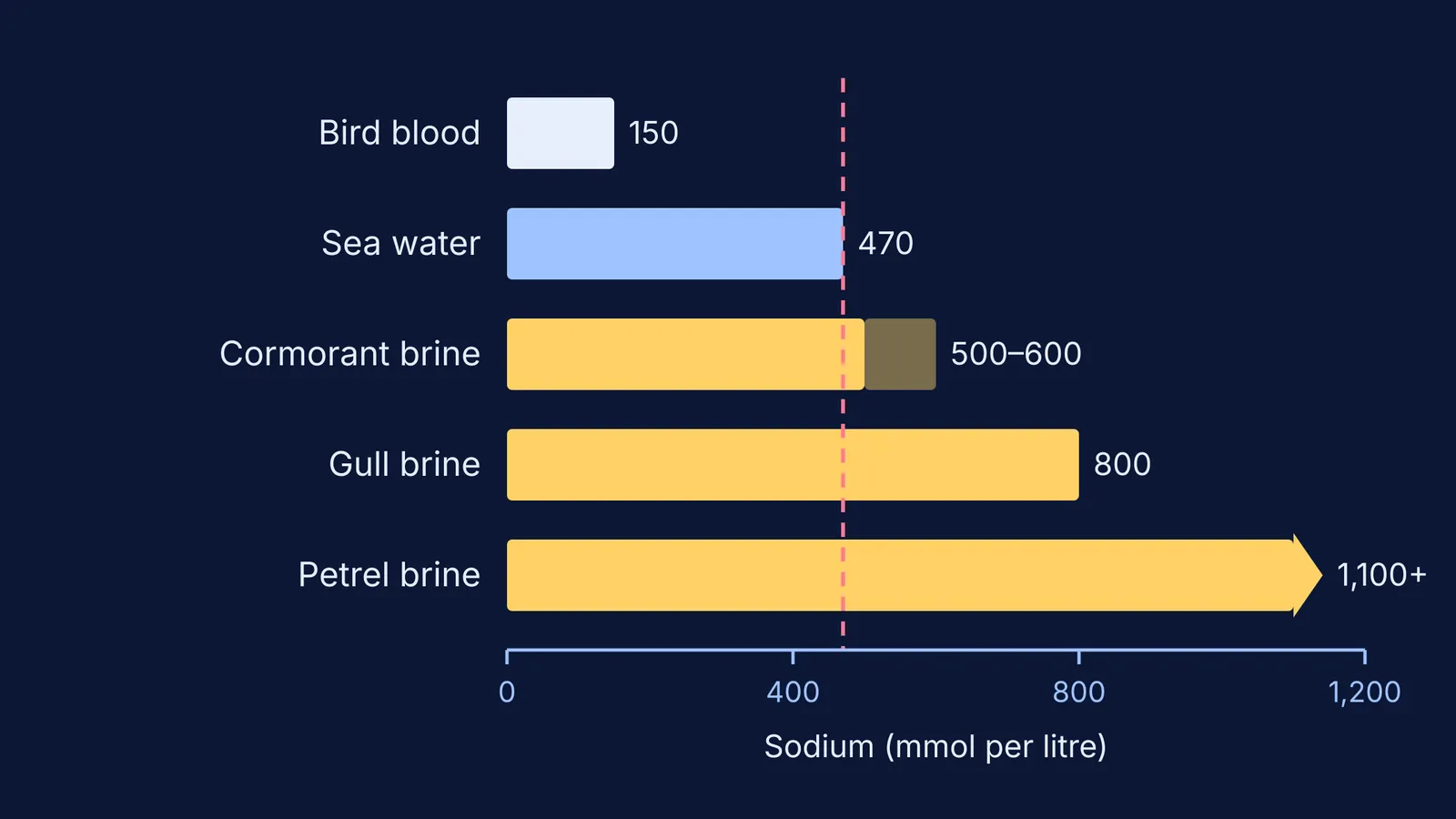
The numbers in the same review make the point. Sea water carries about 470 mmol of sodium and 548 mmol of chloride per litre. The nasal glands of the herring gull (Larus argentatus) can secrete about 800 mmol of sodium chloride per litre, and those of Leach's storm petrel (Oceanodroma leucorhoa) above 1,100 mmol per litre. A seabird's blood plasma holds about 150 mmol of sodium per litre, so the gland concentrates salt five to eight times over. Blood in the gland flows opposite to the secreted fluid, a countercurrent arrangement like the kidney's.
The gland was pinned down in the late 1950s. Knut Schmidt-Nielsen and colleagues gave cormorants salt loads and found they secreted a highly concentrated fluid from the nasal passages, at 500 to 600 mmol of sodium chloride per litre (American Journal of Physiology, 1958). Audubon reports that in Schmidt-Nielsen's 1960 work one Great Black-backed Gull drank one-tenth of its body mass in sea water and had cleared the salt within three hours.
Do sea turtles and other reptiles have salt glands too?
Yes, and they reach a similar range. In green sea turtles given salt loads, Nicolson and Lutz (Journal of Experimental Biology, 1989) measured salt gland fluid rising from 300 to 400 to a plateau of 1,680 to 2,000 mOsm/kg. Sea water is about 1,000 mOsm per litre, so the turtle's brine is up to twice as concentrated as the sea it swims in.
The gland is not in the same place in every animal. A 2011 PLoS One review of marine reptiles notes that marine iguanas use nasal salt glands, and that saltwater crocodiles use salt glands on the tongue. Different body parts, same job.
Why can't the human kidney do the same?
Your kidney is a good concentrator, just not good enough. According to Sands and Layton's review of urinary concentration, human urine can reach about 1,200 mOsm/kg, roughly four times plasma at about 290. But much of that is urea, which Sands and Layton call the predominant urinary solute when urine is strongly concentrated. That leaves limited room for salt. The US National Ocean Service puts it plainly: human kidneys can only make urine that is less salty than salt water, so clearing the salt from sea water means passing more water than you drank.
Birds have it worse. Sabat's review notes that bird urine is generally only two to three times as concentrated as plasma. Unless a bird can excrete fluid saltier than what it drinks, it dehydrates, so the salt gland does that work. For your own body, see our posts on why humans can't drink sea water and what each limb of the loop of Henle does.
Worked example: what does one litre of sea water cost?
Use sodium as the tracer and the figures from the Sabat review. We ignore the other ions and assume the bird gets rid of all the sodium as brine.
Sodium in, per litre of sea water: about 470 mmol.
Herring gull brine at 800 mmol per litre: 470 ÷ 800 = 0.59 litre of brine needed.
Water the gull keeps: 1 − 0.59 = about 0.41 litre.
Leach's storm petrel at 1,100 mmol per litre: 470 ÷ 1,100 = 0.43 litre of brine, so it keeps about 0.57 litre.
A human: urine is less salty than sea water, so the volume needed is more than 1 litre. The balance is negative before you count sweat.
How do you answer osmoregulation questions with this?
The same three checks work for gulls, turtles, marine fish and people:
What goes in, and how salty is it?
What is the most concentrated thing that can come out, and by which route?
Is the exit saltier than the intake? If yes, water is gained; if not, water is lost and must come from somewhere else.
Try it on bony fish in the sea; our post on osmoregulation in freshwater and marine fish walks through it.
If osmotic concentration itself feels shaky, the Fermi Concept Library gives each biology and chemistry concept its own lesson. To work a calculation like the one above step by step, Fermi's AI tutor works out what you already know and teaches through the problem with you.
Next time you see a drop hanging from a gull's beak, you will know which gland it came from.


