On this page
Picture a boat stuck far out at sea with no fresh water left. Water is everywhere, and still nobody on board should drink it. The US National Oceanic and Atmospheric Administration (NOAA) puts the reason in one line: human kidneys can only make urine that is less salty than salt water. Here is why, using Class 10 osmosis and excretion, with the arithmetic.
How salty is sea water compared with your blood?
Scientists at the Woods Hole Oceanographic Institution say a kilogram of seawater holds about 35 grams of salt on average, a salinity of about 35 parts per thousand.
Biologists usually count dissolved particles rather than grams. Osmolality is the number of dissolved particles, in milliosmoles (mOsm), per kilogram of water. A 2006 study in the journal Cell Cycle gives sea water an average osmolality of 1,000 mosmol/kg, against 300 mosmol/kg in most of the intercellular fluids of vertebrates such as us. So sea water carries more than three times as many dissolved particles as the fluid around your cells.
That matters because of osmosis: across a membrane that lets water through but holds back dissolved particles, water moves from the weaker solution to the stronger one. To practise predicting which way it goes, try this osmosis simulation on water crossing a membrane.
What do your kidneys do with extra salt?
The NCERT Class 10 chapter Life Processes describes the kidney's filtering units, the nephrons. Substances such as glucose, amino acids, salts and a major amount of water are taken back from the filtrate as it flows along the tubule. The same chapter says the initial filtrate in a healthy adult is about 180 L a day, but only a litre or two a day is excreted.
NCERT then gives the line that answers this post: the amount of water re-absorbed depends on how much excess water there is in the body, and on how much dissolved waste there is to be excreted. More salt to remove means more water must leave with it. For the full sequence, read how urine forms, step by step.
There is a ceiling. In a review in Seminars in Nephrology, Jeff Sands and Harold Layton write that after several hours without water, such as overnight during sleep, human urine osmolality may rise to about 1,200 mOsm/kg, about four times plasma osmolality of about 290 mOsm/kg. We use that figure below as a rough upper limit for how concentrated human urine gets.
Why does drinking sea water make you more dehydrated?
Put the facts together. The salt arrives in sea water, it can only leave in urine, and the kidneys cannot make urine as salty as the sea. NOAA's conclusion follows: to get rid of the excess salt, you have to urinate more water than you drank, and you dehydrate even as you get thirstier. Why the thirst grows is explained in how the body knows when to feel thirsty.
What does one litre of sea water cost you?
Use the two numbers above: about 1,000 mOsm/kg for sea water (Dmitrieva and colleagues, 2006) and about 1,200 mOsm/kg for highly concentrated human urine (Sands and Layton, 2009). Treat one litre of sea water as about one kilogram.
Particles swallowed: 1 kg × 1,000 mOsm/kg = about 1,000 mOsm.
Best-case urine needed, if urine carried nothing but sea salt: 1,000 ÷ 1,200 = about 0.83 L.
Best-case gain: 1 − 0.83 = about 0.17 L, less than a small glass.
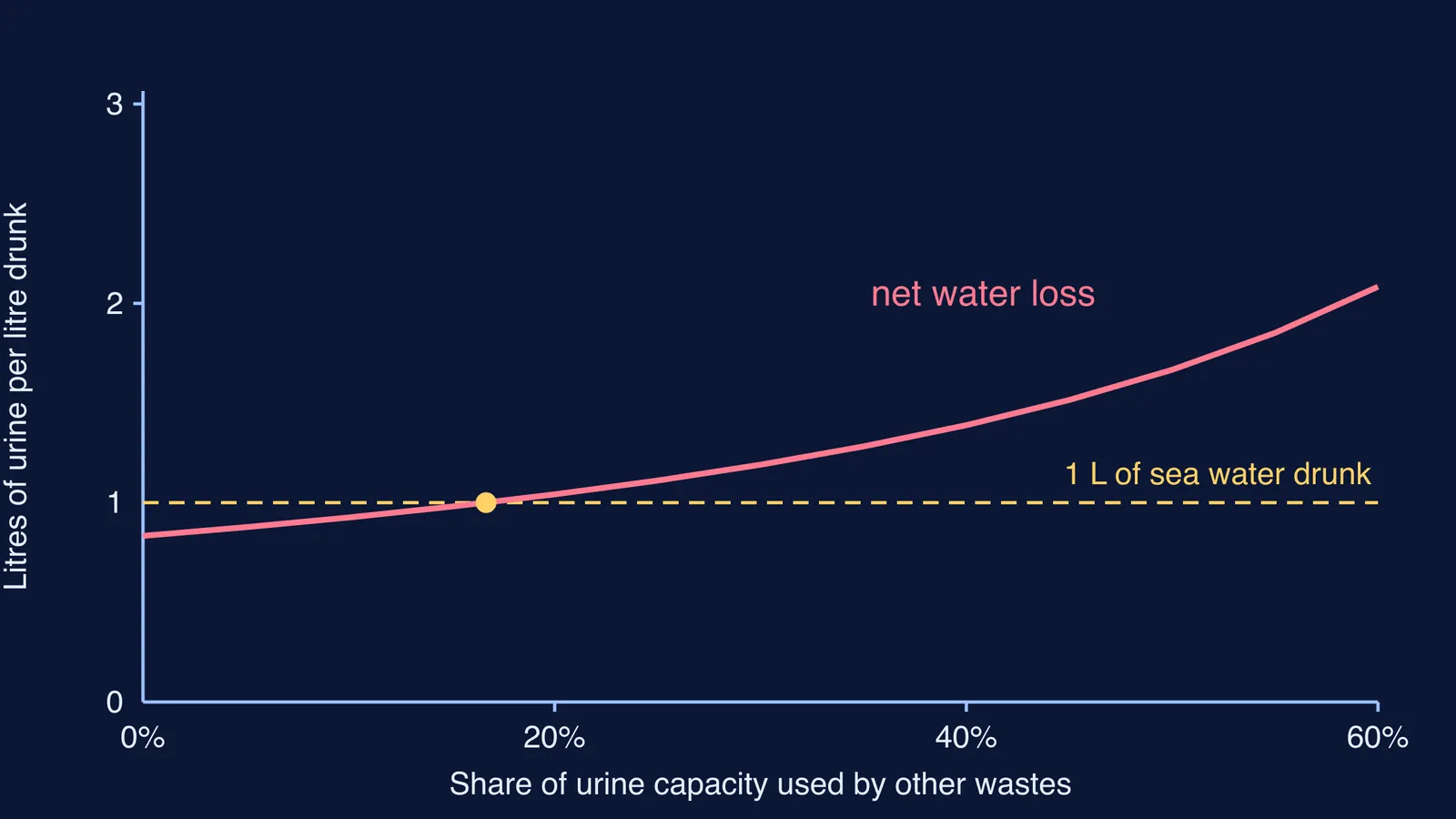
But urine is never only sea salt. The kidneys must also clear urea and uric acid, which NCERT names as the wastes they remove, and those particles share the same 1,200 mOsm/kg of room. Call their share f. The urine needed is 1,000 ÷ (1,200 × (1 − f)):
f = 0: 0.83 L of urine per litre drunk
f = one fifth: 1.04 L, already more than you drank
f = one third: 1.25 L
f = one half: 1.67 L
The break-even point is f = 1/6. Once other wastes take more than about a sixth of the urine's capacity, every litre of sea water costs you more than a litre of water. This is a what-if model, not a measurement of a real body.
How do you write this in a Class 10 answer?
Link osmosis to excretion in three steps:
Sea water has far more dissolved salt than body fluids.
Kidneys can only make urine less salty than sea water, so removing that salt needs extra water.
The body loses more water than it took in, so you dehydrate and feel thirstier.
For other ideas that are easier to see than read, the Fermi Simulation Lab has interactive simulations. For revision, the Fermi Concept Library has lessons on concepts across physics, chemistry, biology, mathematics and computing.