

On this page
An osmosis simulation looks simple: two compartments, a membrane, some moving dots. It teaches you most when you predict first. Here are three set-ups, the numbers to check them, and what it takes to push water back.
What does an osmosis simulation actually show?
A typical osmosis simulation draws small water particles and larger solute particles either side of a membrane with tiny pores. Water molecules pass through the pores and bigger solute molecules are held back; NCERT's Class 12 chemistry textbook calls this a semipermeable membrane (NCERT Chemistry Part I, Unit 1: Solutions). The same chapter defines osmosis as the flow of solvent through such a membrane from pure solvent into the solution.
Follow one water particle and you will see it cross both ways. Osmosis is about the net flow, so count crossings each way, check that solute particles bounce off the membrane, and watch which liquid level rises.
Which way does water move across a semipermeable membrane?
The NCERT Solutions chapter puts the rule in one line: solvent molecules always flow from lower concentration to higher concentration of solution.
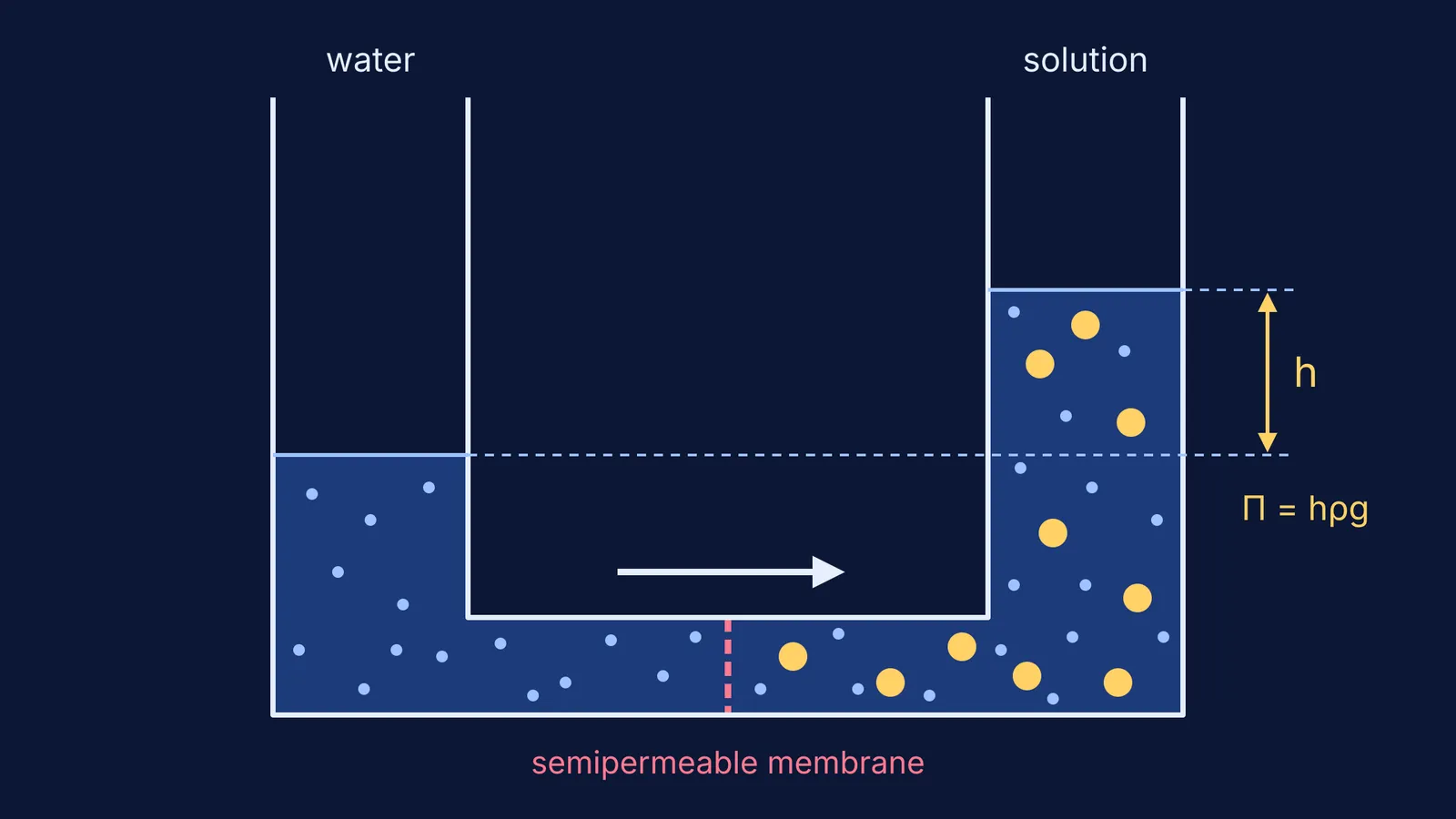
Pure water on the left, sugar solution on the right. Net flow is left to right, and the right-hand level rises.
The same sugar solution on both sides. No net flow: NCERT calls solutions with the same osmotic pressure at a given temperature isotonic, and no osmosis occurs between them.
0.1 mol/L glucose on the left, 0.1 mol/L sodium chloride on the right. You might predict "same concentration, no flow". That is wrong, because osmotic pressure depends on the number of solute particles, not their identity.
Set-up 3 is worth working out. Sodium chloride splits into two ions; NCERT's Table 1.4 gives its van 't Hoff factor i as 1.87 at 0.1 m, close to the ideal 2. Using Π = iCRT with R = 0.083 L bar mol⁻¹ K⁻¹ at 300 K, the glucose side has Π ≈ 0.1 × 0.083 × 300 ≈ 2.5 bar and the salt side about 4.7 bar. Water moves into the salt side.
The same idea explains why pickles in salt brine last for months.
What does osmotic pressure measure?
Osmotic pressure is the excess pressure that must be applied to a solution to prevent osmosis (NCERT Unit 1, section 1.6.4). For dilute solutions it follows Π = CRT, where C is the molarity and T the temperature. It is a colligative property, like the vapour pressure lowering you can test in a Raoult's law simulation.
In the classic thistle-funnel experiment, the solution climbs a tube until the extra column's weight balances the osmotic pressure, so Π = hρg. A worked example:
A 0.001 mol/L sugar solution at 300 K: Π = 0.001 × 0.083 × 300 ≈ 0.025 bar, about 2,490 Pa.
Water column it supports: h = 2,490 ÷ (1,000 × 9.81) ≈ 0.25 m.
That is why NCERT says osmotic pressure is large even for very dilute solutions, and useful for finding the molar masses of proteins.
What does reverse osmosis need?
Osmosis can be reversed if a pressure larger than the osmotic pressure is applied to the solution side, and this is how seawater is desalinated (NCERT section 1.6.5). The textbook names a cellulose acetate film as a workable membrane: water passes, the ions in seawater do not.
How large is "larger"? NOAA puts seawater salinity at about 35 parts per thousand, with chloride and sodium making up around 85 percent of the dissolved ions (NOAA Ocean Service). Treat that as roughly 35 g of NaCl per litre:
Moles of NaCl: 35 ÷ 58.5 ≈ 0.60 mol/L.
Particles with i ≈ 2: about 1.2 mol/L.
Π ≈ 1.2 × 0.083 × 300 ≈ 30 bar.
This is rough, because seawater is a mix of ions and too concentrated for the formula to be exact. Still, the pump must reach tens of bar before any fresh water comes out, and more as the brine left behind gets saltier. A home purifier uses the same idea on far less salty water; see how an RO water purifier works.
A 10-minute plan for your next osmosis simulation
Write a prediction for each set-up: direction of net flow, which level rises, and a rough Π.
Double the solute on one side and check that Π doubles.
Swap glucose for salt at the same molarity and look for the factor of about 2.
Push on the solution side below, at and above Π.
Where the result surprised you, write one sentence explaining why.
For other hard-to-picture ideas, the Fermi Simulation Lab has interactive simulations for ideas that are easier to see than to read, and Fermi's AI tutor can run the simulation with you, notice where you are stuck and check your understanding as it goes.


