

On this page
Turn a sea urchin over and you will see five small points meeting in the middle of its underside. Those are the tips of five teeth, set in a jaw unusual enough to have its own name. It packs three big biology ideas into one structure: five-part symmetry, a calcium carbonate skeleton, and form shaped by function.
What is Aristotle's lantern in a sea urchin?
Aristotle's lantern is the chewing apparatus of a sea urchin: a cone of skeletal pieces, muscles and ligaments that holds five teeth around the mouth.
A 2020 review of the sea urchin skeleton in *Bioinspiration & Biomimetics* by Perricone and colleagues counts its parts exactly: "forty anatomically distinct skeletal ossicles: ten demi-pyramids, ten epiphyses, five rotulae, ten compasses and five teeth". Each pair of demi-pyramids makes one jaw, and each jaw carries one long, curved tooth, so the lantern is five jaws arranged like the segments of an orange. Muscles move the pieces, and the jaws are joined to each other by small articular ossicles, the rotulae, which the same review says "play a role in the basic opening and closing of the jaw".
Notice the number five everywhere. Echinoderms are radially symmetric as adults, usually in fives, even though their larvae are bilateral. We explain that switch in why starfish larvae are bilateral but adults are radial. The lantern is also a good example of the echinoderm endoskeleton, which we cover in which invertebrate has an endoskeleton.
Why is it called Aristotle's lantern?
The name comes from the Greek philosopher Aristotle's *History of Animals*. In D'Arcy Wentworth Thompson's translation of Book IV, Aristotle writes that the urchin "has, also, five hollow teeth inside", and that its mouth-apparatus "looks like a horn lantern with the panes of horn left out".
A horn lantern was a frame with thin, see-through sheets of animal horn as windows. Take out the windows and you are left with a ribbed, five-sided cage, which is close to what the cleaned skeleton of the jaw looks like.
How do sea urchin teeth sharpen themselves?
A sea urchin feeds by scraping rock. You would expect teeth used like that to go blunt. They do not.
A team including UW-Madison physicist Pupa Gilbert studied the teeth of the California purple sea urchin and reported in *Advanced Functional Materials* that they "scrape and bore holes into rock, yet the teeth remain sharp rather than dull with use" (Killian et al., 2010). Each tooth is a mosaic of calcite crystals shaped into plates and fibres, cemented by a robust calcite matrix. Thin organic layers surround the plates and fibres. The authors describe these layers as "fault lines": the tooth fractures along them, outer pieces are shed, and the robust central part, called "the stone", is exposed as the grinding tip.
The tooth also never stops growing. It is formed continuously at one end while it wears at the tip, and the 2020 review notes that it "grows continuously" at its inner growing end, the plumula, "and then slowly descends along the jaw".
In 2019, engineers at Northwestern University led by Horacio Espinosa watched this happen under a scanning electron microscope, wearing down single teeth and filming the process (Espinosa et al., *Matter*). In the university's summary, PhD student Hoang Nguyen put it simply: "Wear-off does not blunt the tip of the tooth, but it instead sharpens it."
How can you remember it for a biology exam?
Rebuild it from a picture with this five-minute drill.
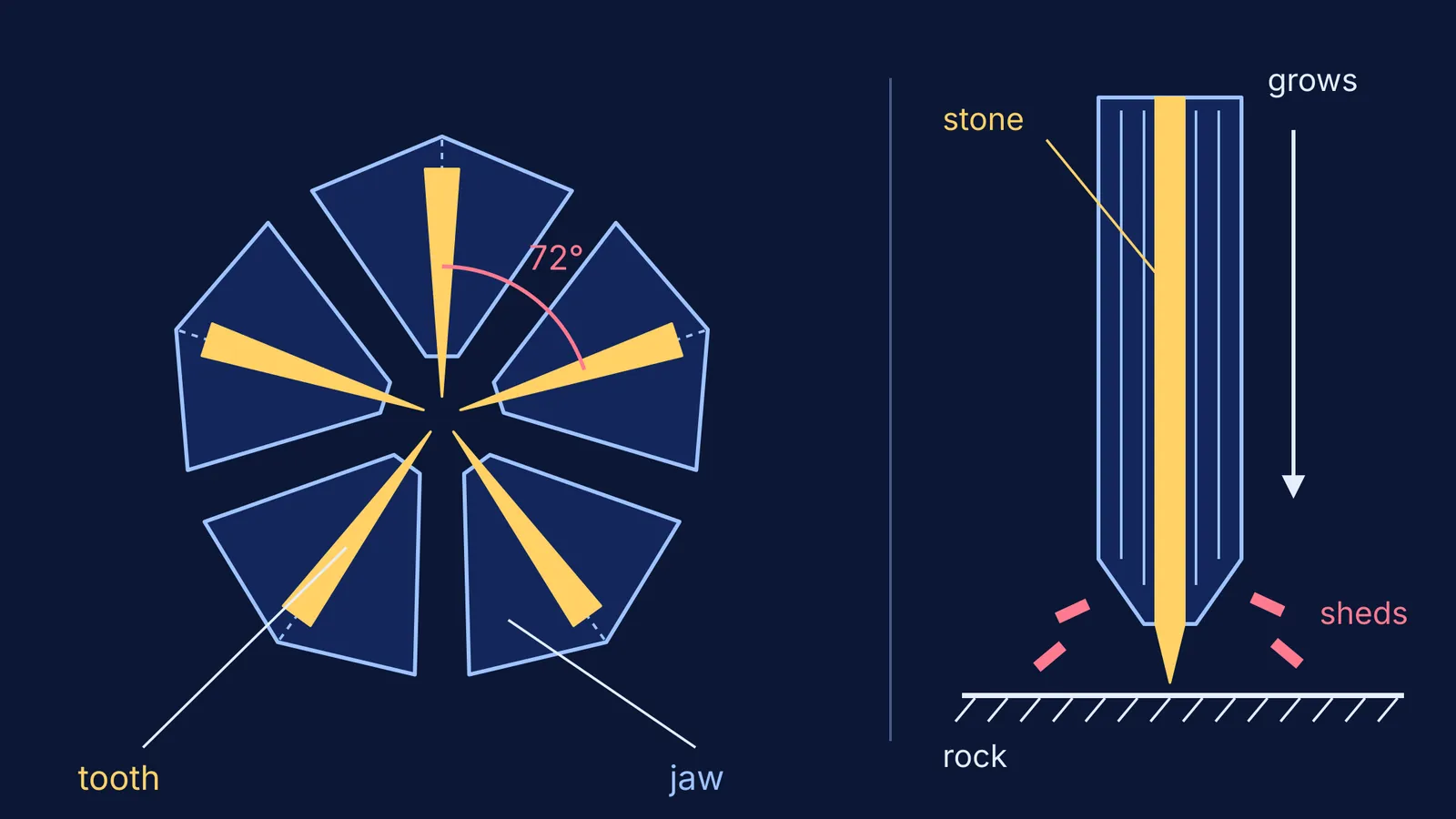
Draw a circle and mark five points around it, 72 degrees apart (360 divided by 5).
Draw a wedge-shaped jaw on each point and a tooth running down its middle to the centre. Say "five jaws, five teeth".
Next to it, draw one tooth from the side: a hard core (the stone) between layered plates, with an arrow showing growth towards the tip.
At the tip, draw a few flakes breaking off and write "organic layers break first, the stone stays sharp".
Close your notes and write three sentences: what the lantern is, who named it and why, and how the teeth stay sharp. Check them against this page.
Watch for these three mix-ups:
The lantern is a feeding structure. It is not part of the water vascular system, which works the tube feet. We cover that in how the echinoderm water vascular system powers tube feet.
The teeth are calcite (calcium carbonate), not enamel.
"Lantern" refers to the whole jaw apparatus, not to a single tooth.
If drawing structures from memory is where you get stuck, Fermi's AI tutor works on a board and draws the figure as it explains, checking your understanding as it goes. To see where echinoderms sit among the other animal groups, start with the Fermi Concept Library, which gives every biology concept its own lesson and its place in the map.


