

On this page
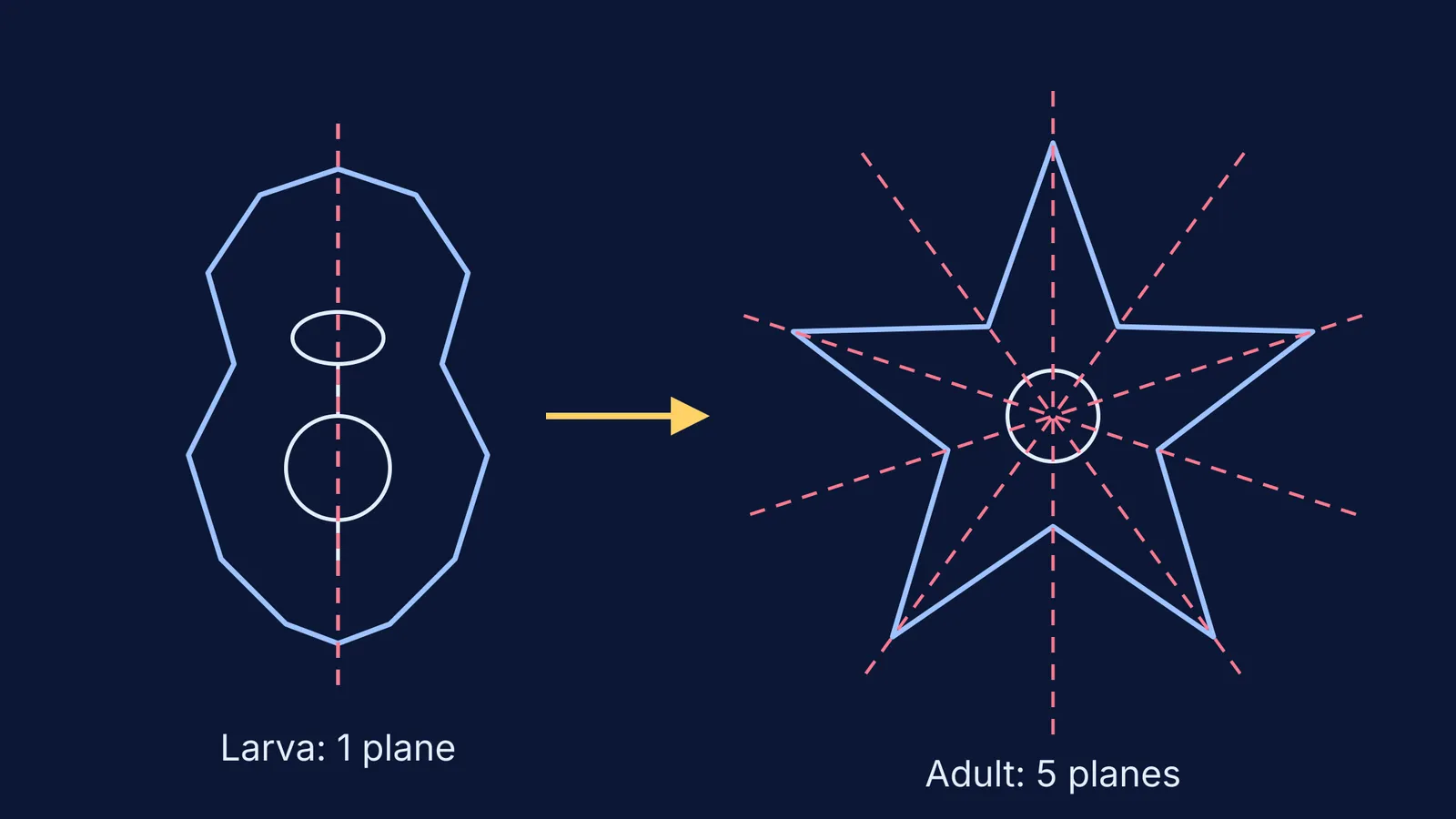
Draw a starfish and you draw five arms around a centre. Its larva looks nothing like that: it has a left side and a right side, like a fish, or like you.
NCERT's Class 11 chapter Animal Kingdom puts it in one sentence: "The adult echinoderms are radially symmetrical but larvae are bilaterally symmetrical" (NCERT Biology Class 11, Chapter 4). Here is why, how the switch happens, and how NEET tests it.
What do radial and bilateral symmetry mean?
In NCERT's words, radial symmetry is "when any plane passing through the central axis of the body divides the organism into two identical halves" (NCERT Biology Class 11, Chapter 4).
Bilateral symmetry is when the body "can be divided into identical left and right halves in only one plane", as in annelids and arthropods (same NCERT chapter).
A starfish is a special case: five similar parts around a centre, called pentaradial symmetry. It does not split into identical halves along any plane you like. An idealised five-armed star has exactly five mirror planes, each running down one arm and between the two opposite arms, as in the diagram above. NCERT simply groups echinoderms with the radial animals. For a refresher on all the types, see our guide to radial, bilateral and asymmetrical animal symmetry.
Why is the echinoderm larva bilateral but the adult radial?
The short answer: the bilateral larva shows the older body plan, and the radial adult is built on top of it.
Ancestry. Echinoderms "are thought to have evolved from a bilateral ancestor", as a 2022 study in Scientific Reports puts it (Udagawa et al., 2022). The larva keeps that ancestral left-right plan.
Lifestyle. NCERT notes that echinoderm development is "indirect with free-swimming larva". The adult's radial body is "most likely an adaptation to a sessile or slow-moving existence", as the Wikipedia overview of echinoderms summarises it.
The exam word is secondary: echinoderms become radial only after a bilateral start, so theirs is secondary radial symmetry (same Wikipedia overview).
How does a bilateral larva turn into a five-armed adult?
The change starts inside the larva. Sumio Udagawa and colleagues followed it in the sea cucumber Apostichopus japonicus (Scientific Reports, 2022):
A coelom pouch called the hydrocoel "emerges on the left side of bilateral larvae". In this sea cucumber it forms about 4 days after fertilisation.
At about 10 days, the hydrocoel buds into lobes in multiples of five, which the authors call "the firstly emerging pentameral character".
At metamorphosis, "the whole hydrocoel encircles the mouth, forming a ring" and becomes the water vascular system: a ring canal around the mouth with radial canals.
So the five-part plan grows out of one side of a two-sided larva, inside the water vascular system that NCERT calls "the most distinctive feature of echinoderms". More in our explainer on how the water vascular system powers tube feet.
How does NEET test echinoderm symmetry?
The latest published NEET-UG syllabus, for 2026, finalised by the National Medical Commission and announced by NTA, asks for "salient features and classification of animals-nonchordate up to phyla level" with three to five features and at least two examples (NTA public notice and syllabus, 8 January 2026). Symmetry is on NCERT's list of echinoderm features, so expect direct recall, statement questions with one feature swapped, and odd-one-out sets built on NCERT's radial groups: coelenterates, ctenophores and echinoderms.
Sample MCQ 1: Which statement about Asterias (starfish) is correct?
Both larva and adult are radially symmetrical.
The larva is bilaterally symmetrical and the adult is radially symmetrical.
The larva is radially symmetrical and the adult is bilaterally symmetrical.
Both larva and adult are bilaterally symmetrical.
Answer: 2. This is NCERT's sentence almost word for word. Option 3 is the trap for students who remember the switch but not its direction. Ask which plan is older: bilateral ancestor, so bilateral larva.
Sample MCQ 2: Which feature does NOT belong to phylum Echinodermata?
Water vascular system that helps in locomotion, capture of food and respiration
Triploblastic, coelomate body
Fertilisation usually internal
Free-swimming larva
Answer: 3. NCERT says "Fertilisation is usually external"; the other three options are on its list of echinoderm features (NCERT Biology Class 11, Chapter 4).
What should you revise before your next mock test?
Say it aloud: "Echinoderm larva bilateral, adult radial, so the radial symmetry is secondary."
Name where the five-fold pattern starts (the hydrocoel) and what it becomes (the water vascular system). This goes beyond NCERT but fixes the direction of the switch.
List NCERT's five examples: Asterias, Echinus, Antedon, Cucumaria and Ophiura.
Write the three radial groups NCERT names: coelenterates, ctenophores and echinoderms.
Explain to a friend why a starfish has five mirror planes, not infinitely many.
For the whole phylum, read why a starfish is not a fish. If words like coelom or deuterostome still feel shaky, the Fermi Concept Library gives every concept in biology its own lesson and its place in the map. When you are ready to practise, the Fermi Problem Library has worked problems with a step-by-step solver that explains the reasoning rather than printing an answer.


