

On this page
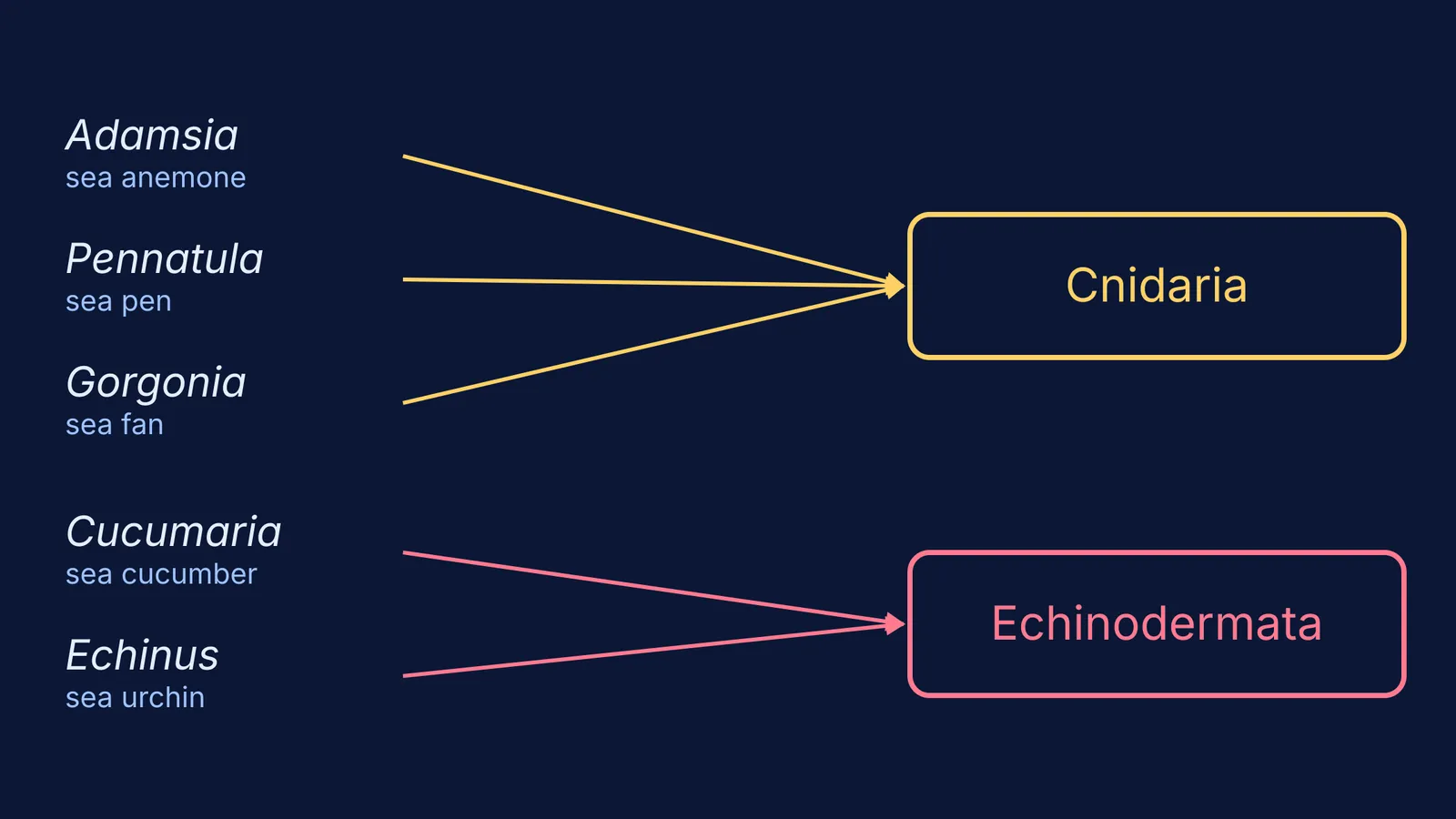
Five animals in NCERT's Animal Kingdom chapter have common names that start with 'sea', and match-the-column questions like to shuffle them. The fix is short: three of them sting, two are spiny.
Which phylum do sea anemone, sea pen and sea fan belong to?
All three belong to Phylum Coelenterata, also called Cnidaria. The NCERT Class 11 Biology chapter Animal Kingdom lists its cnidarian examples as Physalia (Portuguese man-of-war), Adamsia (Sea anemone), Pennatula (Sea-pen), Gorgonia (Sea-fan) and Meandrina (Brain coral).
NCERT describes cnidarians as aquatic, mostly marine, radially symmetrical animals named after their cnidoblasts, the cells that hold stinging capsules called nematocysts. They are diploblastic, show tissue level of organisation and have a gastro-vascular cavity with a single opening, the mouth on the hypostome. Adamsia is NCERT's own example of the polyp, the sessile and cylindrical body form, drawn next to the jellyfish Aurelia as the medusa in Figure 4.6.
Despite looking like a quill and a fan, both are animals. The World Register of Marine Species places Pennatula and Gorgonia in class Octocorallia of phylum Cnidaria. The same register now lists Adamsia as an unaccepted genus name, pointing to Calliactis, still within the sea-anemone order Actiniaria.
Which phylum do sea cucumber and sea urchin belong to?
Both belong to Phylum Echinodermata. The same NCERT chapter gives the examples Asterias (Star fish), Echinus (Sea urchin), Antedon (Sea lily), Cucumaria (Sea cucumber) and Ophiura (Brittle star).
Echinodermata means 'spiny bodied', a name NCERT ties to their endoskeleton of calcareous ossicles. All are marine, triploblastic and coelomate; adults are radially symmetrical but larvae are bilaterally symmetrical. Their most distinctive feature is the water vascular system, which helps in locomotion, capture and transport of food, and respiration.
The sea cucumber is the usual trap, because it looks soft and sausage-shaped rather than spiny. The World Register of Marine Species places Cucumaria in class Holothuroidea of phylum Echinodermata, and Echinus in class Echinoidea of the same phylum. For the starfish, see why a starfish is not a fish but an echinoderm.
Memory table: scientific name, common name, phylum
Every name below comes from the NCERT Animal Kingdom chapter; for the ctenophores, NCERT gives 'sea walnuts or comb jellies' as the common name of the whole phylum. Say each line aloud once, then cover the right side and test yourself.
Adamsia: sea anemone: Cnidaria
Pennatula: sea pen: Cnidaria
Gorgonia: sea fan: Cnidaria
Meandrina: brain coral: Cnidaria
Physalia: Portuguese man-of-war: Cnidaria
Cucumaria: sea cucumber: Echinodermata
Echinus: sea urchin: Echinodermata
Antedon: sea lily: Echinodermata
Asterias: star fish: Echinodermata
Ophiura: brittle star: Echinodermata
Pleurobrachia, Ctenoplana: sea walnuts or comb jellies: Ctenophora
Aplysia: sea-hare: Mollusca
A hook that works: the anemone, pen and fan are a 'sting set'; the cucumber, urchin and lily are a 'spine set'. Two 'sea' names sit outside both sets, the sea walnut and the sea-hare, and they make easy distractors. Our list of animal common names that mislead has more of these.
How do you sort any 'sea' animal quickly?
Use these questions in order, and stop at the first yes.
Cross out the word 'sea'. It tells you where the animal lives, not what it is.
Does it have stinging cells and one opening to the gut? Cnidaria.
Does it have comb plates for swimming? Ctenophora (see how Cnidaria differs from Ctenophora).
Is it spiny bodied, with a water vascular system and a bilateral larva? Echinodermata.
Does it have a mantle, a muscular foot and a radula? Mollusca.
Check your answer against the NCERT example list.
Worked example. Match the column: (a) Pennatula, (b) Cucumaria, (c) Gorgonia, (d) Echinus, with (i) Cnidaria and (ii) Echinodermata. Pennatula is the sea pen and Gorgonia the sea fan, both cnidarians, so (a) and (c) go to (i). Cucumaria is the sea cucumber and Echinus the sea urchin, both echinoderms, so (b) and (d) go to (ii). Any option pairing Cucumaria with Cnidaria is the trap.
To see where Cnidaria, Ctenophora and Echinodermata sit relative to each other, the Fermi Concept Library has every concept in biology with its own lesson and its place in the map. When you practise match-the-column sets, the Fermi Problem Library has worked problems with a step-by-step solver that explains the reasoning rather than printing an answer.
Tonight, cover the right side of the memory table and name the phylum for all twelve lines. Whatever you miss goes on tomorrow's list.


