

On this page
Two animals can both have a true coelom and still have built it in opposite ways. That difference splits the coelomate animals into two large branches, and it is a standard comparison in school biology, often asked as a match-the-column question.
What is a coelom, and why does the way it forms matter?
A coelom is a fluid-filled body cavity, lined by cells from the mesoderm, that lies between the gut and the body wall, as OpenStax Biology 2e describes it. Not every animal has one. The same chapter gives flatworms (Platyhelminthes) as acoelomates and roundworms (Nematoda) as pseudocoelomates, and says annelids, molluscs, arthropods, echinoderms and chordates are all true coelomates. If you want a refresher on those three body plans first, read our explainer on acoelomate, pseudocoelomate and coelomate examples.
The true coelomates then divide again, by how the cavity first appears in the embryo. That is the schizocoelom versus enterocoelom question.
How does a schizocoelom form?
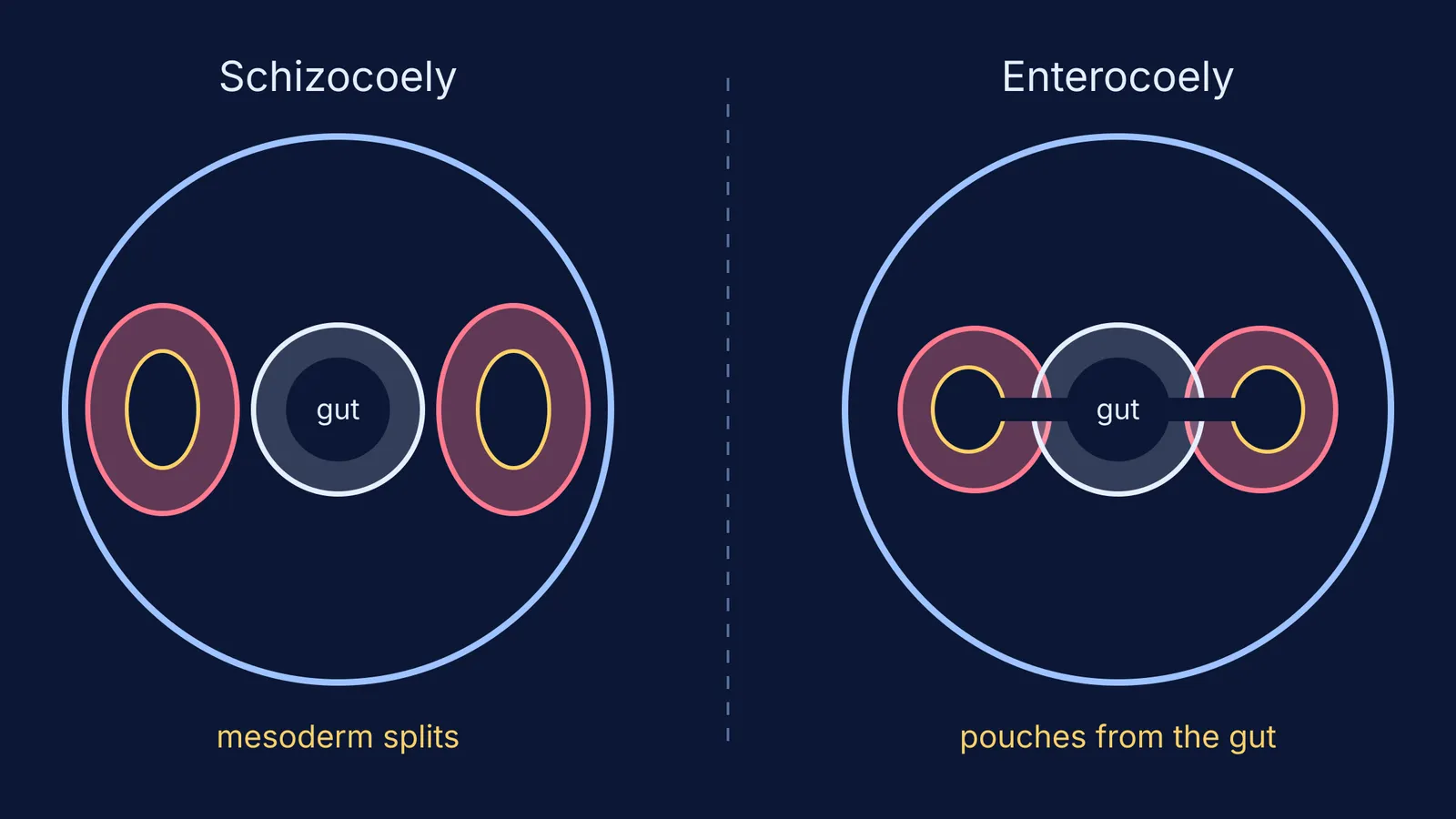
In schizocoely, specific early cells (blastomeres) become mesoderm, move into the interior of the embryo and form two clumps of mesodermal tissue; cavities then develop within each clump and merge to make the coelom (OpenStax Biology 2e). "Schizo" means split, so think of the coelom as a split inside solid mesoderm.
OpenStax says this is how the coelom of most protostomes forms, and it lists arthropods, molluscs and annelids as protostomes. So the standard schizocoelomate examples are:
Annelids: earthworms and leeches
Molluscs: snails and octopuses
Arthropods: cockroaches and prawns
How does an enterocoelom form?
In enterocoely, the mesoderm grows out as pouches pinched off from the endoderm of the developing gut; the pouches then fuse and expand to fill the space between the gut and the body wall (OpenStax Biology 2e). "Entero" means gut, so the coelom starts life as an outpocketing of the gut.
This is the deuterostome route. OpenStax notes that deuterostomes include chordates and also some simple-looking animals such as echinoderms. So the standard enterocoelomate examples are:
Echinoderms: starfish, sea urchins and sea cucumbers
Chordates: fish, frogs and humans
Why are echinoderms grouped with chordates?
A five-armed starfish looks nothing like a fish or a person, but its embryo tells a different story. OpenStax Biology 2e lists three linked differences between protostomes and deuterostomes:
Blastopore: in protostomes the mouth forms at the blastopore; in deuterostomes the anus forms there and the mouth forms at the other end of the gut.
Cleavage: protostomes show spiral, determinate cleavage; deuterostomes show radial, indeterminate cleavage.
Coelom: schizocoely in protostomes, enterocoely in deuterostomes.
Echinoderms sit on the deuterostome side of all three, alongside chordates. Molecular data fit this picture: a 2006 study in Nature by Sarah Bourlat and colleagues, using an alignment of more than 35,000 amino acids from across the deuterostomes, supported a group called Ambulacraria (echinoderms plus hemichordates) and found that the chordates form a single group (Bourlat et al., 2006). Our post on why echinoderms are grouped with chordates as deuterostomes goes further into the evidence.
One caution for curious readers: biology has exceptions. A 2012 study of the priapulid worm Priapulus caudatus, a protostome, found that its blastopore becomes the anus, a deuterostome pattern (Martín-Durán et al., 2012). OpenStax also says the link between the blastopore and the mouth remains under debate. For school exams, the textbook pairing above is still the one to learn.
How do you sort an animal in an exam?
Use this three-question check, in order:
Does it have a true coelom? If it is a flatworm (acoelomate) or a roundworm (pseudocoelomate), stop: it is neither schizocoelomate nor enterocoelomate.
Which phylum? Annelida, Mollusca or Arthropoda means schizocoelomate and protostome. Echinodermata or Chordata means enterocoelomate and deuterostome.
Do the partner features fit? Spiral cleavage or mouth-from-blastopore points to the schizocoelomate side; radial cleavage or anus-from-blastopore points to the enterocoelomate side.
Worked example: match earthworm, sea urchin, Ascaris and octopus to a coelom type. The earthworm is an annelid, so schizocoelom. The sea urchin is an echinoderm, so enterocoelom. Ascaris is a roundworm, so it has a pseudocoelom and no true coelom; this is the trap option. The octopus is a mollusc, so schizocoelom.
We explain that trap in full in why arthropods are coelomates despite a haemocoel. If words like blastopore and cleavage still feel loose, the Fermi Concept Library covers every concept in biology, each with its own lesson and its place in the map, so you can see how germ layers, cleavage and the coelom connect.


