

On this page
A starfish has no head, no backbone and five arms, and it isn't even a fish. Yet textbooks put echinoderms in the same group as chordates, including humans: the deuterostomes. The reason lies in the first stages of the embryo.
What does deuterostome mean?
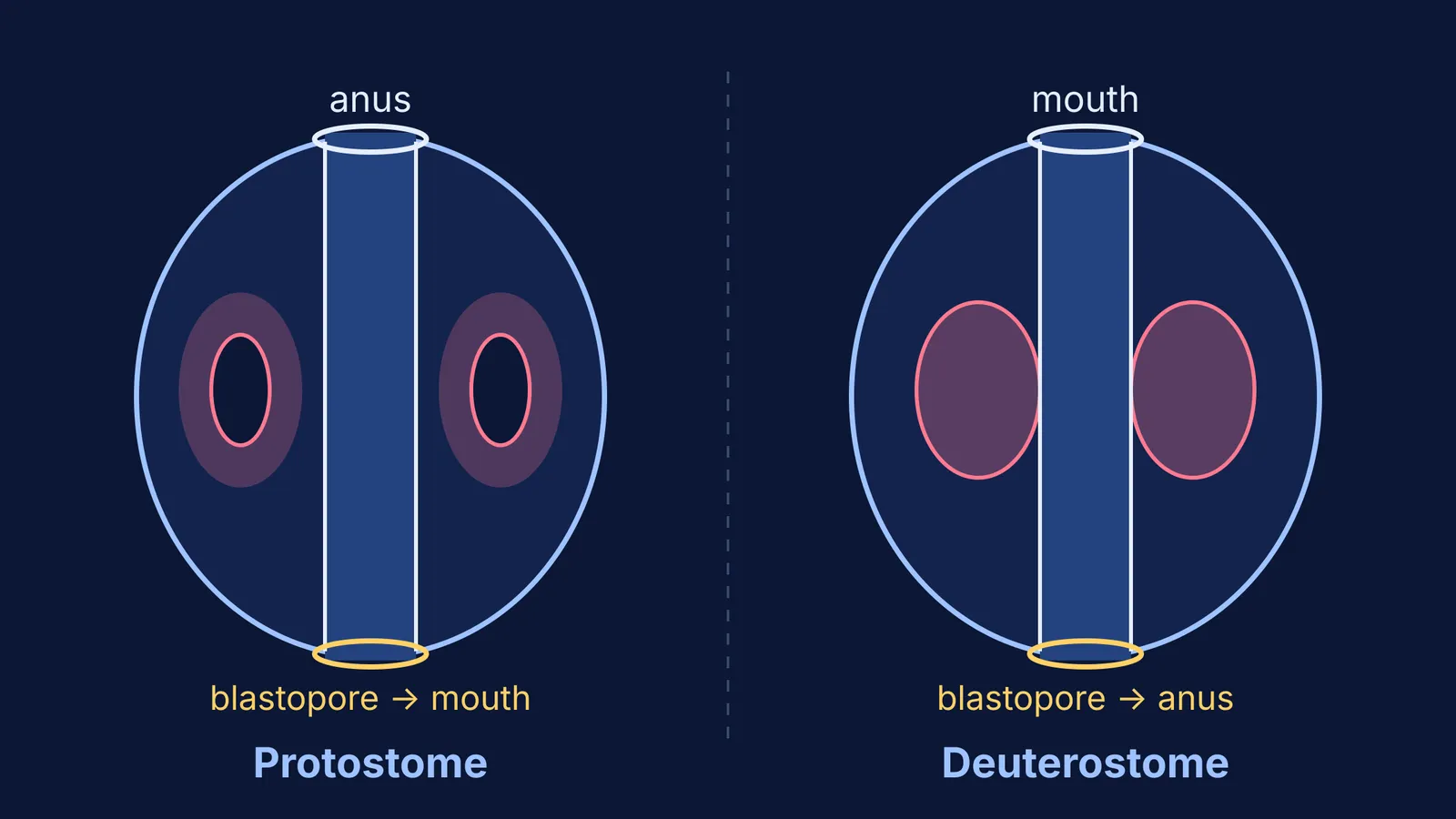
Early on, a ball of cells folds inwards to start the gut, opening to the outside through a hole called the blastopore. What that hole becomes is the main test. In deuterostomes, the anus develops at the blastopore and the mouth forms at the other end of the gut, as explained in OpenStax Biology 2e. In other words, the mouth comes second. In protostomes, the same source says, the mouth develops at the blastopore.
The second test is how the coelom (the main body cavity) forms. In deuterostomes, the mesoderm grows out as pouches pinched off from the gut lining, which is called enterocoely. In protostomes, cavities open up inside solid mesoderm and merge, which is called schizocoely (OpenStax). If you're not yet sure what counts as a coelom, start with our guide to acoelomate, pseudocoelomate and coelomate examples.
How do protostomes and deuterostomes differ?
Here are the tested features side by side, from the same OpenStax chapter:
Blastopore becomes: in protostomes, the mouth; in deuterostomes, the anus.
Cleavage pattern: protostomes show spiral cleavage, where cells at one pole sit rotated out of line with those at the other. Deuterostomes show radial cleavage, where the cells line up directly above one another.
Fate of early cells: in protostomes it is determinate, meaning each cell's fate is already fixed. In deuterostomes it is indeterminate, meaning early cells are not yet committed.
Coelom formation: schizocoely in most protostomes; enterocoely in deuterostomes.
Examples: protostomes include arthropods, molluscs and annelids. Deuterostomes include echinoderms and chordates.
Why are echinoderms closely related to chordates?
Three kinds of evidence point the same way.
The embryo. Echinoderms share the deuterostome pattern with chordates: blastopore to anus, radial and indeterminate cleavage, and an enterocoelous coelom.
The larva. The early larvae of all echinoderms have bilateral symmetry, and the five-part (pentaradial) symmetry appears only in adults, according to OpenStax Biology 2e. So the star shape develops later in life; it is not a sign of kinship with radially symmetric animals such as jellyfish.
The genes. A 2006 study in Nature by Bourlat and colleagues compared more than 35,000 aligned amino acids, including new data from a starfish and a hemichordate (Bourlat et al., 2006). It supported a group called Ambulacraria (hemichordates plus echinoderms) and concluded that chordates form a single natural group.
Today's textbook picture splits the deuterostomes into two major clades, Chordata and Ambulacraria (OpenStax). So a starfish is a cousin of yours through a shared ancestor, not an ancestor of yours. Within Ambulacraria, its fellow members are the hemichordates, which is why Balanoglossus is not counted as a chordate.
Is the blastopore rule ever broken?
Yes. In the priapulid worm *Priapulus caudatus*, a protostome, the blastopore gives rise to the anus, so its gastrulation follows a deuterostome pattern (Martín-Durán et al., 2012, Current Biology). The same paper notes that blastopore fate varies across protostome groups.
A 2021 analysis of several independent gene datasets found strong support for the protostomes as a group, but only equivocal support for the deuterostomes (Kapli et al., 2021, Science Advances). In other words, chordates and the echinoderm-hemichordate group may not be each other's closest relatives after all. The authors suggest that the common ancestor of bilateral animals may have been deuterostome-like. If so, "blastopore becomes anus" could be an old trait that echinoderms and chordates both kept, not a new one that marks them as close cousins. For exams, the textbook answer still stands; the debate is about what the shared pattern means, not the pattern itself.
How do you answer this in an exam?
Here is a worked assertion-reason example.
Assertion: Echinoderms are grouped with chordates rather than with arthropods.
Reason: In echinoderms, the blastopore develops into the mouth.
Echinoderms are deuterostomes, so the assertion is true. In deuterostomes the blastopore becomes the anus, so the reason is false; mouth-from-blastopore is the protostome pattern, which is the trap. Answer: assertion true, reason false.
For a three-mark "why" question, make sure your answer covers these points:
Both groups are deuterostomes.
The blastopore becomes the anus, and the mouth forms second.
The coelom is enterocoelous, and cleavage is radial and indeterminate.
Echinoderm larvae are bilaterally symmetric.
Molecular data place echinoderms in Ambulacraria, which textbooks treat as one of the two deuterostome clades alongside Chordata.
If one link in that chain feels shaky, the Fermi Concept Library covers every concept in biology, each with its own lesson and its place in the map, so you can see how embryology connects to classification.
Next time you see a starfish, remember that its embryo, like yours, made the anus first.


