

On this page
For decades, biology students were taught that *Balanoglossus*—a burrowing, ocean-dwelling acorn worm—was a primitive member of our own phylum, Chordata. These worm-shaped marine animals spend their lives hiding in shallow sand burrows along warm coasts. They possess gill slits and a dorsal nerve cord, which are key hallmarks of the chordate family tree. However, the true biological debate centered on a small, rigid tubular structure in the worm's head called the stomochord.
Biologists once believed this stomochord was a rudimentary notochord, the defining feature of all chordates from fish to humans. Today, we know better. Through advanced microscopy and genetic testing, *Balanoglossus* has been evicted from Chordata and placed in its own non-chordate phylum, Hemichordata. Here is exactly why the stomochord lost its status, and how you should classify these unique animals today.
What is a stomochord?
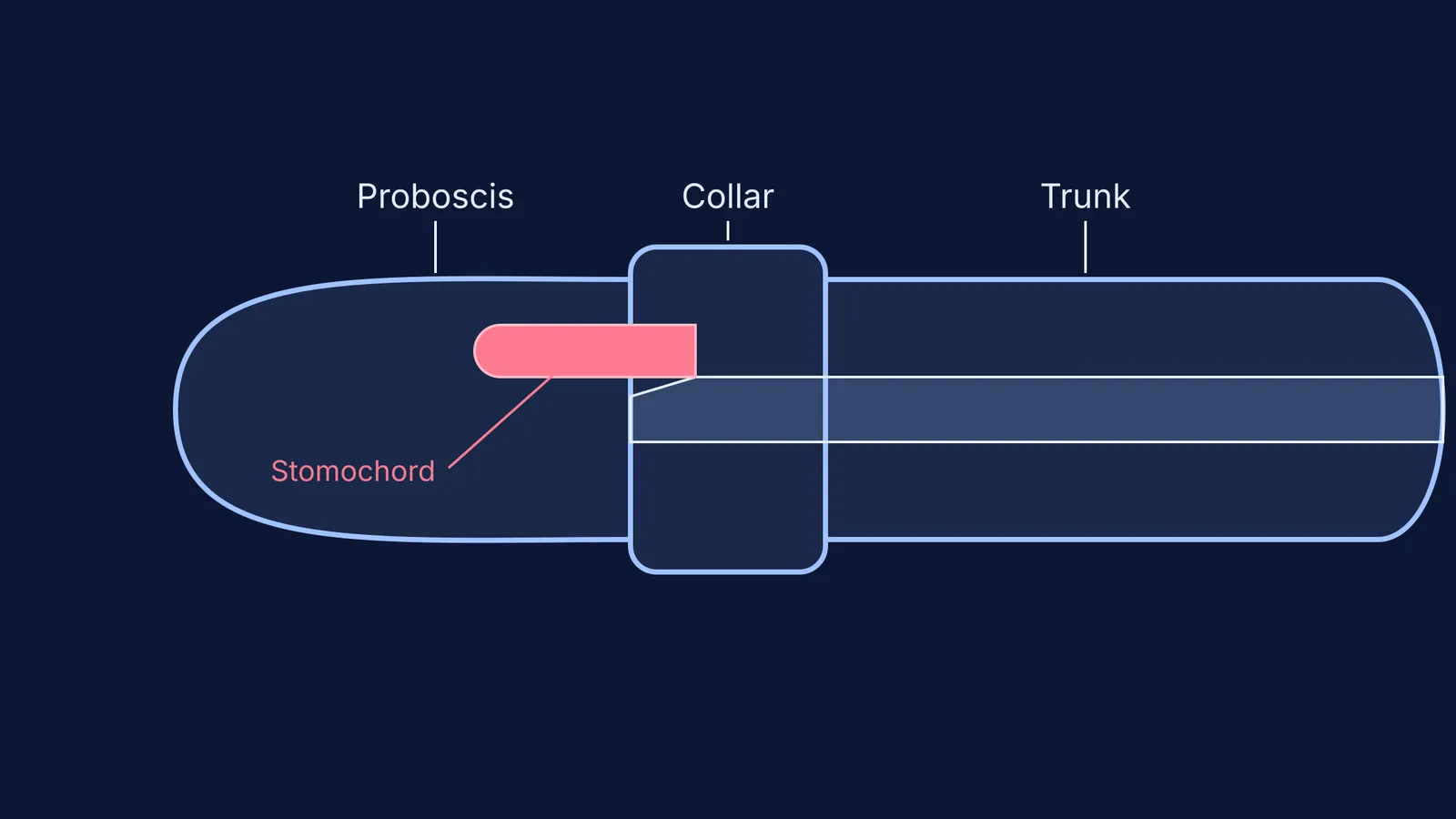
The stomochord is a flexible, hollow tube found exclusively in hemichordates. It begins its development as an outpocketing from the roof of the embryonic gut, right in front of the pharynx. In an adult acorn worm, whose head is typically between 2.5 mm and 5 mm wide (Wikipedia), this tube extends forward from the buccal cavity (the mouth region inside the short collar) into the base of the conical proboscis.
Because it originates directly from the digestive tract, anatomists also accurately call it a "buccal diverticulum." It provides crucial structural support to the worm's front end, acting almost like a skeletal rod that helps the proboscis stay firm as the animal pushes and burrows through dense ocean sand.
If you are struggling to picture where the stomochord sits internally compared to a true notochord, Fermi's AI tutor can draw the figure and check your understanding as it goes, ensuring you never mix up the anatomy.
Why was Balanoglossus called a chordate?
To belong to the phylum Chordata, an animal must clearly demonstrate three defining biological features at some stage in its life cycle: a dorsal hollow nerve cord, pharyngeal gill slits, and a solid notochord.
*Balanoglossus* clearly has gill slits, which it relies on to filter tiny food particles from the surrounding seawater. It also possesses a nerve cord running along its back. When the British biologist William Bateson studied the acorn worm extensively in 1885, he noticed the rigid stomochord tube supporting the proboscis and concluded it was a primitive notochord.
Based directly on Bateson's anatomical work, hemichordates were officially classified as a sub-phylum of Chordata. This grouping persisted unquestioned for decades in textbooks worldwide, lumping acorn worms into the same broad category as fish, amphibians, birds, and mammals. Much like how viruses, viroids and lichens break the traditional rules of the five-kingdom biological system, *Balanoglossus* blurred the evolutionary lines between invertebrates and vertebrates.
Why is Balanoglossus not a chordate?
The evolutionary relationship completely fell apart when biologists looked closer at the cellular histology and the genetic makeup of the stomochord structure.
First, a true chordate notochord is a completely solid cellular rod surrounded by a thick, robust fibrous sheath made largely of collagen. The stomochord, by contrast, is completely hollow, entirely lacks this characteristic fibrous sheath, and contains no collagen whatsoever in its cellular walls.
Second, modern gene expression studies dismantled the evolutionary link at the molecular level. The *Brachyury* (T) gene is the undisputed master regulator required for building a notochord in all true chordates. A 1999 molecular study on hemichordate embryos conclusively proved that *Brachyury* is completely unexpressed in the stomochord during any stage of development (Development, 1999). The genetic blueprints simply do not match.
Recognizing these fundamental anatomical differences, the invertebrate zoologist Libbie Hyman formally removed them from Chordata in 1959, placing them in an independent non-chordate phylum (The Invertebrates, 1959). Just as chemistry students now learn why zinc, cadmium and mercury are not called transition elements due to their filled d-orbitals, biology students learn that *Balanoglossus* was demoted due to its lack of a true notochord.
How do you classify hemichordates for the exam?
In Class 11 Biology and competitive medical entrance exams like NEET-UG, multiple-choice questions frequently target this exact historical classification change. Examiners love to test whether you know that Hemichordata is no longer a sub-phylum of Chordata.
Here is a quick, practical classification checklist for *Balanoglossus* to use in your final exam revision:
Phylum: Hemichordata (strictly a non-chordate phylum).
Body structure: A cylindrical body divided into an anterior proboscis, a short collar, and a long trunk.
Stomochord: A rudimentary outpocketing (buccal diverticulum) in the collar region, entirely lacking true notochord histology.
Circulatory system: Open type circulation.
Respiration: Occurs exclusively through pharyngeal gills.
Excretion: Driven by the proboscis gland.
When you encounter biological exceptions and historical corrections like this, memorising them by rote reading can be incredibly frustrating. The Fermi Concept Library connects these classification shifts directly to their evolutionary history, making the underlying reasons highly intuitive to remember for test day.


