

On this page
NCERT Class 11 Biology lists arthropods and molluscs as coelomates, yet their blood fills a cavity that bathes the organs directly. The two facts only look like they clash: "coelomate" is about how a cavity forms and what lines it, not what fills it or how big it is.
What makes an animal a coelomate?
NCERT defines it in one line: "The body cavity, which is lined by mesoderm is called coelom," and animals that have one are coelomates, for example annelids, molluscs, arthropods, echinoderms, hemichordates and chordates (NCERT Class 11 Biology, Chapter 4). The same chapter calls a cavity with mesoderm only as scattered pouches a pseudocoelom (aschelminthes), and animals with no body cavity acoelomates (platyhelminthes).
A university textbook adds the developmental detail: a true coelom "arises entirely within the mesoderm germ layer and is lined by an epithelial membrane" (OpenStax Biology 2e, section 27.2).
Where is the coelom in an arthropod?
OpenStax describes arthropods as eucoelomate (true-coelom) animals whose body has "a central cavity, called the hemocoel (or blood cavity)" (OpenStax Biology 2e, section 28.6). NCERT agrees on both counts: arthropods are coelomate, and their circulatory system "is of open type" (NCERT Class 11 Biology, Chapter 4).
So where did the coelom go? Describing the pill bug, a common land crustacean, zoologist Richard Fox writes that "the coelom is reduced to small spaces associated with the gonads and kidney," while "the functional body cavity is a spacious hemocoel" (Invertebrate Anatomy OnLine, Lander University).
Embryos show how the switch can happen. Georg Mayer, Hilke Ruhberg and Thomas Bartolomaeus followed the coelom through the embryos of a velvet worm, a close relative of arthropods, and found that the embryonic coelomic cavities fuse with spaces of the primary body cavity to form a mixed cavity, the "mixocoel" (Acta Zoologica, 2004). Their findings support the idea that this mixed cavity was already present in the common ancestor of velvet worms and arthropods.
The haemocoel, then, is not a giant coelom. It is a different space, built largely from the primary body cavity, that became the main body cavity, while the true coelom lives on in small pockets. For the colour of that blood, see why insect blood is colourless.
Where is the coelom in a mollusc?
Around the heart. In molluscs, "the coelomic cavity in adult animals has been largely reduced to a cavity around the heart," and blood from the heart is sent to the rest of the body "in a hemocoel", an open circulation (OpenStax Biology 2e, section 28.4). The same source notes an exception: cephalopods such as the octopus and squid have a closed circulatory system. So a snail's coelom is the small space around its heart, and that is enough.
How do coelom, pseudocoelom and haemocoel compare?
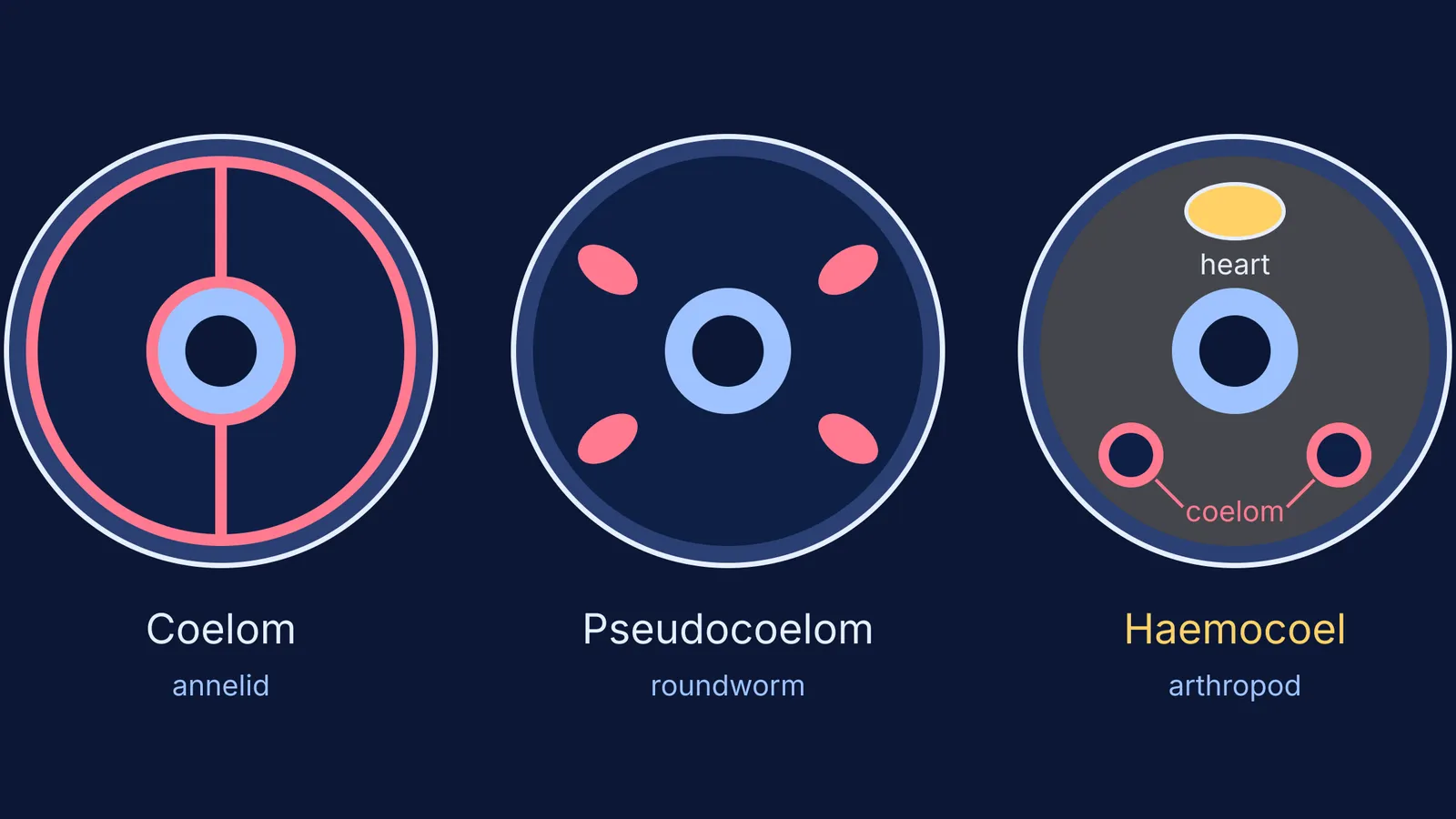
Coelom (true body cavity): forms within the mesoderm and is lined by mesoderm. It is the main body cavity in annelids and chordates, and is reduced to small pockets in arthropods (around the gonads and excretory organs) and molluscs (around the heart).
Pseudocoelom (false body cavity): not lined by mesoderm; NCERT describes the mesoderm as scattered pouches between ectoderm and endoderm. Found in aschelminthes, such as roundworms.
Haemocoel (blood cavity): part of an open circulatory system, where blood is pumped out of the heart and the cells and tissues "are directly bathed in it" (NCERT). It is the main body cavity in arthropods and most molluscs, and it does not change the label: the animal is still a coelomate because a true coelom is present elsewhere.
For more examples of each cavity type across the phyla, see our guide to coelom types with examples.
How do you write this answer in an exam?
A model answer in four points:
A coelom is a body cavity lined by mesoderm; animals that have one are coelomates.
Arthropods have a true coelom, but in adults it is reduced to small spaces, such as those around the gonads and excretory organs.
Their main body cavity is a haemocoel, a blood-filled space of the open circulatory system, which is not a true coelom.
Because a true coelom is present, though reduced, arthropods are coelomates. Molluscs follow the same logic: their coelom survives as the cavity around the heart.
Four traps to avoid:
"Open circulation means no coelom." False: NCERT lists hemichordates as coelomates with an open circulatory system too.
"Haemocoel is the same as pseudocoelom." False: NCERT classes arthropods as coelomates and keeps the pseudocoelomate label for aschelminthes.
"All molluscs have open circulation." False: cephalopods have closed circulation.
"Coelomate means the coelom is the biggest cavity." False: it only means a mesoderm-lined coelom is present.
If body-cavity terms keep blurring, the Fermi Concept Library gives every biology concept its own lesson and its place in the map. To test yourself, the Fermi Problem Library has worked problems with a step-by-step solver that explains the reasoning rather than printing an answer.
Then revise the rest of the chapter with our Class 11 Animal Kingdom notes.


