

On this page
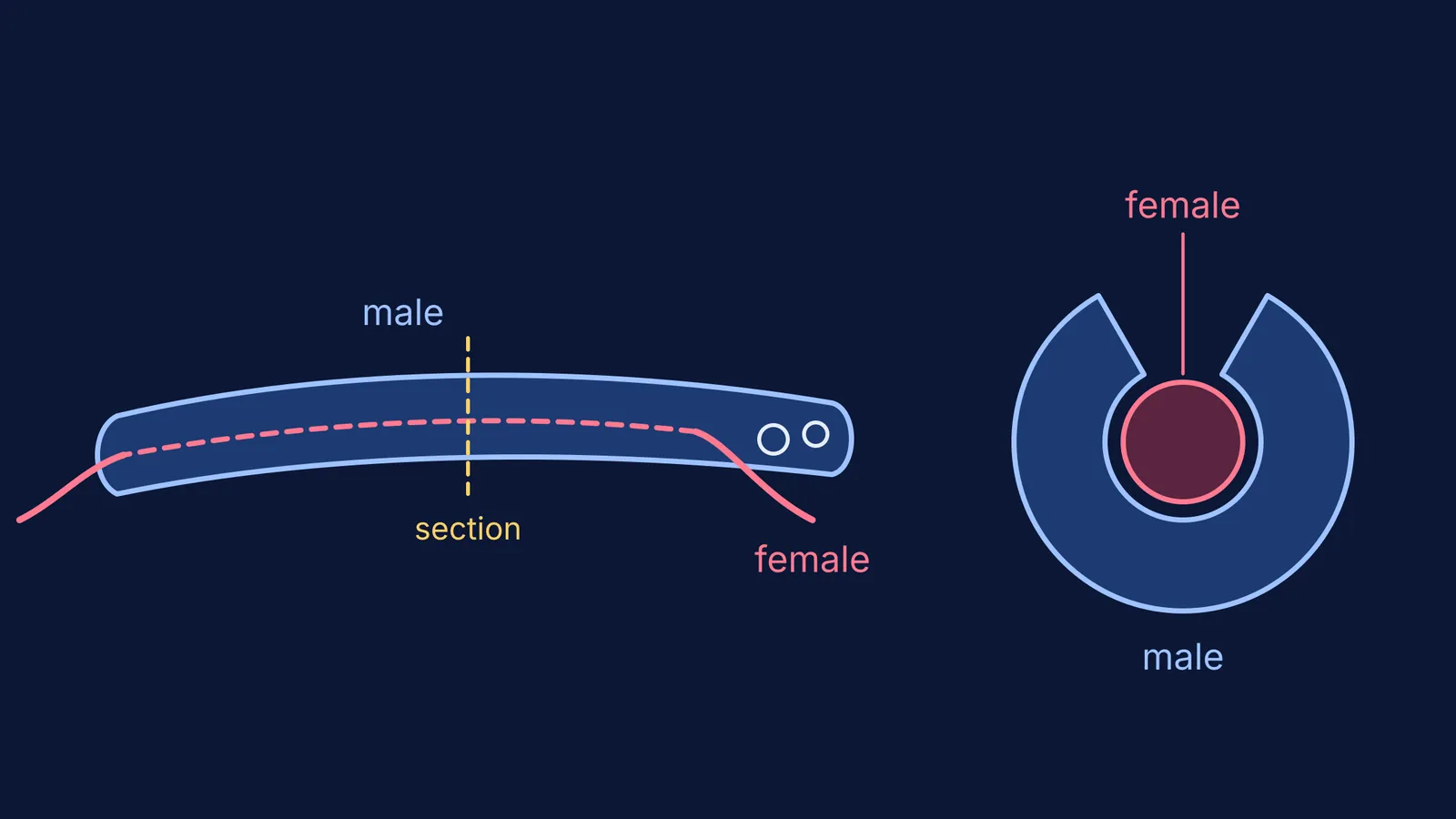
If you learned flatworms from NCERT, you learned one rule: they are hermaphrodites. The blood fluke *Schistosoma* breaks it. Its males and females are separate worms, and the adult female lives tucked into a groove along the male's body. That one fact makes it an easy trap to set in odd-one-out and statement questions, so it is worth ten minutes tonight.
Which flatworm has separate male and female sexes?
The NCERT Class 11 chapter on the animal kingdom sums up phylum Platyhelminthes with a line worth knowing by heart: "Sexes are not separate" (NCERT Biology Class 11, Chapter 4). Its examples are *Taenia* (tapeworm) and *Fasciola* (liver fluke).
*Schistosoma* is the exception. A 2019 review in Frontiers in Genetics by Zhigang Lu, Christoph Grevelding and colleagues states that "Schistosomes are the only platyhelminths that have evolved separate sexes" (Lu et al., 2019). Parasitologist Michelle Steinauer describes *Schistosoma mansoni* as "dioecious and sexually dimorphic": the two sexes are separate individuals, and they look different (Steinauer, 2009).
For why most flatworms carry both sets of sex organs in the first place, see our explainer on hermaphrodite animals, from sponges to tapeworms.
How does the female Schistosoma live inside the male?
The male's body forms a ventral groove called the gynaecophoric canal (also spelt gynecophoral canal). Steinauer describes it as the groove "in which females reside for maturation, mating and egg production" (Steinauer, 2009).
The partnership is not optional. "Females will not become sexually mature without male contact," Steinauer writes. Lu and colleagues add that this close pairing "can last over years, an exceptional phenomenon in nature" (Lu et al., 2019).
The pair lives in small veins. According to the US CDC, adults of *S. mansoni* and *S. japonicum* live in the mesenteric veins that drain the intestine, while *S. haematobium* most often lives in the venous plexus around the bladder (CDC DPDx: Schistosomiasis).
Why does this blood fluke matter outside the exam?
The World Health Organization defines schistosomiasis as "an acute and chronic parasitic disease caused by blood flukes (trematode worms)" (WHO fact sheet). WHO reports that at least 253.7 million people required preventive treatment for schistosomiasis in 2024. People become infected when larvae released by freshwater snails penetrate the skin during contact with infested water.
This post is about the biology. If you have a health question about a possible infection, ask a doctor. To compare *Schistosoma* with a hermaphroditic fluke, read our post on the liver fluke's life cycle and its two hosts.
How do NEET odd-one-out questions use the Schistosoma exception?
Odd-one-out questions reward a fixed method more than a good memory. Use these four steps:
Name the property the options are being judged on (habitat, symmetry, body cavity, sexes).
Write the textbook rule for that property.
Check each option against the rule.
Ask whether the question names a known exception.
Worked example: Which flatworm has separate sexes? (a) *Taenia* (b) *Fasciola* (c) *Planaria* (d) *Schistosoma*. All four are flatworms, so phylum is not the property. The property is sexes. The rule for Platyhelminthes is "sexes are not separate". *Schistosoma* is the named exception, so the answer is (d).
Now a harder one. True or false: "All flatworms are hermaphrodites." Strictly, it is false, because of *Schistosoma*. If a statement uses "all" and *Schistosoma* appears anywhere in the question, the exception is very likely the point being tested. If no exception is named, the NCERT generalisation is usually what the question expects, so read every option before you decide.
Here is a sexes map built from the same NCERT chapter:
Ctenophora: sexes are not separate.
Platyhelminthes: sexes are not separate; *Schistosoma* is the exception.
Aschelminthes: sexes are separate (dioecious), as in *Ascaris*; females are often longer than males.
Annelida: *Nereis* is dioecious, but earthworms and leeches are monoecious.
Notice the trap runs both ways. Flatworms are hermaphrodites with one exception, and annelids include both kinds. For more traps like this one, work through our list of animal kingdom NCERT exceptions and odd-one-out questions.
Where can you practise this?
If the sexes question keeps catching you, treat it as a concept gap. The Fermi Concept Library covers every concept in biology, each with its own lesson and its place in the map. For practice, the Fermi Problem Library has worked problems with a step-by-step solver that explains the reasoning rather than printing an answer.
Tonight, write the sexes map from memory, then check it against page 42 of the NCERT chapter.


