

On this page
If a biology question asks you to explain parasitism in flatworms, the liver fluke is the example worth knowing well. It shows almost every idea at once: a flattened body, suckers for holding on, a body that makes both eggs and sperm, and a life cycle that needs two very different hosts.
What kind of animal is the liver fluke?
Flatworms (phylum Platyhelminthes) are unsegmented, bilaterally symmetrical worms with no body cavity (acoelomate), according to the Animal Diversity Web at the University of Michigan. The same source notes that flatworms have no respiratory or circulatory system and exchange materials through the body wall. Flukes form the parasitic class Trematoda; tapeworms form a separate class, Cestoda.
The common liver fluke is Fasciola hepatica, and adults are hermaphroditic, capable of both cross- and self-fertilisation, as the Animal Diversity Web entry for Fasciola hepatica records. Adult flukes grow up to 30 mm long and 15 mm wide, according to the CDC's DPDx page on fascioliasis.
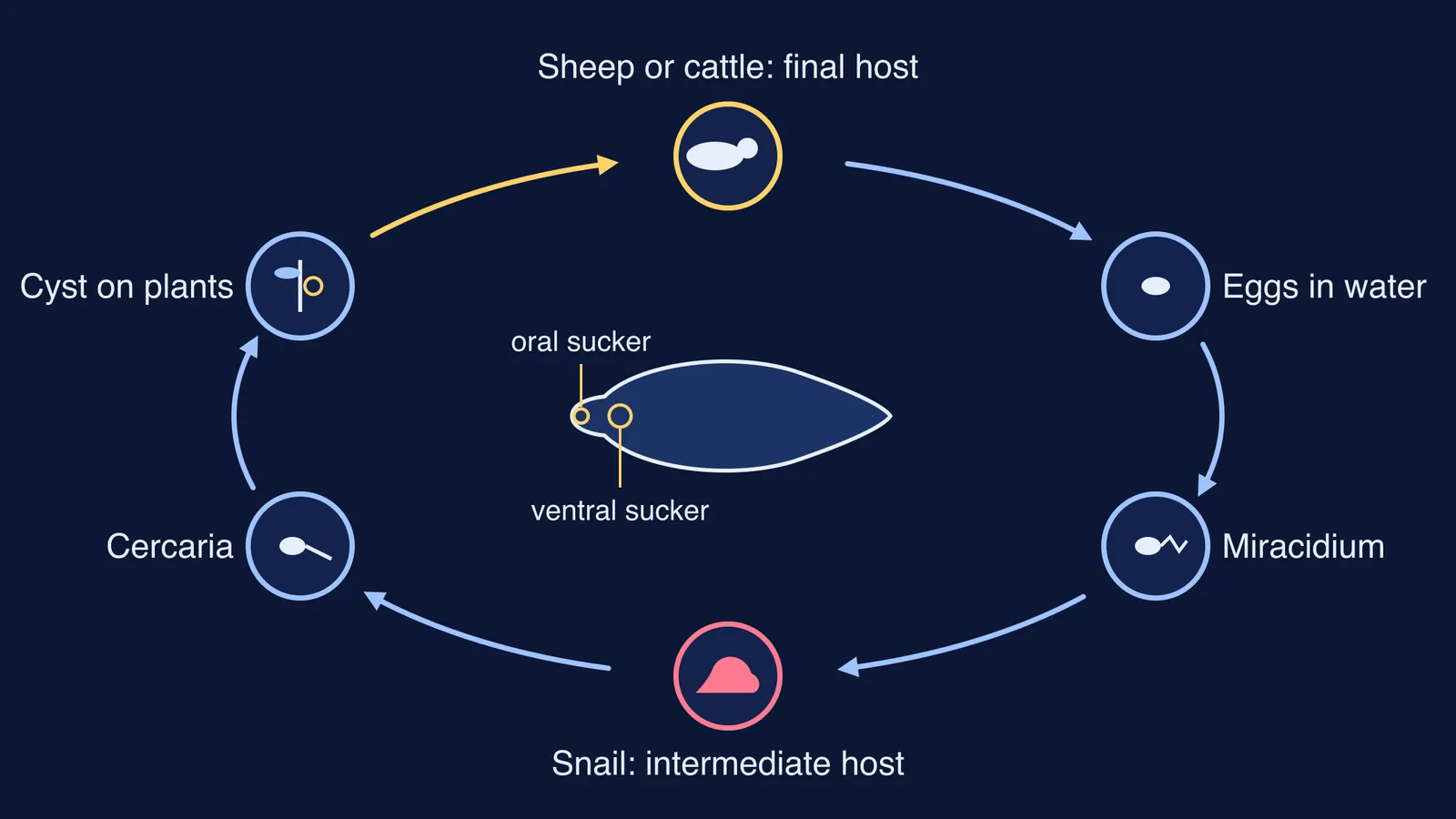
The suckers are the feature examiners like. In a 2012 scanning electron microscopy study of adult Fasciola gigantica60246-9), Massoud and colleagues described an apical cone at the front of the body with the oral sucker at its tip, and the ventral sucker on the underside, where the cone meets the main body.
What are the hosts in the liver fluke life cycle?
The definitive host, where adults live and reproduce, is a mammal: most commonly sheep, cattle and goats, and also humans, according to the CDC's life cycle description. The intermediate host is a freshwater lymnaeid snail, such as Lymnaea or Galba.
India has its own version of this story. The tropical species Fasciola gigantica is a major problem in livestock here, especially buffaloes, and a 2011 review in the Journal of Parasitic Diseases by Sharma, Godara and Thilagar describes the snail Lymnaea auricularia as its intermediate host. That review lists reported infection rates in Indian buffaloes of 25 to 100% in hill regions and 13 to 60% in the plains.
What are the stages of the liver fluke life cycle, step by step?
This sequence follows the CDC's DPDx life cycle:
Adult flukes in the bile ducts release eggs, which pass out in the host's dung.
In fresh water, the eggs develop for about 2 weeks and hatch into swimming miracidia.
A miracidium enters a lymnaeid snail.
Inside the snail it passes through sporocyst and redia stages, multiplying as it goes, and ends as cercariae.
Cercariae leave the snail and encyst as metacercariae on water plants.
A mammal eats the plants. The young flukes break out in the small intestine, cross the gut wall, travel through the liver and settle in the bile ducts. In humans this takes about 3 to 4 months.
Unlike the Chinese liver fluke Clonorchis, which also needs a fish, Fasciola does not require a second intermediate host and reaches people through contaminated freshwater plants, as the WHO fact sheet on foodborne trematode infections explains. The CDC's liver fluke page names raw watercress and other freshwater plants as the usual route.
How do you remember the stages for an exam?
The order is egg, miracidium, sporocyst, redia, cercaria, metacercaria. Try the line "Every Monday, Snails Rarely Carry Mangoes" (E, M, S, R, C, M), then attach a place to each word:
Egg: in dung, then water
Miracidium: swimming, looking for a snail
Sporocyst and redia: inside the snail, multiplying
Cercaria: leaving the snail
Metacercaria: cyst on a plant, waiting to be eaten
A worked example. Question: "Why does the liver fluke need a snail?" A strong three-line answer: the snail is the intermediate host; inside it the larvae multiply through sporocyst and redia stages, so one egg gives many cercariae; this raises the chance that some cysts reach a grazing mammal.
If the jump from body plan to life cycle still feels shaky, the Fermi Concept Library gives every biology concept its own lesson and its place in the map, so you can see where flatworms fit before you memorise examples. For practice, the Fermi Problem Library has worked problems with a step-by-step solver that explains the reasoning rather than printing an answer.
Where does this fit with other flatworm topics?
The liver fluke pairs naturally with the tapeworm, which shows a different set of parasite adaptations; read our post on how the tapeworm is adapted to life as a parasite. For excretion and water balance, see how flame cells work in planaria and other flatworms, and for the bigger picture, our guide to the animal kingdom chapter for NEET.
Next time you revise, draw the cycle from memory once, then check it against the six steps above.


