

On this page
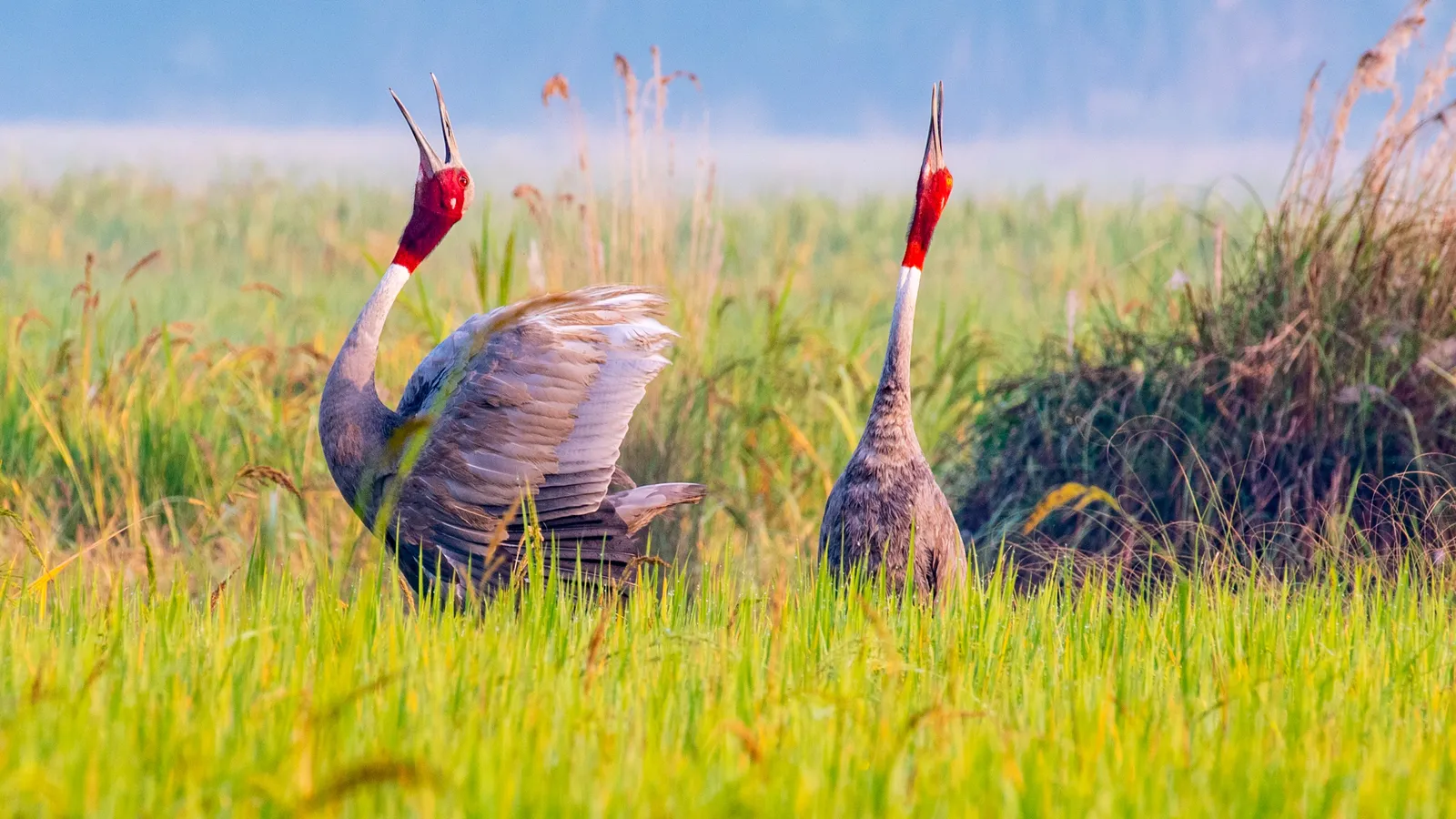
Walk past a flooded rice field in Etawah or Mainpuri in Uttar Pradesh and you may see two grey cranes with red heads, standing side by side. Soon they throw their heads back and call together. Sarus cranes are known for staying with one partner for years, and the likely reasons come down to how hard it is to raise a chick in farmland.
Do sarus cranes really mate for life?
Mostly, yes. The International Crane Foundation's Field Guide to Crane Behavior says that once paired, two cranes will normally remain together for life.
Scientists also add a caution. The Animal Diversity Web account of the sarus crane notes that the mate-for-life idea has been suggested but has little research behind it.
Fieldwork in India then found something new. Between 2013 and 2020, K. S. Gopi Sundar, Swati Kittur and Suhridam Roy of the Nature Conservation Foundation recorded 11,591 sarus crane groups, of which 193 were trios: three adults living and breeding together (Roy, Kittur and Sundar, Ecology, 2022; Mongabay India report). Trios are rare, so the pair is still the normal unit, but "for life" is a strong tendency, not a fixed rule.
Why do sarus cranes call in duets?
The duet is called the unison call. In the crane behaviour guide, it is performed by a mated pair to defend territory and reinforce the pair bond, and the male and female each use a different posture and series of calls (International Crane Foundation).
Suhridam Roy and K. S. Gopi Sundar studied these duets in the wild in Gujarat, Haryana and Uttar Pradesh (Roy and Sundar, Bioacoustics, 2025). According to Mongabay India's report on the study:
They analysed 215 duet recordings from 136 breeding pairs.
A full duet lasts about 15 seconds and has three parts: an introduction, a trill and a main section.
The female usually starts, calling more often with shorter, higher notes.
The male gives fewer, longer, lower notes and spreads and bobs his wings.
Roy's doctoral project at the Nature Conservation Foundation adds that duet coordination signals pair quality, and that duets were more coordinated at sites with more cranes.
Why do sarus cranes dance?
The International Crane Foundation guide describes crane dancing as bowing, arching, stick-tossing and jumping. Young cranes may dance to socialise, choose a mate or relieve tension. Dances often include threat displays, because pairing is stressful for these aggressive birds.
How does a pair bond help raise chicks?
Raising a crane chick takes months of work. The same crane behaviour guide describes the jobs for cranes in general:
Both parents build the nest.
They take turns incubating in shifts of about two to four hours by day, and incubation lasts about 30 days in most species.
After hatching, parents feed the chick, and a parent keeps it warm under a wing.
A parent may lead a predator a safe distance away from the nest or chick, then return to the family.
The sarus crane's main breeding season falls in the rains, between June and September (Animal Diversity Web). Sundar's nest study in Etawah and Mainpuri found that eggs in rice paddies were as likely to hatch as eggs in natural wetlands (Sundar, The Condor, 2009). As Current Conservation's summary of that work explains, pairs there keep year-round territories and raise chicks inside them. Late broods survived less well in territories that were mostly paddy, likely because chicks that cannot yet fly when the crop is harvested are more exposed to predators. Most egg losses were caused by people, and nesting in fields works only because farmers tolerate the birds.
No study has tested exactly why sarus pairs stay together, but these findings suggest an answer: a pair that holds its territory all year and already works as a team can share the nesting, the chick care and the danger. For more on why these patches of water matter, read our explainer on why wetlands matter for birds and floods.
How can you watch a sarus pair yourself?
If you live near wetlands or paddy fields in Uttar Pradesh, Gujarat or Haryana, try this 20-minute watch. Stay on the road or bund, well away from any nest.
Count: two birds or three? Note any chick.
Duet: time it. Who starts? Which bird spreads its wings?
Dance: look for bows, jumps or tossed grass.
Guard: listen for one bird's single bugling call, which can warn a mate or chicks of danger.
Write one line: what you think each behaviour is for.
To compare with other animals, our posts on how birds learn to sing and innate vs learned behaviour use the same way of thinking. If ideas like territory, courtship or parental care feel fuzzy, the Fermi Concept Library gives each biology concept its own lesson and shows where it sits in the map.


