On this page
This guide explains three wetland services, water filtering, flood control and bird habitat, with the mechanism behind each and two Indian examples you can quote in an exam: Chilika in Odisha and Keoladeo in Rajasthan.
What counts as a wetland?
The Ramsar Convention defines wetlands as "areas of marsh, fen, peatland or water, whether natural or artificial, permanent or temporary, with water that is static or flowing, fresh, brackish or salt, including areas of marine water the depth of which at low tide does not exceed six metres", as quoted in an October 2026 Press Information Bureau backgrounder.
The same backgrounder says India had 103 Ramsar sites as of 15 October 2026, up from 26 in 2014. It sums up why: wetlands "store fresh water, recharge groundwater, buffer floods and sustain fisheries and farming".
How do wetlands filter water?
When a river spreads into a marsh, the water slows and drops the soil it was carrying. Plants and microbes take up dissolved nutrients, and in waterlogged, low-oxygen mud some bacteria turn nitrate into nitrogen gas.
A 2016 systematic review by Land and colleagues pooled data from 93 articles covering 203 created or restored wetlands, mostly in Europe and North America. Median removal rates were 93 g of total nitrogen and 1.2 g of total phosphorus per square metre per year, and median removal efficiencies were 37% of incoming nitrogen and 46% of incoming phosphorus. Removal depended strongly on how much was flowing in, and also on temperature and the wetland's area.
In India, the PIB list of Ramsar sites describes the East Kolkata Wetlands as supporting "wastewater-fed fisheries and agriculture".
Do wetlands really control floods?
The popular picture of a sponge is too simple. Bullock and Acreman (2003) gathered 439 statements from 169 studies worldwide. They found "only limited support" for the general model of flood control by wetlands, and said that support is "confined largely to floodplain wetlands". Earlier studies they cite had even identified some headwater wetlands as flood-generating areas.
So the careful statement is that the evidence for flood control is strongest for floodplain wetlands, which can store floodwater from the river. The PIB list describes Chennai's Pallikaranai Marsh as an "urban marsh; flood buffer and birds". For the coastal version of the same idea, see how mangroves protect coasts from cyclones and waves.
Why are Chilika and Keoladeo important for birds?
Both were named India's first Ramsar sites in 1981, according to the PIB backgrounder.
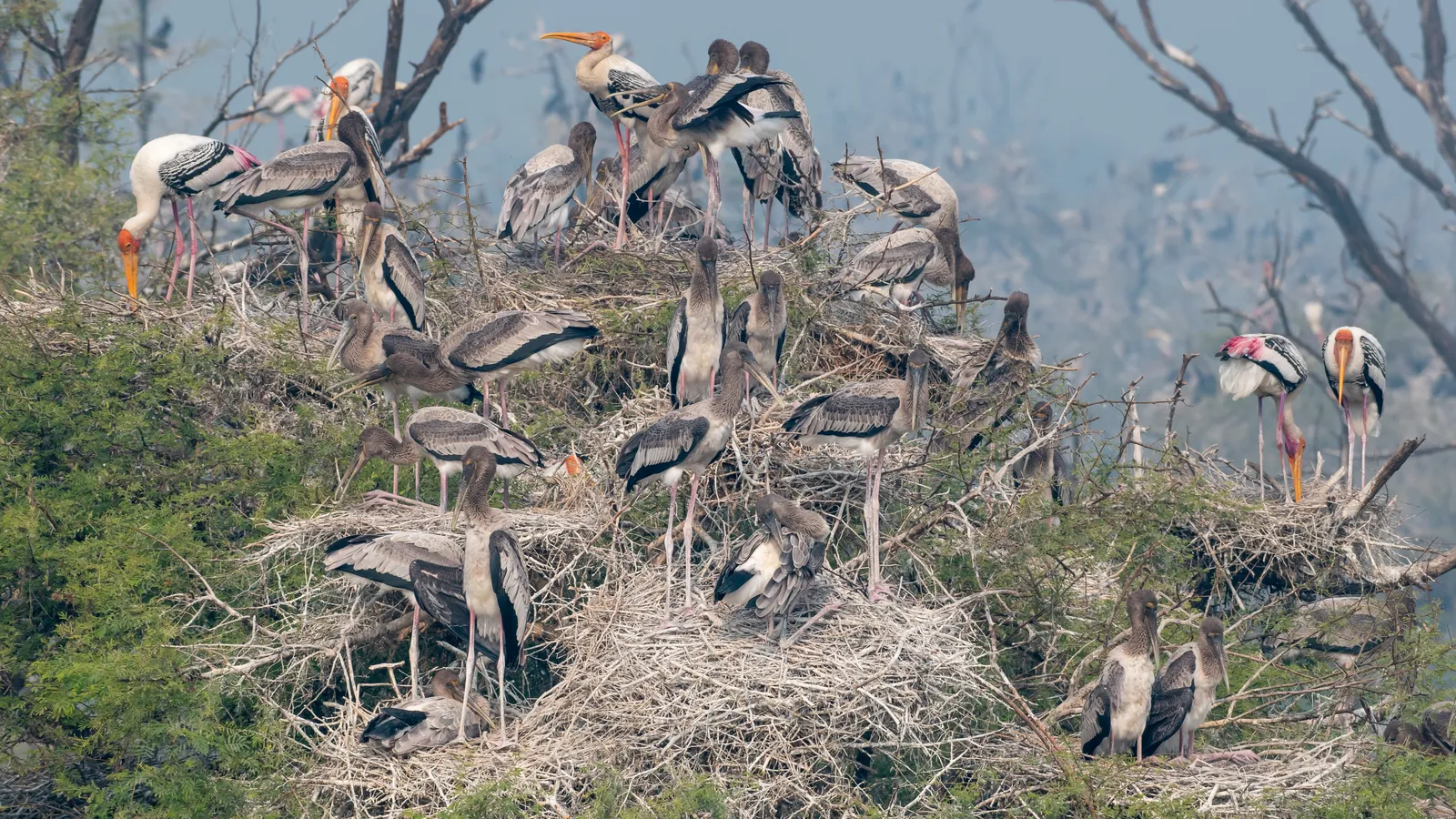
Chilika is Asia's largest brackish water lagoon, according to the Chilika Development Authority. The authority lists 228 bird species and 335 fish species, says the lagoon hosts over a million migratory waterfowl and shorebirds in winter, and says it supports about 0.2 million fisherfolk. It also shows that damage can be reversed: after restoration, Chilika was removed from the Montreux Record of threatened Ramsar sites in 2002, the PIB backgrounder notes.
Keoladeo, in Bharatpur, covers 2,873 hectares and has recorded about 375 bird species, according to the IUCN World Heritage Outlook. Its lesson is about water supply: the park depends on Ajan Bandh, the Chambal pipeline, the Govardhan drain and rain. It has long been reckoned to need at least 550 million cubic feet a year from outside, and its management plan now asks for more. The Siberian crane has not been seen there since 2002, a loss the IUCN links to threats along the birds' route rather than inside the park. Read why birds migrate to Indian wetlands.
Why are wetlands disappearing?
A review by Nick Davidson (2014) of 189 reports estimated that 64-71% of wetlands have been lost since 1900, and possibly as much as 87% since 1700. Loss has slowed in Europe but remained high in Asia. Part of the problem is that clean water and calmer floods carry no price tag, the same puzzle covered in ecosystem services of forests and why they are hard to price.
How do you write a full-marks answer on wetlands?
Use this four-step frame for any "importance of wetlands" question. Here it is for "Explain the importance of wetlands with Indian examples":
Define: areas of marsh or water, natural or artificial, fresh, brackish or salt (Ramsar Convention).
Service + mechanism + example: slow flow lets sediment settle and microbes remove nitrogen, limiting eutrophication (East Kolkata Wetlands); floodplain wetlands can store excess river water (Pallikaranai Marsh); Chilika hosts over a million migratory birds in winter (Chilika Development Authority).
Threat: Keoladeo depends on water piped and channelled in from outside.
Protection: Chilika was restored and removed from the Montreux Record in 2002.
If a mechanism such as denitrification or eutrophication is the weak spot, the Fermi Concept Library covers every concept in biology, each with its own lesson. For practice questions, the Fermi Problem Library has worked problems with a step-by-step solver that explains the reasoning rather than printing an answer.