

On this page
Most city water in India passes through a bed of sand that catches fine dirt the settling tanks miss. Over a day or two the sand clogs. The fix sounds odd: the plant stops filtering and pumps clean water upward through the bed. At one particular flow speed the whole sand bed lifts, the grains separate and rub each other clean, and the dirt washes out over the top. That speed comes straight from Class 11 fluids: buoyancy, weight and viscous flow through narrow gaps.
How does a rapid sand filter clean water, and why does it clog?
A rapid sand filter is a concrete box holding a bed of sand with water standing on top. Water flows down through the bed under gravity. The flow is described by the filtering rate, the volume filtered per square metre of bed per hour. TU Delft's granular filtration module gives rapid filtration rates of about 5 to 20 m/h.
The gaps between grains are narrow, so the flow through them is slow and smooth (laminar). The head lost across the bed is then proportional to the flow speed, which is Darcy's law, the same law Henry Darcy found for water moving through sand at Dijon. As dirt lodges in the gaps they get narrower and the head loss climbs. When it reaches the head the plant has available, the filter must be cleaned. An IIT lecture on NPTEL puts this maximum loss of head at 2 to 5 m.
What happens when you push water up through a sand bed?
Turn the flow round. At low upflow the grains still rest on one another, and the pressure drop across the bed grows in proportion to speed, as it did when filtering. Speed up the flow and the upward push on the grains grows until it equals their weight minus their buoyancy. Take a bed of depth L and area A with porosity ε (the fraction of the volume that is water). The solid volume is (1 − ε)AL, so its apparent weight in water is (1 − ε)AL(ρs − ρw)g, where ρs is the density of sand and ρw that of water. Divide by the area and you get the pressure drop at which the bed lifts:
Δp = (1 − ε)(ρs − ρw)gL
This is Archimedes' principle applied to a whole bed. For the single-object version, see Archimedes' principle numericals on loss of weight.
Why does the pressure drop stop rising once the sand lifts?
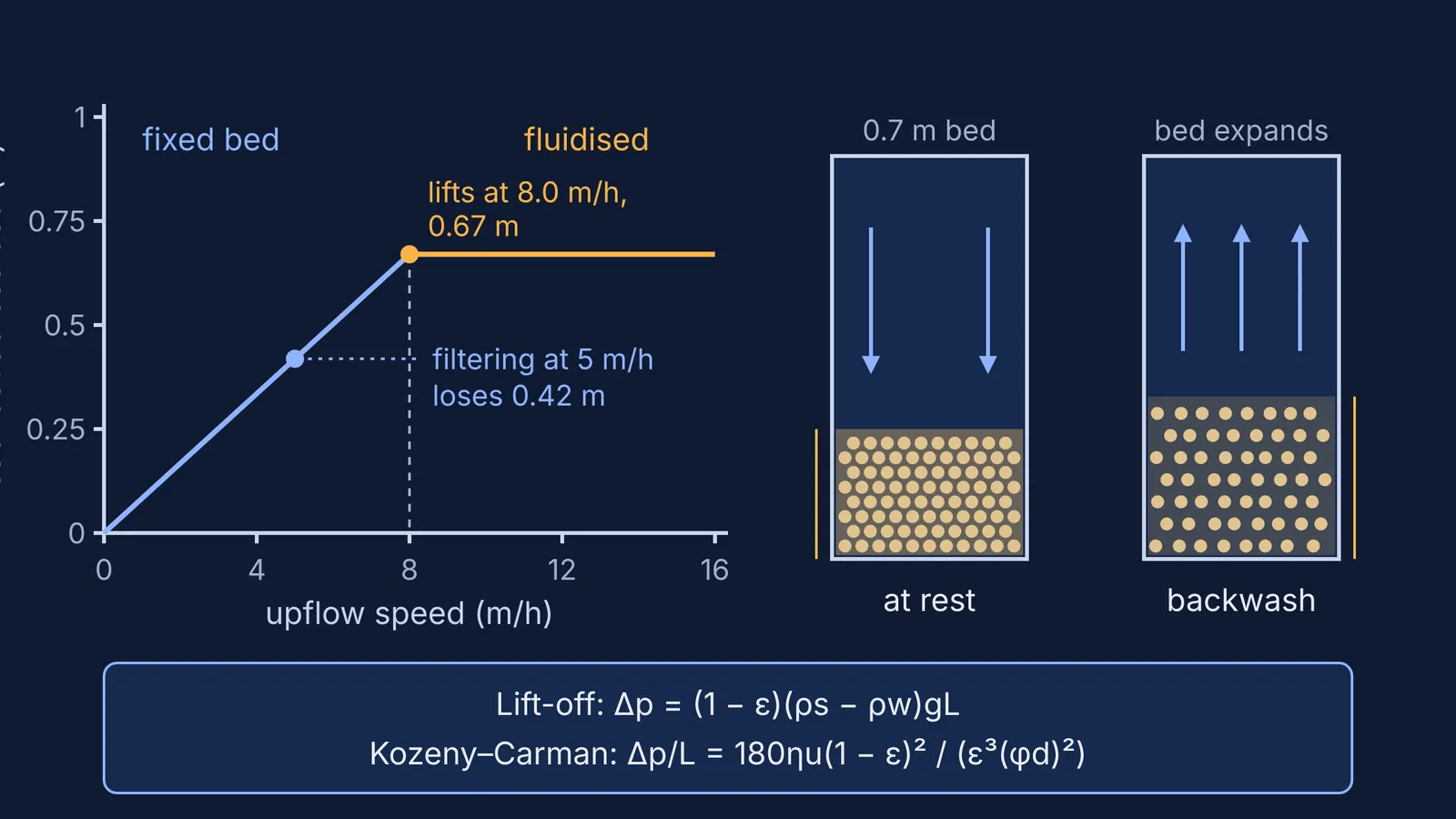
Once the bed lifts, it is fluidised: each grain hangs in the rising water, held up by drag. Push harder and the grains move apart: the bed expands until the drag again just balances the apparent weight. The total weight being held up has not changed, so the pressure drop stays at the same value however fast you pump.
The TU Delft module states the same condition: fluidisation occurs when the resistance equals the mass of the filter bed under water. For sand it notes that the maximum head loss is almost equal to the bed height. A 2020 laboratory study in the journal Water saw this directly: for 0.4 to 0.6 mm sand, the head loss stopped rising at the onset of expansion, at about 0.94 m of water per metre of bed.
How fast must the water flow to lift the sand?
You need the link between pressure drop and speed in the fixed bed. For slow flow through packed grains, the Kozeny–Carman law, as given in the TU Delft module, is:
Δp/L = 180ηu(1 − ε)² / (ε³(φd)²)
Here η is the viscosity of water, u the upflow speed (flow per unit area), d the grain size and φ a shape factor for grains that are not perfect spheres. The 180 and φ are fitted to experiments. Notice the d² at the bottom: halve the grain size and the same flow needs four times the pressure drop. This is the porous-bed cousin of the r⁴ law in Poiseuille flow through a narrow tube.
Worked example. A bed is 0.7 m deep with porosity 0.42. The sand has density 2,650 kg/m³, grains 0.55 mm across and shape factor 0.8. Water at 20 °C has η = 1.0 × 10⁻³ Pa s. The values are illustrative.
Apparent weight per area. Δp = (1 − 0.42) × (2,650 − 1,000) × 9.81 × 0.7 = 6,572 Pa.
As a head of water. h = Δp/(ρw g) = 6,572 / (1,000 × 9.81) = 0.67 m. The bed lifts when the upflow loses 0.67 m of head across it.
Pressure gradient. Δp/L = 6,572 / 0.7 = 9,388 Pa/m.
Rearrange Kozeny–Carman for u. u = (Δp/L) ε³(φd)² / (180η(1 − ε)²). With ε³ = 0.0741, φd = 0.44 mm so (φd)² = 1.94 × 10⁻⁷ m², and (1 − ε)² = 0.336: u = 9,388 × 0.0741 × 1.94 × 10⁻⁷ / (180 × 1.0 × 10⁻³ × 0.336) = 2.2 × 10⁻³ m/s.
Convert. 2.2 mm/s × 3,600 s/h = 8.0 m/h. This is the minimum fluidising speed.
Check the law applies. The Delft module says Kozeny–Carman holds when ud/(εν) is below 5. Here it is 2.2 × 10⁻³ × 0.55 × 10⁻³ / (0.42 × 1.0 × 10⁻⁶) = 2.9, so it does.
Clean bed while filtering. Pressure drop is proportional to speed below lift-off, so at a filtering rate of 5 m/h the clean bed loses 0.67 × 5/8.0 = 0.42 m.
Now warm the water to 30 °C, as in much of India. Viscosity falls to about 0.80 × 10⁻³ Pa s, so the same bed lifts at about 10 m/h. The lift-off head does not change, because it depends only on weights.
Why are real backwash rates much higher than the minimum?
Just lifting the bed does not clean it. The grains must spread out and tumble so the dirt is sheared off, so plants aim for a set bed expansion. The TU Delft module uses 15 to 20% for 0.8 mm grains and gives a table in which 20% expansion of 1 mm sand at 10 °C needs a backwash rate of about 30 m/h. The NPTEL lecture gives a rising wash water velocity of 0.5 to 1.0 m/min, which is 30 to 60 m/h. That is several times our 8 m/h minimum.
Too much flow carries sand out over the wash troughs. Fine sand is also hard to clean with water alone. Delft notes that below about 0.8 mm, backwashing is difficult, so air is blown up through the bed first or with the water to scrub the grains.
To practise rearranging formulas like Kozeny–Carman, the Fermi Problem Library has a step-by-step solver that explains the reasoning. The Concept Library covers buoyancy and viscosity.
Quick checklist
A sand filter clogs because dirt narrows the gaps and the head loss climbs.
Upflow lifts the bed when Δp = (1 − ε)(ρs − ρw)gL, the bed's weight minus its buoyancy per area.
After lift-off the pressure drop stays fixed; extra flow only expands the bed.
Kozeny–Carman gives the speed: Δp/L ∝ ηu/d², valid for slow flow.
Our 0.7 m bed lifts at 0.67 m of head and about 8 m/h at 20 °C.
Real backwash runs several times faster to expand the bed.


