

On this page
Heat water from below and the hot water rises. That is convection. A solar pond breaks this rule on purpose. Its bottom layer can sit near 80 °C while the surface stays close to air temperature, and the hot water never comes up. The trick is salt, and the physics is Class 11 density, buoyancy and conduction.
What is a salt-gradient solar pond?
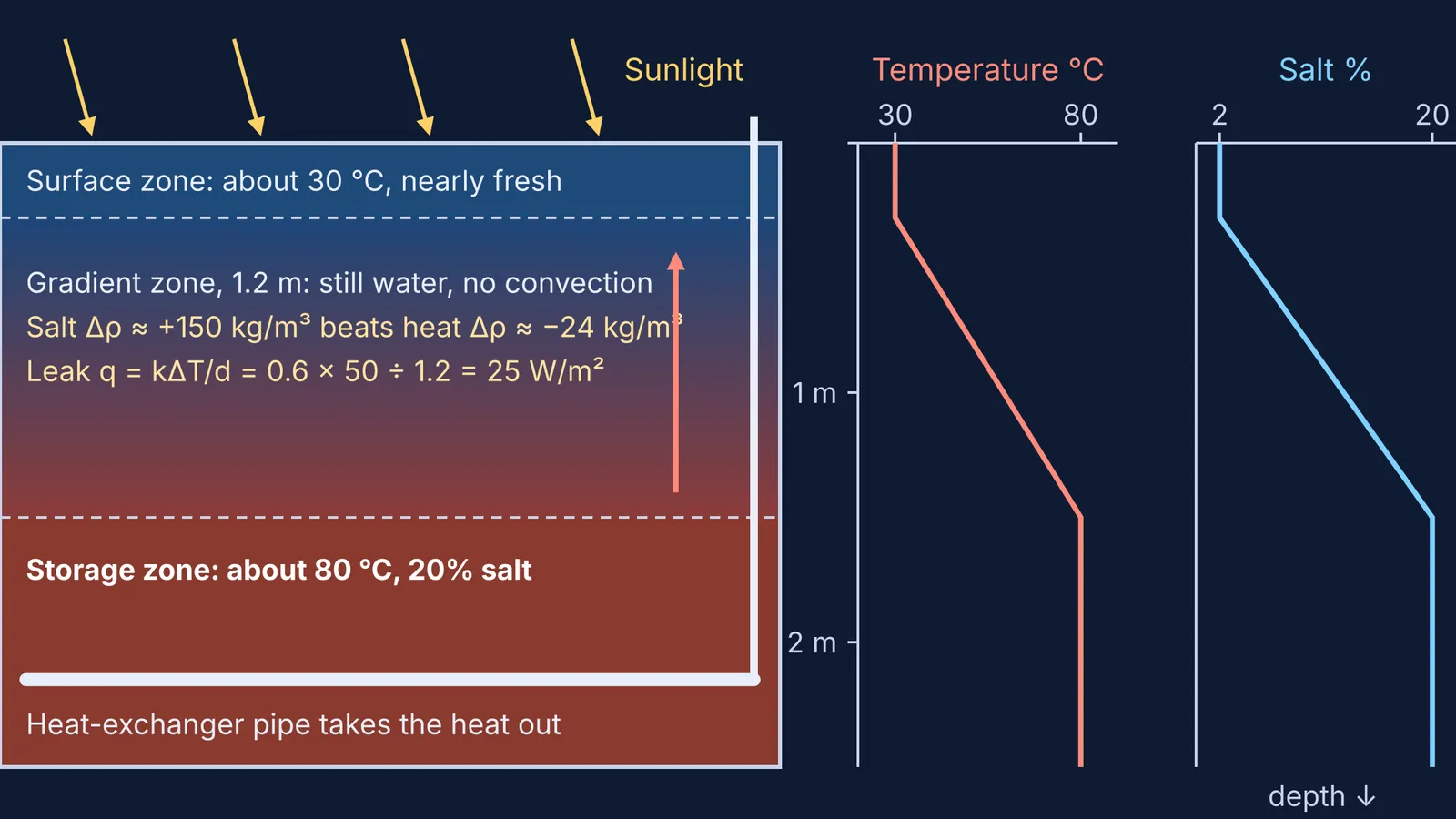
A salt-gradient solar pond is a pond, a few metres deep, filled with salt water in three layers.
Surface zone. A thin layer of nearly fresh water at the top, at about air temperature.
Gradient zone. A middle layer, often a metre or more thick, in which the salt concentration rises steadily with depth.
Storage zone. A bottom layer of very salty brine, around 20% salt by mass, where the heat collects.
Sunlight passes through the clear water and is absorbed at the dark bottom. In an ordinary pond the heated water would rise and lose its heat at the surface. In a solar pond it stays down, and a heat-exchanger pipe takes the heat out.
Why doesn't the hot water at the bottom rise?
Hot water rises only if it is less dense than the water above it. Heating makes water expand, but adding salt makes it far denser, and in a solar pond the salt effect wins easily.
Compare the two effects with round numbers.
Salt. Brine with 20% salt by mass has a density of about 1,150 kg/m³ (table of salt-solution densities, Simon Fraser University, from Kaye and Laby and the CRC Handbook). Nearly fresh surface water is close to 1,000 kg/m³. The salt makes the bottom about 150 kg/m³ denser.
Heat. Pure water is about 996 kg/m³ at 30 °C and about 972 kg/m³ at 80 °C (approximate standard table values). Heating by 50 K makes it only about 24 kg/m³ lighter.
So the salt adds about six times as much density as the heat takes away. Every layer is denser than the one above it, so a parcel of water that starts to move up is pushed back down. Convection stops.
How a temperature difference normally drives convection is shown in how convection currents form when a tank is heated from one corner. The solar pond is that experiment with the density gap reversed. If you want to watch warm and cold water move, the Simulation Lab has interactive simulations for ideas that are easier to see than read.
How does still water act as insulation?
With convection switched off, heat can leave the storage zone only by conduction up through the gradient zone. Water is a poor conductor, with a thermal conductivity k of about 0.6 W/(m K), so a thick layer of still water works like a blanket.
The heat leak through a layer of thickness d with a temperature difference ΔT across it is
q = kΔT/d
where q is the heat flow per square metre of pond in W/m². It is the steady-state conduction you use for a wall, applied to water.
Worked example: how much heat can a solar pond deliver?
All the numbers below are round illustrative values, chosen to show the method. They are not measurements from any real pond.
Take a pond of area 6,000 m². The surface zone is at 30 °C, the storage zone at 80 °C, and the gradient zone is 1.2 m thick.
Temperature difference across the gradient zone. ΔT = 80 − 30 = 50 K.
Conduction leak. q = kΔT/d = 0.6 × 50 ÷ 1.2 = 25 W/m².
Sunlight reaching the bottom. Assume the site averages 250 W/m² of sunshine over a day and night, and that a quarter of it gets through the water to the storage zone (much of the infrared is absorbed in the top few centimetres). That gives 250 × 0.25 = 62.5 W/m².
Heat available for use. 62.5 − 25 = 37.5 W/m², ignoring losses through the bottom and sides.
Whole pond. 37.5 × 6,000 = 225,000 W, or about 225 kW of heat.
Check the units. (W/(m K)) × K ÷ m = W/m², and W/m² × m² = W. Both steps are consistent.
Now halve the gradient zone to 0.6 m. The leak doubles to 0.6 × 50 ÷ 0.6 = 50 W/m², and only 12.5 W/m² is left for use, a third of what you had. If the gradient zone shrank to 0.48 m, the leak would equal the 62.5 W/m² arriving, and the pond could not hold 80 °C at all. That is why solar ponds are built with a thick gradient zone and why it must be protected.
How was the Bhuj solar pond used?
India built a demonstration pond at Bhuj in Kutch, Gujarat. According to the peer-reviewed account by A. Kumar and V. V. N. Kishore, Construction and operational experience of a 6000 m² solar pond at Kutch, India (Solar Energy, 1999), the pond had an area of 6,000 m² and was built on the premises of a milk processing plant, to show that the technology could work in India.
The same paper reports that:
the pond was lined with alternating layers of clay and low-density polyethylene, an inexpensive lining scheme
with no heat being drawn off, it reached 99.8 °C in May 1991, and a leak developed soon after
the liner was redesigned, the pond was re-established in June 1993, and it supplied hot water to the dairy from September 1993
The pond made hot water for a dairy, not electricity, which fits the physics. Heat collected at about 80 °C is low-grade. A heat engine working between 80 °C and 30 °C has a Carnot efficiency of only 1 − 303/353 ≈ 14%, and a real engine gets well below that. The same Carnot limit holds back the ocean thermal plants worked in why ocean thermal energy conversion is limited to a few per cent. Using the heat directly avoids that loss.
How is a solar pond different from a rooftop solar water heater?
A rooftop solar water heater absorbs sunlight on a dark panel and moves the heat into a separate insulated tank. A solar pond is both collector and store at once: the water absorbs the light, and the salt gradient does the insulating. Its large mass of hot brine keeps supplying heat at night and through cloudy days.
It also needs looking after. Wind, rain or careless pumping can mix the layers. Salt slowly diffuses upward, so operators add salt near the bottom and flush fresh water across the top to keep the gradient in place. Algae or dust in the water cut the sunlight reaching the bottom.
Quick checklist
Hot water rises only if it is less dense than the water above; in a solar pond the salt makes it denser.
Salt adds about 150 kg/m³ at the bottom; 50 K of heating removes only about 24 kg/m³.
No convection means heat escapes only by conduction: q = kΔT/d.
With k = 0.6 W/(m K), ΔT = 50 K and d = 1.2 m, the leak is 25 W/m²; halving d doubles it.
Heat at 80 °C is low-grade: a Carnot engine down to 30 °C gets at most 14%.
For more conduction and calorimetry problems worked step by step, try the Fermi Problem Library.


