

On this page
Many school notes say starch digestion happens in the mouth, stops in the stomach and resumes in the small intestine. The middle part is too neat. Salivary amylase switches off when acid reaches it, and acid takes time to soak into a mouthful of food.
Does salivary amylase work in the stomach?
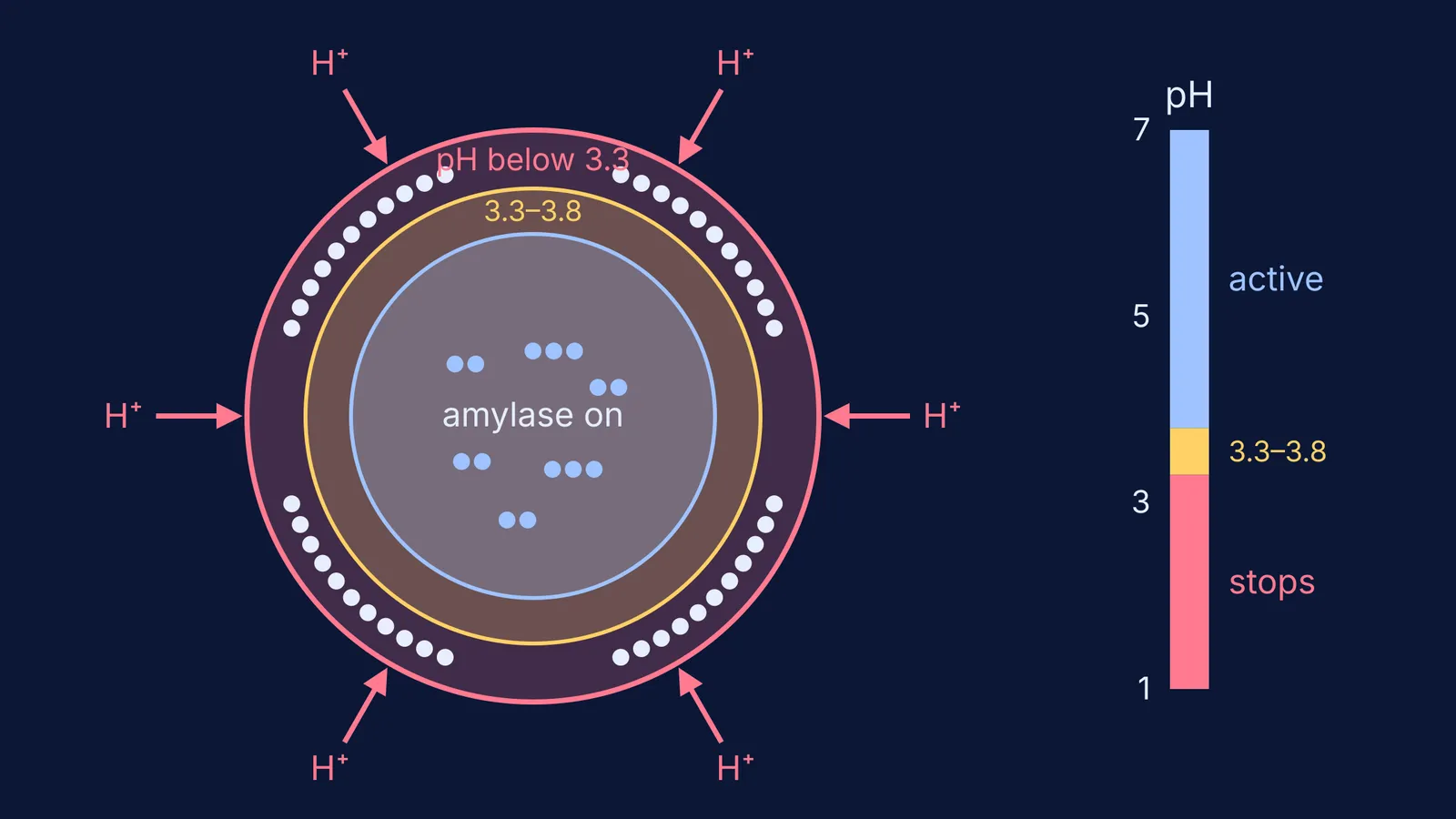
It does, until the acid catches up. In a 1987 study of six healthy volunteers, Fried, Abramson and Meyer found that salivary amylase was detected less often in gastric or jejunal samples as gastric pH fell below 3.0. In the same study, amylase mixed with gastric juice in a test tube was inactivated as the pH fell between 3.8 and 3.3.
Some of the enzyme even survives the stomach: salivary amylase made up 13.8% (mean) of the total amylase reaching the jejunum after liquid test meals (Fried et al., 1987). For the pH and temperature side of the story, see how pH and temperature change salivary amylase activity.
Why does acid stop amylase, and why not straight away?
Amylase is a protein, and strong acid disrupts its shape so it can no longer cut starch. The key word is reach. A swallowed bolus is a soft lump of food and saliva, and its outside meets gastric juice first. Its centre is still food mixed with saliva, not yet reached by the acid.
A review by Peyrot des Gachons and Breslin notes that once a bolus is infiltrated with gastric juice, amylase activity is mostly stopped by the low pH. Until then, the enzyme in the core keeps working. See our post on how long food stays in the stomach for how the stomach fills and empties.
How much starch does salivary amylase actually digest?
More than most textbooks suggest, at least in lab models. Using a dynamic model of the stomach, Freitas and colleagues (2018) found that saliva's amylase hydrolysed up to 80% of wheat bread starch in the first 30 minutes of gastric digestion. The curves nearly overlapped whether the model stomach acidified quickly or slowly.
A follow-up by Freitas and Le Feunteun (2019) compared foods. Before low gastric pH inactivated it, salivary amylase released about 80% of the starch in bread but about 30% of the starch in pasta, and it broke over half of that down to oligosaccharides.
Two cautions. These were lab systems, not measurements inside people, though the 2019 authors report good agreement with in vivo data. And digestion is partial: amylase cuts starch into maltose and other short chains, and other enzymes, including maltase, finish the job (Peyrot des Gachons and Breslin, 2016).
How do you trace one bite of bread?
Use this walk-through when a question asks where starch digestion happens.
Mouth: chewing mixes starch with saliva, and amylase starts cutting chains.
Swallow: the bolus carries saliva, and the enzyme, into the stomach.
Stomach: the outer layer acidifies first; amylase stops there, but keeps working in the core until acid soaks in.
Small intestine: pancreatic amylase and brush-border enzymes finish what is left.
In a written answer, a safe sentence is: "Salivary amylase continues to act inside the swallowed bolus until gastric acid lowers the pH and inactivates it." Starch digestion is still mainly completed in the small intestine. For why the stomach is acidic at all, read the functions of HCl in the stomach.
That site is neet.nta.nic.in. If digestion keeps blurring with enzymes and pH for you, the Fermi Concept Library gives each biology concept its own lesson and its place in the map, so you can see how the pieces connect.
NEET-style true/false: can you spot the traps?
Cover the answers and mark each statement first. Unlinked answers come from the studies cited above.
Salivary amylase stops working the instant food enters the stomach. False. It keeps working in the bolus until acid reaches it.
In a test tube of gastric juice, salivary amylase was inactivated as pH fell between 3.8 and 3.3. True (Fried et al.).
Salivary amylase digests starch all the way to glucose. False. It yields maltose and short chains; maltase splits maltose into glucose.
Most of the body's amylase comes from the pancreas, not the salivary glands. True.
Some salivary amylase can be detected beyond the stomach, in the jejunum. True.
In lab models, salivary amylase released similar shares of starch from bread and pasta. False. About 80% for bread, about 30% for pasta (Freitas and Le Feunteun).
Because the oral phase is short, salivary amylase does nearly all of its work in the mouth. False. In a model stomach it hydrolysed up to 80% of bread starch during the first 30 minutes of gastric digestion (Freitas et al.).
Starch digestion is mainly completed in the small intestine. True.
If you got a statement wrong for the wrong reason, the Fermi Problem Library has worked problems with a step-by-step solver that explains the reasoning rather than printing an answer.


