

On this page
Your stomach does not run on a fixed timer. It lets food into the small intestine a little at a time, and how fast depends mostly on what you ate. Water is gone in under an hour; a heavy, fried meal can sit there for many hours.
How long does food stay in the stomach after a meal?
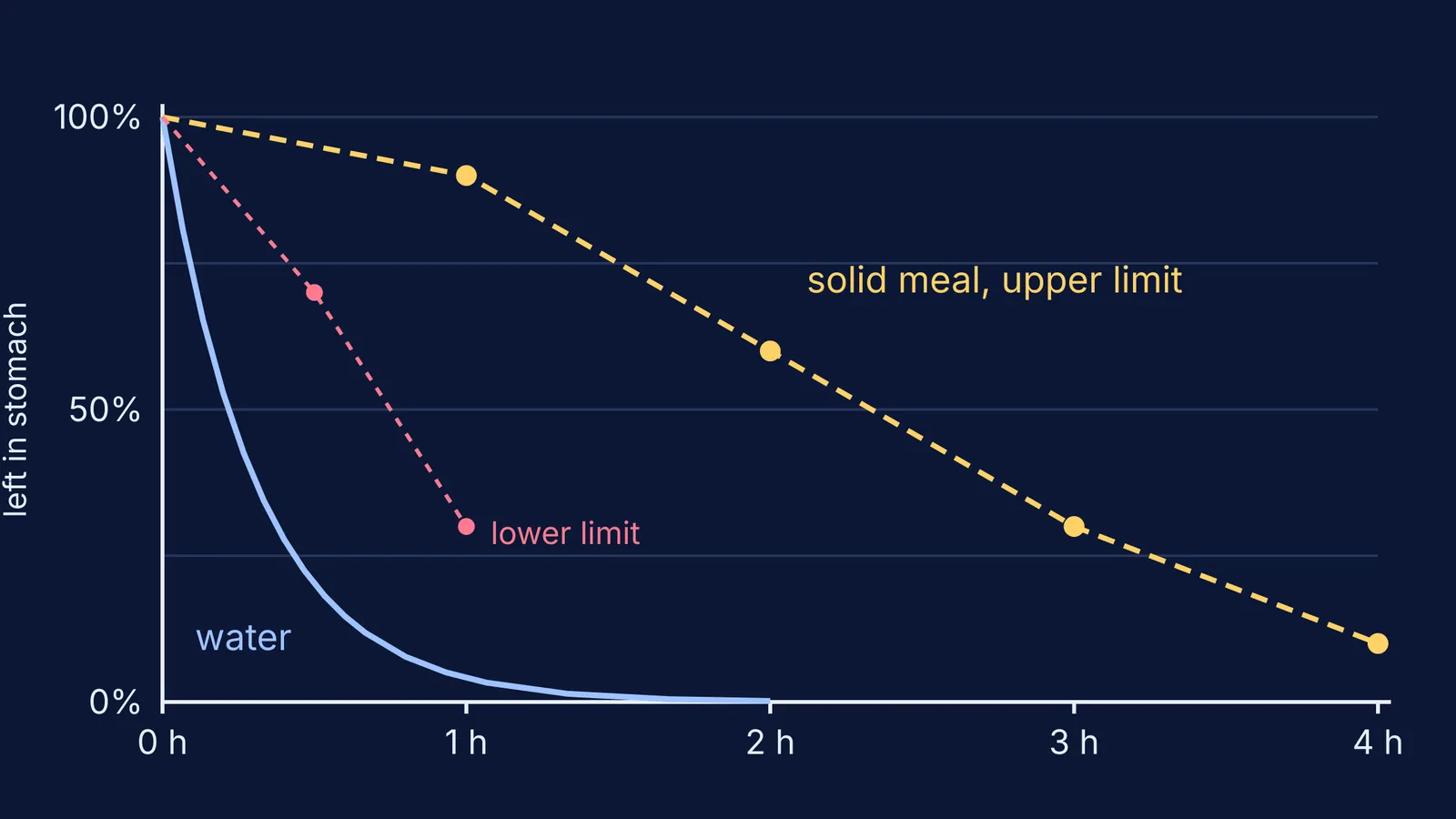
Doctors measure gastric emptying with a scan: you eat a standard meal carrying a tiny amount of radioactive tracer, and a camera tracks what is left over four hours. The 2008 consensus of the American Neurogastroenterology and Motility Society and the Society of Nuclear Medicine set normal values for this test, using a low-fat meal of egg whites, two slices of bread with jam, and water.
At 1 hour, a healthy stomach still holds 30% to 90% of that meal.
At 2 hours, it holds 60% or less.
At 4 hours, it holds 10% or less.
So for a light meal, "nearly empty after about four hours" is a fair rule of thumb. The report adds that emptying of solids starts only after a lag phase, the time needed to grind the food into small particles, which normally lasts 20 ± 10 minutes.
Why do liquids leave the stomach faster than solids?
Liquids need no grinding. In an MRI study of 12 healthy volunteers, the stomach's water after a 240 mL glass, drunk fasting, halved in 13 ± 1 minutes and was back to baseline by 45 minutes.
A drink is not automatically fast, though. Hunt and Stubbs pooled results from 33 studies and found that the higher a meal's nutritive density (calories per millilitre), the more slowly it emptied. To your stomach, sweet milky chai is not water.
Why does a fatty meal empty slower than a watery one?
First, the stomach meters calories. Hunt and Stubbs found their data fitted equal slowing from equal calories of fat, protein or carbohydrate: 4 g of fat or 9 g of carbohydrate, both 36 kcal. Fat carries 9 kcal per gram against 4 for carbohydrate, so gram for gram it slows the stomach more than twice as much.
Second, the gut senses fat directly. In a 1999 study led by John McLaughlin70227-1), fatty acids with 12 or more carbon atoms, infused into the upper gut of volunteers, raised the hormone cholecystokinin (CCK). A 12-carbon fatty acid also weakened contractions of the lower stomach; a 10-carbon one did not. Blocking the CCK receptor removed that effect, so CCK is one signal that slows the stomach when fat arrives. For what happens to the fat itself, see whether the stomach digests fat.
The American Society of Anesthesiologists' 2017 fasting guidelines show the same order. Clear liquids need a fast of at least 2 hours before an elective procedure and a light meal such as toast at least 6 hours, while meals with fried or fatty foods or meat may need 8 hours or more because they may prolong gastric emptying. These are safety margins, not emptying times.
How do common Indian meals compare?
No study has timed each dish, so this ranks meal types using the sources above.
Fastest: water, clear tea, black coffee, juice without pulp. Clear liquids in the ASA guidelines; water half-empties in about 13 minutes.
Milky drinks: chai, lassi, haldi doodh. The ASA treats non-human milk as similar to solids in gastric emptying time, with the same 6-hour fast as a light meal.
Light, low-fat meals: idli-sambar, poha, plain roti with dal. Closest to the consensus test meal, which in healthy people is at least 90% gone by 4 hours.
Everyday thali with ghee or oil: dal-chawal-sabzi, rajma-chawal. More calories and fat than the test meal, so expect it to stay longer.
Slowest: puri-bhaji, chole bhature, butter paratha, samosa, mutton biryani. The ASA's "fried or fatty foods or meat" group.
For the order in which one meal's carbohydrate, protein and fat are digested, see our dal-rice digestion timeline.
Worked example: what 10 g of ghee adds
Stir 10 g of ghee into a light dal-rice plate. At about 9 kcal per gram of fat, that is roughly 90 kcal. By Hunt and Stubbs' rule (4 g fat slows emptying as much as 9 g carbohydrate), it should slow the stomach about as much as 22.5 g of carbohydrate would. The consensus report notes that some European investigators have suggested adding 10 g of butter to the test meal for patients whose symptoms worsen after fatty food.
When should you eat before studying or an exam?
This is everyday planning, not medical advice, based on the test-meal values above.
3 to 4 hours before: a light, low-fat meal such as poha, idli or roti-dal.
In the last hour: water rather than a heavy snack.
Afterwards: the samosas and chole bhature.
If big lunches make you drowsy, read why we feel sleepy after lunch. If you often feel full for hours, feel sick or vomit after meals, see a doctor.
If digestion is on your biology syllabus, the Fermi Concept Library gives every biology concept its own lesson and its place in the map.


