

On this page
Put a salamander next to a garden lizard and most people see the same animal: long body, four legs, a tail. Biologists see two different classes. The difference shows up in four things you can check yourself: skin, eggs, claws and breathing. It is also a favourite one-liner in Class 11 tests and NEET-style questions on the Animal Kingdom.
Is a salamander a lizard?
No. The NCERT Class 11 Biology chapter Animal Kingdom lists *Salamandra* (salamander) under Class Amphibia, and *Calotes* (garden lizard) and *Hemidactylus* (wall lizard) under Class Reptilia.
The same NCERT chapter explains why the body plans look alike: it groups amphibians, reptiles, birds and mammals together as Tetrapoda because they have two pairs of limbs. Having four legs tells you an animal is a tetrapod. It does not tell you which class it belongs to.
For the full list of class features, see our posts on amphibian features and the dual life and reptile features, from scales to eggs.
What is the difference between a salamander and a lizard?
The National Aquarium in Baltimore sets out the differences in its guide Mistaken identities: lizards vs. salamanders, and the Virginia Department of Wildlife Resources sums them up in one line in its salamander FAQ. Here they are side by side:
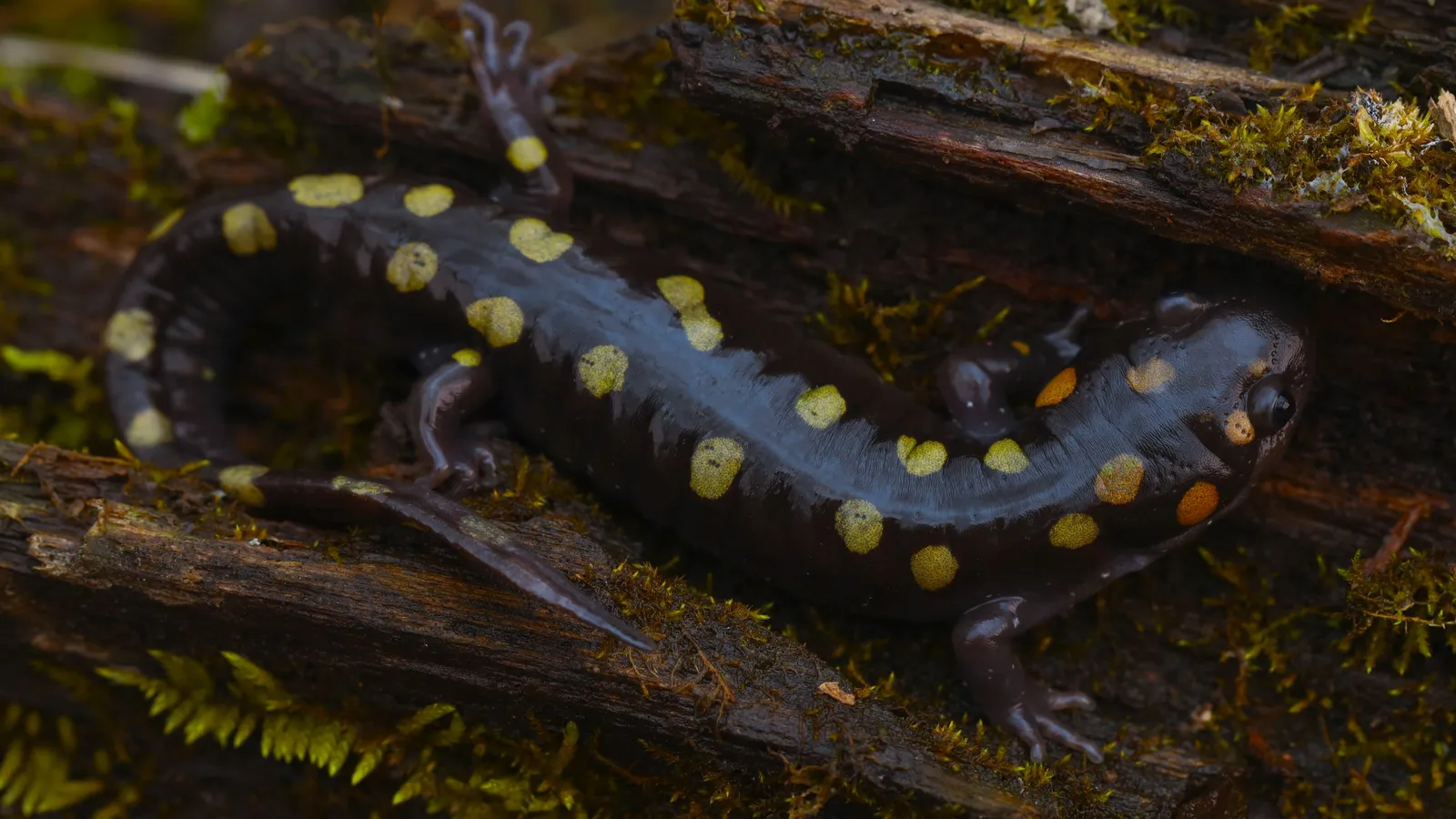
Skin. Salamander: moist and porous, with no scales. Lizard: dry and covered in scales, which helps it hold on to water.
Eggs. Salamander: most species lay eggs without a shell. Lizard: usually lays shelled eggs on land, which Virginia's wildlife agency describes as leathery.
Claws. Salamander: no claws on its toes. Lizard: claws on its toes, except in a few legless species.
Breathing. Salamander: through the skin and the lining of the mouth, and some species also have lungs. Lizard: lungs.
Class. Salamander: Amphibia. Lizard: Reptilia.
NCERT adds one more difference that examiners like: amphibian development is indirect, while reptile development is direct (NCERT, Animal Kingdom). Not every salamander fits the textbook pattern, though: the National Aquarium notes that salamanders which lay their eggs on land have no aquatic larval stage.
Why does a salamander need wet skin?
For many salamanders, the skin is a breathing organ. The family Plethodontidae has no lungs at all. A Harvard University release on ScienceDaily states that all adult plethodontids are lungless and breathe mainly through the skin and the mucous membranes of the mouth and throat.
The family accounts for more than two-thirds of living salamander species, according to the same ScienceDaily report.
The study behind that report, by Zachary Lewis and colleagues in Science Advances (2022), found that these salamanders still begin to grow lungs as embryos, but the lung buds disappear before hatching. Adult plethodontids have been without working lungs for at least 25 million years, and possibly more than 60 million years.
Breathing through the skin depends on keeping it moist, which is why salamanders stay in damp places. A lizard's dry, scaly skin does the opposite job: it keeps water in, so lizards can live on a sunny wall or in dry country. For why the shelled egg let reptiles breed away from water, see our explainer on the amniotic egg.
How can you tell a salamander from a lizard in 30 seconds?
Run these four checks, taken from the comparison above. Two or three matching answers settle it.
Toes. Can you see claws? Claws mean lizard. Soft, clawless toes mean salamander.
Skin. Is it dry and made of tiny scales, or smooth, glossy and wet-looking? Scales mean lizard.
Place. Was it basking on a dry wall or rock, or hiding under a damp log or in leaf litter? Dry and sunny points to lizard.
Eggs, if you find them. Shelled eggs on land point to a lizard. Soft eggs without shells point to a salamander.
Worked example: the wall lizard on a kitchen wall in India is usually a species of *Hemidactylus*, NCERT's own example of a reptile. It sits on a dry surface, its skin is covered in small scales, and it climbs on clawed toes. That is three checks out of three for Reptilia.
How do you write this answer in an exam?
A two- or three-mark question usually reads: "Give three differences between a salamander and a lizard." Use NCERT's wording, one feature per point, and name the class:
Skin: the salamander (Amphibia) has moist skin without scales, while the lizard (Reptilia) has dry, cornified skin with epidermal scales.
Respiration: the salamander can breathe through its skin as well as gills or lungs, while the lizard breathes with lungs.
Development: as an amphibian, the salamander shows indirect development, while the lizard, as a reptile, shows direct development.
If Amphibia and Reptilia blur together with the other vertebrate classes, the Fermi Concept Library covers every concept in biology, each with its own lesson and its place in the map. If you would rather be tested, Fermi's AI tutor notices where you are stuck and checks your understanding as it goes.
Next time you see a small four-legged animal with a tail, check the toes first.


