

On this page
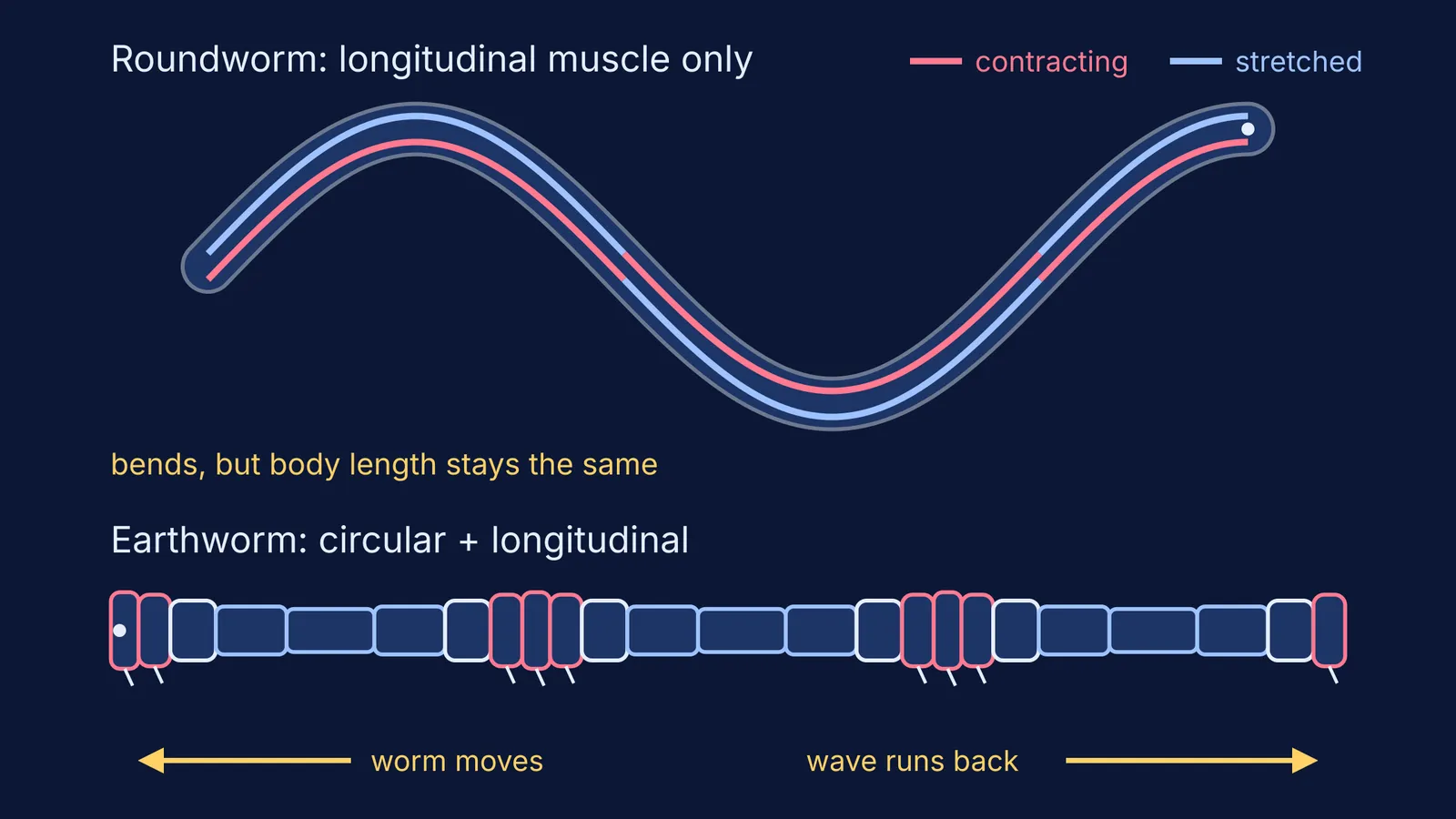
A roundworm such as *Caenorhabditis elegans* never inches along like an earthworm; it throws its body into a travelling S. That happens when every body-wall muscle runs lengthwise inside a pressurised tube that refuses to shorten.
Why do roundworms move in a whip-like S shape?
In a hydrostatic skeleton, force is transmitted by internal pressure rather than rigid bones, as William Kier explains in a review of hydrostatic skeletons in the Journal of Experimental Biology. Nematodes have robust longitudinal muscle bundles but lack the circular muscle fibres that other hydrostatic animals use as antagonists, the review notes. In *C. elegans*, the 95 body wall muscle cells sit in four longitudinal bundles, one in each quadrant of the body, according to the WormAtlas guide to somatic muscle. The same guide says the body is limited to making dorsoventral bends.
Tightening one side curves the body towards that side. A biomechanics study of *C. elegans* by Christopher Fang-Yen and colleagues describes the worm moving forward by sending these bends as waves from head to tail in the dorsal-ventral plane. A run of alternating bends is an S.
Why can't a roundworm shorten its body?
A muscle can only pull; something has to stretch it back out. In a roundworm, that job falls to the cuticle and the fluid inside it.
Kier's review describes the nematode cuticle as a crossed-fibre helix, with fibres at about 75 degrees to the long axis in *Ascaris*, citing Harris and Crofton's 1957 measurements. Contracting longitudinal muscles try to shorten the body and widen that fibre angle, which would need the volume to shrink. The fluid in the pseudocoelom is essentially incompressible and cannot escape, so shortening is resisted and pressure rises instead. In *Ascaris* that pressure averaged 9 kPa, with a range of 2 to 30 kPa, the review reports.
For where the pseudocoelom sits among body cavities, see the first phylum with a true coelom, mesoderm and segments.
How is an earthworm's movement different?
An earthworm has a second layer. Contracting its longitudinal muscles makes the body short and fat; contracting its circular muscles makes it long and thin, as North Carolina State University's annelid notes put it. Circular contraction starts at the front and passes backwards as a peristaltic wave, followed by longitudinal contraction. Where longitudinal muscle contracts, the body bulges and the chaetae (setae) stick out to grip.
Kier's review adds that muscular septa divide the earthworm coelom and stop fluid moving between segments during normal crawling. The two layers stretch each other: when the circular muscles contract, the longitudinal ones are lengthened, and the reverse, as this open biology reading on annelids explains. For a relative that kept the segments but dropped the bristles, read why a leech has no setae, unlike an earthworm.
Body wall muscle: roundworm, longitudinal only; earthworm, circular plus longitudinal.
What stretches a contracted muscle back: roundworm, cuticle and pressurised pseudocoelom; earthworm, the opposite muscle layer, through coelomic fluid.
Possible shape changes: roundworm, bending only; earthworm, segments that lengthen and thin or shorten and fatten.
Movement: roundworm, undulating S waves; earthworm, peristaltic waves anchored by setae.
Does the S shape change in water and on a surface?
Yes. Fang-Yen and colleagues report that swimming in water and crawling on surfaces impose roughly 10,000-fold differences in mechanical resistance on *C. elegans*, and that as load rises, both the wavelength and frequency of its bends fall.
In their measurements, swimming worms bent at about 1.76 Hz with a wavelength of 1.54 body lengths, while worms crawling on agarose slowed to about 0.30 Hz with a wavelength of 0.65 body lengths (PNAS, 2010). The gait shifts smoothly with load, so fast thrashing in water and a tight S on a plate are two ends of one range. Fish also swim with a travelling body wave; see how fish swim with myotomes and a body wave.
How do you answer exam questions on worm movement?
Use three checks:
Which muscle layers does the body wall have?
What stretches each muscle back after it contracts?
So which shape changes are possible: bending, lengthening, shortening, or all three?
Worked example (assertion-reason):
Assertion: *Ascaris* cannot crawl by peristalsis the way an earthworm does.
Reason: The body wall of *Ascaris* has longitudinal muscles but no circular muscles.
Check 1 makes the Reason true. Check 3 makes the Assertion true: peristalsis needs segments that lengthen and shorten, and only circular muscle lengthens a segment. Check 2 links them: with only pressure opposing the longitudinal muscles, *Ascaris* can only bend. Both are true, and the Reason explains the Assertion.
If the bending is hard to picture from text, the Fermi Simulation Lab has interactive simulations for ideas easier to see than to read. If pseudocoelom versus coelom keeps tripping you up, the Fermi Concept Library gives each biology concept its own lesson and its place in the map.


