

On this page
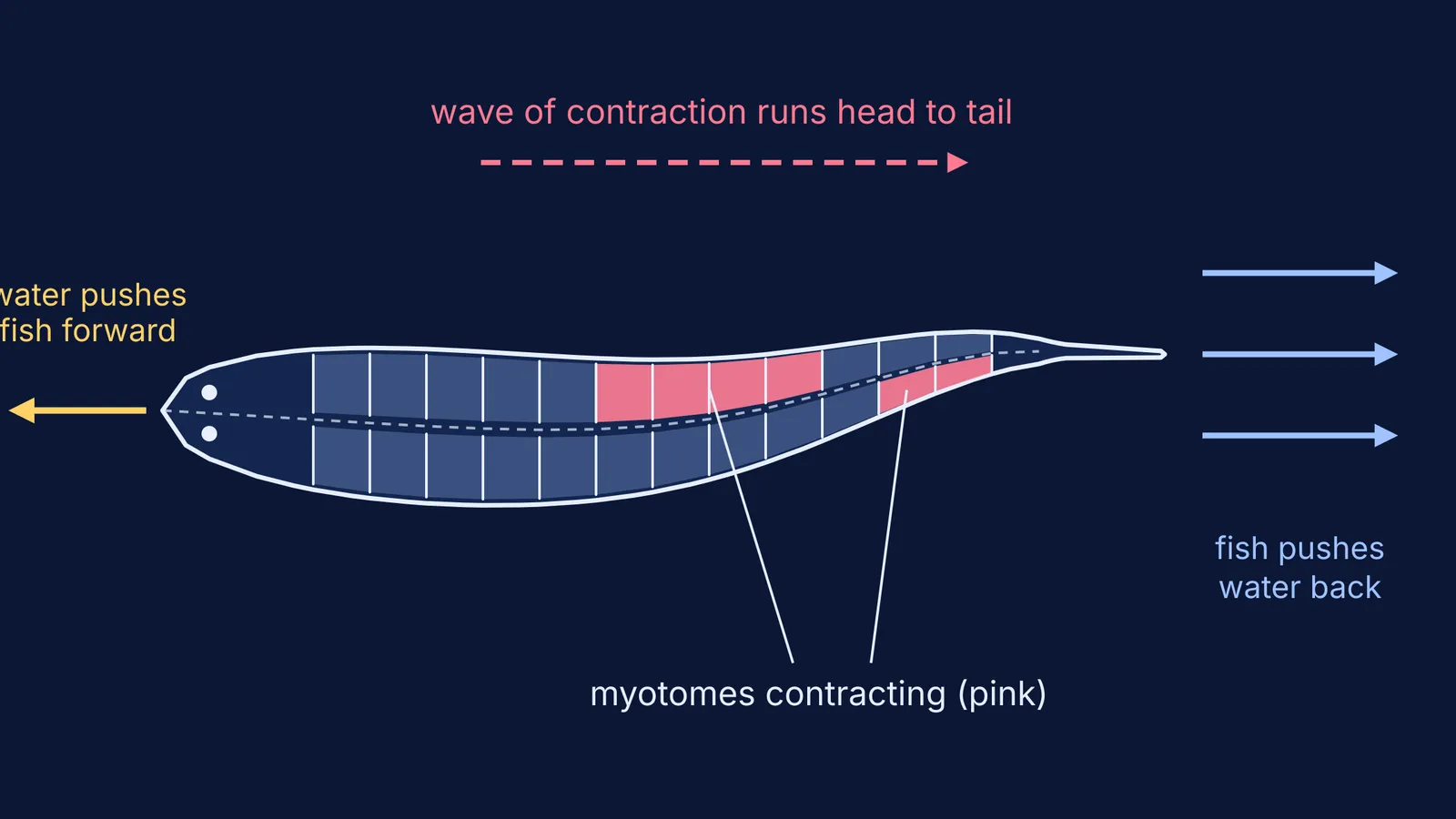
Watch a fish in a tank and its body seems to ripple without effort. Underneath, blocks of muscle fire one after another down each side, bend the body into a travelling wave, and use the water itself as something to push against.
What muscles does a fish use to swim?
A fish swims with the muscle of its trunk, arranged as a row of blocks called myotomes (or myomeres) along both sides of the backbone. A 1999 mechanical analysis by Johan van Leeuwen describes this muscle as “a longitudinal series of geometrically complex myomeres”.
The muscle comes in two kinds. A review by John Altringham and David Ellerby explains that slow (red) muscle powers slow, steady swimming. As speed and tail-beat frequency rise, faster (white) fibres are recruited, because slow muscle is too slow to do useful work at high tail-beat rates. Fast muscle typically makes up 80 to 100% of the fish's cross-section.
How do myotomes make a fish swim?
The same review reports that in all fish studied, slow steady swimming uses muscle on alternate sides of the body, and that the front muscle fires first, so “a wave of activation travels from head to tail” (Altringham and Ellerby).
Picture one point on the body. The left-side blocks there shorten and the body bends left; a moment later the right-side blocks take over and the bend flips. Because each point fires a little after the one in front, the bend runs backwards along the body as a wave, as in the diagram above.
Wardle, Videler and Altringham note that the wave of body bending runs more slowly than the wave of muscle activation that causes it, because the water pushes back on the body. Nauen and Lauder's 2002 paper, drawing on earlier studies, notes that the front of a chub mackerel's body swings sideways by less than 2.5% of body length in steady swimming, and that the back third of the body and the tail are the main site of force production.
Where does Newton's third law come in?
Newton's third law says that when one object pushes on another, the second pushes back on the first with a force of equal size in the opposite direction.
A fish has nothing solid to push against, so it pushes on water. Because water yields, the body wave “must travel backwards faster” than the fish swims forwards (Altringham and Ellerby). Each stretch of body then sweeps sideways and backwards through the water and shoves it towards the tail.
That is the action: fish pushes water back. The reaction is the water pushing the fish forward. Nauen and Lauder begin their introduction: “Fish move by transferring momentum to the surrounding fluid”, and they saw it in the wake: a chain of linked vortex rings, each with a jet of water through its centre.
These two forces act on different objects, the water and the fish, so they do not cancel. Our explainer on why action and reaction forces do not cancel has more examples.
Worked example: how hard does a mackerel's tail push?
Nauen and Lauder studied chub mackerel 20 to 26 cm long (nose to tail fork), swimming at 1.2 of those lengths per second. Thrust was 11 ± 6 mN (millinewtons), the sideways force was about double that at 22 ± 6 mN, and the ratio of thrust to total force was 0.32.
Speed: 1.2 per second × 0.20 m = 0.24 m/s, up to 1.2 per second × 0.26 m ≈ 0.31 m/s. That is roughly 1 km/h.
Thrust in everyday terms: m = F ÷ g = 0.011 ÷ 9.8 ≈ 0.0011 kg. The push equals the weight of about 1.1 g.
Steady speed means zero net force, so drag must also be about 11 mN. The study fits this: for the two smallest fish, wake thrust was not significantly different from the drag measured by towing them. Our piece on fluid friction and streamlined shapes explains where that drag comes from.
Mechanical performance: a ratio of 0.32 means only about a third of the force went into moving forward. The authors suggest the rest is a cost of swimming by bending.
How do you explain fish swimming in an exam answer?
Structure: myotomes, blocks of muscle, line both sides of the backbone.
Pattern: they contract on alternate sides, in a wave from head to tail.
Shape: the body bends into a wave that travels backwards and grows larger towards the tail.
Force: body and tail push water backwards (action); water pushes the fish forwards (reaction), by Newton's third law.
Balance: at steady speed, thrust equals drag. Staying up is a separate job; see how a swim bladder adjusts buoyancy.
If the travelling wave is hard to picture, the Fermi Simulation Lab has interactive simulations for ideas that are easier to see than to read. If step 4 feels shaky, the Fermi Concept Library gives every concept in physics and biology its own lesson.
Next time you watch a fish, look for the wave running towards the tail. That is Newton's third law in action.


