On this page
If equal and opposite forces cancel, how does a horse ever move a cart? It is a classic puzzle from Class 9 to JEE Main. Below are two free-body sketches, a horse and cart and a person walking, with numbers you can check.
What does Newton's third law actually say?
Newton's own wording, in Andrew Motte's English translation of the Principia, is: "To every action there is always opposed an equal reaction: or the mutual actions of two bodies upon each other are always equal, and directed to contrary parts" (Principia, Motte translation, on Wikisource/Axioms,_or_Laws_of_Motion)). He even used our example: "If a horse draws a stone tied to a rope, the horse (if I may so say) will be equally drawn back towards the stone."
The key phrase is two bodies. A third-law pair is always one interaction seen from both ends: A on B, and B on A.
Why don't action and reaction forces cancel each other?
Forces cancel only when they act on the same body. The OpenStax University Physics chapter on Newton's third law says the pair forces "are acting on different bodies or systems" and "do not act on the same body. Thus, they do not cancel each other."
To ask whether the cart accelerates, add up the forces on the cart only. The cart's pull on the horse is not on that list.
This is a known stumbling block. In a 1989 paper in Physics Education, David Brown reported data indicating that students have a naive view of force as a property of objects, and suggested the third law may need to be stressed in teaching (Brown, 1989, Physics Education).
How can a horse pull a cart if the cart pulls back equally?
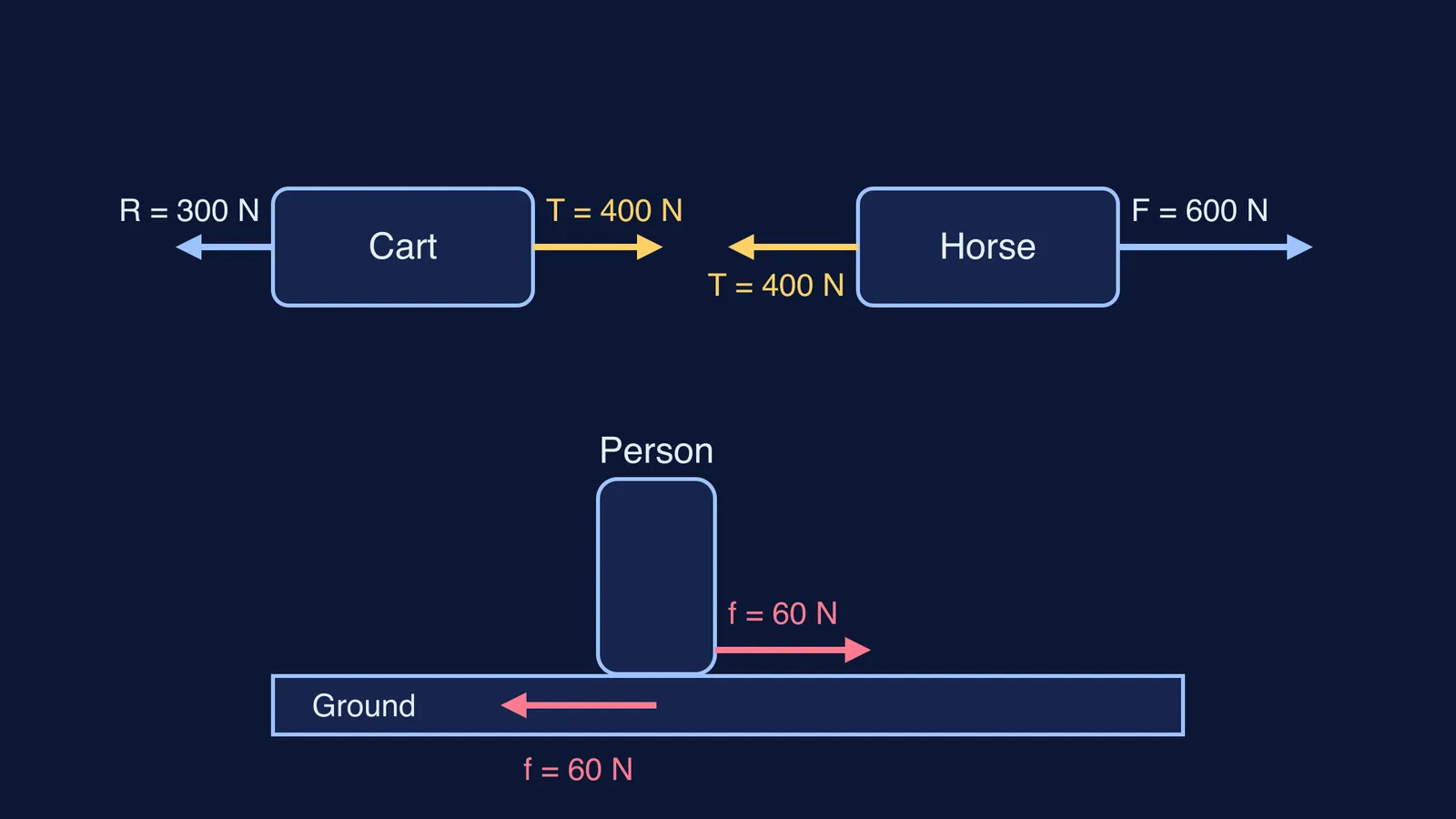
Take a 400 kg horse pulling a 200 kg cart that speeds up at 0.5 m/s², with 300 N of rolling resistance on the cart. The values are illustrative.
Free-body sketch of the cart (horizontal forces only):
Rope tension T forward, pulled by the horse
Resistance R = 300 N backward
Newton's second law: T − 300 = 200 × 0.5, so T = 400 N
Free-body sketch of the horse:
Rope tension T = 400 N backward, pulled by the cart (the third-law partner of the force above)
Friction from the ground F forward, because the hooves push backward on the ground
Newton's second law: F − 400 = 400 × 0.5, so F = 600 N
The two 400 N rope forces are equal and opposite, but they sit in different sketches. The cart moves because 400 N forward beats 300 N backward. The horse moves because the ground pushes it forward with 600 N, more than the cart's 400 N pull back. Check with both bodies together: 600 − 300 = 600 × 0.5 = 300 N. The rope pair is internal and drops out.
The horse moves because of the ground. On smooth ice, F would be tiny and the horse could not get the cart going.
How does a person walk forward if the ground pushes back equally?
OpenStax uses the same idea for walking: a professor pacing in front of a whiteboard exerts a force backward on the floor, and "the floor exerts a reaction force forward" that accelerates him (OpenStax University Physics).
Take a 60 kg student speeding up at 1 m/s² from rest.
Sketch of the person: static friction from the ground, 60 × 1 = 60 N forward. Vertically, weight down and normal force up, which balance.
Sketch of the ground (the Earth): 60 N backward, from the shoe.
The 60 N on the Earth does not stop you, because it is not on you, and the Earth is far too massive to visibly move. Our post on which way friction acts when you walk goes further into why the friction on your foot points forward.
If the arrows are hard to picture, the Fermi Simulation Lab has interactive simulations for ideas that are easier to see than to read.
How do you check a third-law pair in an exam?
Run this four-point check:
Same interaction: both forces come from the same contact or field (rope, ground, gravity between two bodies).
Two bodies: one force on A, its partner on B, never both on A.
Same type: a friction force pairs with a friction force, a gravitational pull with a gravitational pull.
Equal and opposite, always, whether or not anything accelerates.
A classic trap: a book's weight and the table's normal force are equal and opposite, but both act on the book and are different types. They are not a third-law pair. The partner of the book's weight is the book's pull on the Earth.
For more practice, see our guide to spotting Newton's third law pairs and the common free-body diagram mistakes in laws of motion. If you set up a connected-body problem and keep getting a sign wrong, the Fermi Problem Library has worked problems with a step-by-step solver that explains the reasoning rather than printing an answer.