

On this page
Newton's laws of motion form the foundation of mechanics across CBSE Class 11, JEE Main, and NEET-UG. Yet examiners frequently report identical conceptual traps that cost students straightforward marks. The difficulty rarely begins with algebraic manipulation; it begins on the diagram. Students commonly make three errors: assuming the normal contact force always equals weight, counting internal interactions inside a multi-body system, and adding pseudo forces in ground frames. When you encounter complex multi-body setups or angled constraints, the Fermi Problem Library offers worked problems with a step-by-step solver that explains the reasoning rather than printing an answer.
Why is the normal force not always equal to mg?
A frequent error in mechanics is treating normal force N as identical to mg. Beginners memorize N = mg from flat tables as a universal law and frequently mistake normal force and gravity for an action-reaction pair.
In an analysis of textbook definitions and student models of weight, researchers (Taibu et al., 2015) demonstrated that students routinely conflate normal force with gravitational weight because they balance in static horizontal cases. But third-law pairs act on different bodies. Gravity is an interaction between the Earth and the block, whereas normal force is an electromagnetic contact push from the floor.
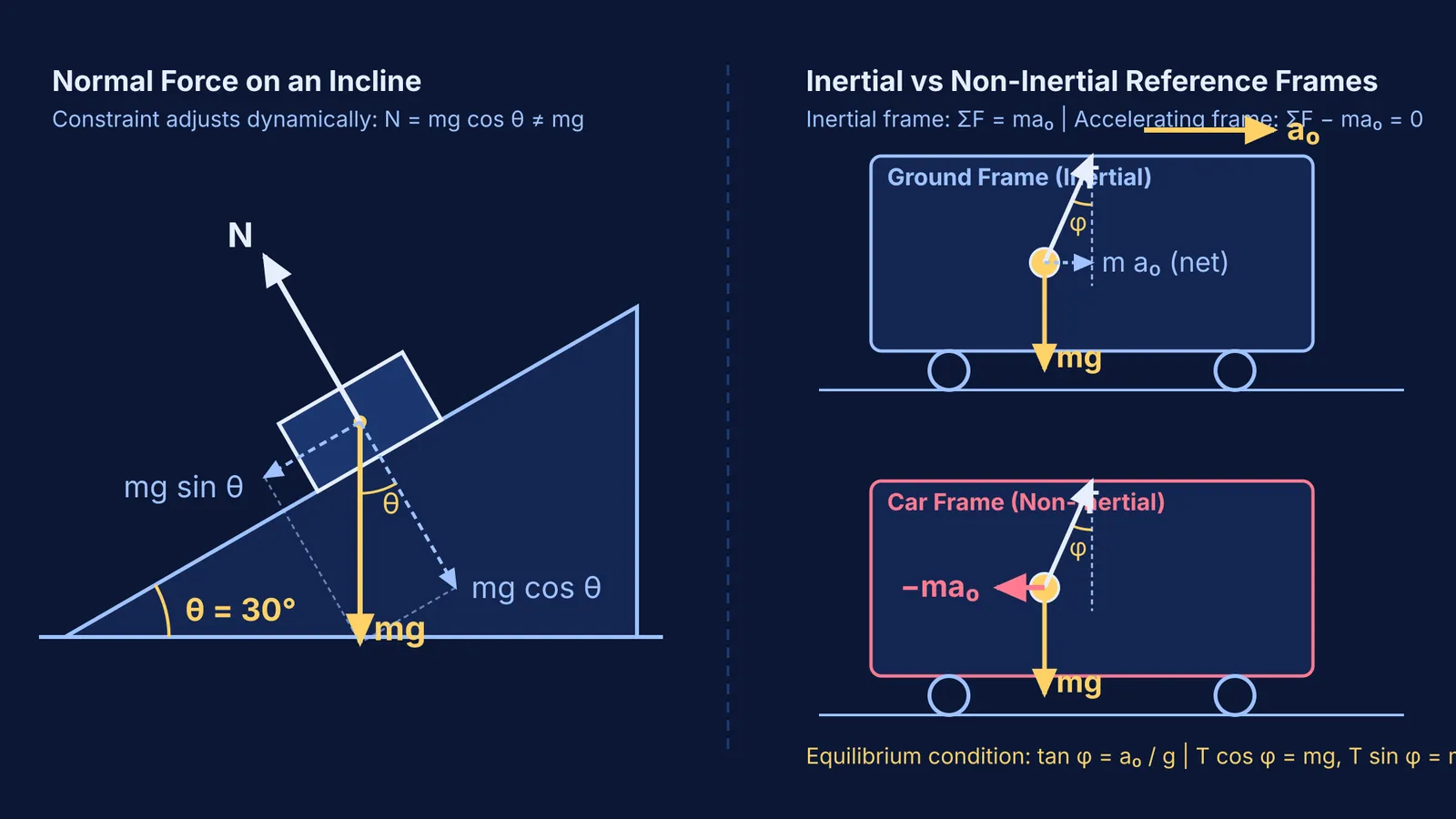
Because normal force is a constraint force, its magnitude adjusts dynamically:
On an incline of angle θ, resolving forces perpendicular to the surface gives N = mg cos θ.
When a pull F acts at angle θ above horizontal, the contact force eases to N = mg − F sin θ.
In an elevator accelerating upward at a, the floor pushes harder, giving N = m(g + a); downward acceleration reduces it to N = m(g − a).
In vertical circular motion, such as normal force on a car moving over a hump of radius R, inertia reduces contact force to N = mg − mv²/R.
When do internal forces belong on a free-body diagram?
Another persistent error is failing to define a clean system boundary. A free-body diagram must display only external forces acting across that boundary.
Consider two blocks of masses m₁ and m₂ in contact on a frictionless floor pushed by force F. For the combined system (m₁ + m₂), the contact forces between the blocks are internal. By Newton's third law, they are equal and opposite, cancelling completely. Counting this contact force in the combined system equation double-counts forces and corrupts the acceleration calculation.
To calculate that contact force, you must isolate a single block across a defined boundary, as shown in contact force between blocks pushed together on a smooth floor.
In a study on representational tools, David Rosengrant, Alan Van Heuvelen, and Eugenia Etkina (Rosengrant et al., 2009) found that 58% of students in a representation-rich course spontaneously drew free-body diagrams on exams even when no credit was awarded. Drawing an accurate diagram strongly correlated with problem-solving success, whereas blurring system boundaries consistently led to wrong equations.
Why do students add pseudo forces in inertial frames?
The third common slip is adding pseudo forces in inertial reference frames. When a vehicle accelerates, passengers feel thrown backward. Students often sketch this sensation directly onto paper as an "inertial push" while solving from the ground.
The Force Concept Inventory (Hestenes et al., 1992) catalogs how students frequently treat centrifugal force as an actual outward interaction rather than an effect of inertia. Similarly, John Clement (Clement, 1982) showed that students intuitively believe ongoing motion requires a continuous forward push.
Keep your frames distinct:
In an inertial frame (such as the ground), Newton's second law is Σ F = ma. Every force must have a physical agent. Acceleration a is the kinematic result of the net force, not a force itself.
In a non-inertial frame accelerating at a₀, you must add an inertial pseudo force F_pseudo = −m a₀ opposite to the frame's acceleration, yielding Σ F_real − m a₀ = m a_rel.
Adding −m a₀ while solving from the ground double-counts acceleration. Review systematic frame selection in pseudo forces when solving from an accelerating frame.
If picturing how normal forces shift across curved surfaces or accelerating frames feels abstract, the Fermi Simulation Lab provides interactive simulations for the ideas that are easier to see than to read.
How to audit your free-body diagrams before solving?
Before converting your sketch into equations, run this four-step audit:
Select your reference frame: Pick the ground frame or an accelerated frame. If you choose the ground, omit all pseudo forces.
Isolate the body with a boundary: Sketch the outline of the single body or system. Omit every interaction that takes place entirely inside that boundary.
Apply the agent test: For every vector you draw, name the physical agent that produces it. If there is no physical agent, erase the arrow.
Align axes with acceleration: Resolve forces along and perpendicular to motion. Set Σ F_perp = 0 to solve for the true normal force dynamically rather than assuming a formula.
When diagnosing recurring diagram slips or mastering multi-body numericals, Fermi's AI tutor notices where a student is stuck and decides whether to explain, ask, or show, ensuring your conceptual setup is watertight before you write the first line of algebra.


