

On this page
This set follows our first set of rotational motion JEE Main practice questions and tests what that set left out: centre of mass, torque as a cross product, the perpendicular axes theorem, a particle's angular momentum, a hinged beam and an impact on a pivoted rod. Take g = 9.8 m/s².
All of these sit in Unit 5 of the NTA syllabus for JEE (Main) 2027. New to the chapter? Read our guide on how to prepare rotational motion for JEE Main.
How should you use this set?
Allow 25 minutes for all eight; Q6 has a numerical answer.
Mark the axis or origin first.
Answer before reading the solution.
Easy: centre of mass, torque and radius of gyration
Q1 (easy). A uniform wire is bent into an L with its corner at the origin: 40 cm along the x-axis and 20 cm along the y-axis. Where is its centre of mass?
(A) (10 cm, 5 cm) (B) (13.3 cm, 3.3 cm) (C) (6.7 cm, 6.7 cm) (D) (20 cm, 10 cm)
Answer: (B). The arms carry 2/3 and 1/3 of the mass, centred at (20, 0) and (0, 10), so x = (2/3)(20) = 13.3 cm and y = (1/3)(10) = 3.3 cm. Trap: (A) gives both arms equal mass; the longer arm is heavier.
Q2 (easy). A force F = (î + 4ĵ − 2k̂) N acts at the point r = (2î − ĵ + 3k̂) m. The torque about the origin is
(A) (10î − 7ĵ − 9k̂) N m (B) (−10î + 7ĵ + 9k̂) N m (C) (−10î − 7ĵ + 9k̂) N m (D) (2î − 4ĵ − 6k̂) N m
Answer: (B). τ = r × F. The x-component is (−1)(−2) − (3)(4) = −10, the y-component is (3)(1) − (2)(−2) = 7, and the z-component is (2)(4) − (−1)(1) = 9. Trap: (A) is F × r; swapping the order flips every sign.
Q3 (easy). A thin uniform ring has radius 20 cm. What is its radius of gyration about an axis in the plane of the ring, parallel to a diameter and 10 cm from the centre?
(A) 14.1 cm (B) 17.3 cm (C) 22.4 cm (D) 24.5 cm
Answer: (B). Perpendicular axes give I about a diameter = MR²/2 = 0.02M. Parallel axes, shifting 0.1 m: I = 0.02M + 0.01M = 0.03M, so k = √0.03 m = 17.3 cm. Trap: (C) starts from MR², the perpendicular-to-plane value.
Medium: angular momentum, braking and the centre of mass at rest
Q4 (medium). A merry-go-round (I = 120 kg m², radius 2 m) is at rest. A 30 kg child runs at 4 m/s along a line passing 1.5 m from the axis, then jumps on at the rim. The final angular speed is
(A) 0.75 rad/s (B) 0.96 rad/s (C) 1.00 rad/s (D) 1.50 rad/s
Answer: (A). A particle's angular momentum is L = mvd, with d the perpendicular distance from the axis to its line: 30 × 4 × 1.5 = 180 kg m²/s. No external torque acts about the axis, so L is conserved. Final I = 120 + 30(2)² = 240 kg m², so ω = 180/240 = 0.75 rad/s. Trap: (C) uses the rim radius, 2 m, as the lever arm of the run-up.
Q5 (medium). A grinding wheel (uniform disc, 5 kg, radius 0.2 m) spins at 120 rad/s. A brake pad presses its rim with a normal force of 20 N; the coefficient of friction is 0.4. How long does the wheel take to stop?
(A) 3 s (B) 3.75 s (C) 7.5 s (D) 15 s
Answer: (C). Friction is 8 N, so τ = 8 × 0.2 = 1.6 N m. With I = MR²/2 = 0.1 kg m², α = τ/I = 16 rad/s², and t = 120/16 = 7.5 s. Trap: (D) uses a ring's I = MR².
Q6 (medium, numerical). A 50 kg student stands at one end of a 6 m raft of mass 150 kg, at rest on still water. How far, in cm, does the raft move when the student walks to the other end?
Answer: 150. With no external horizontal force, the centre of mass stays put. If the raft moves x, the student moves 6 − x the other way: 50(6 − x) = 150x, so x = 1.5 m = 150 cm. Trap: 200 is (m/M)L, forgetting the raft moves too.
Hard: equilibrium and an impact on a pivoted rod
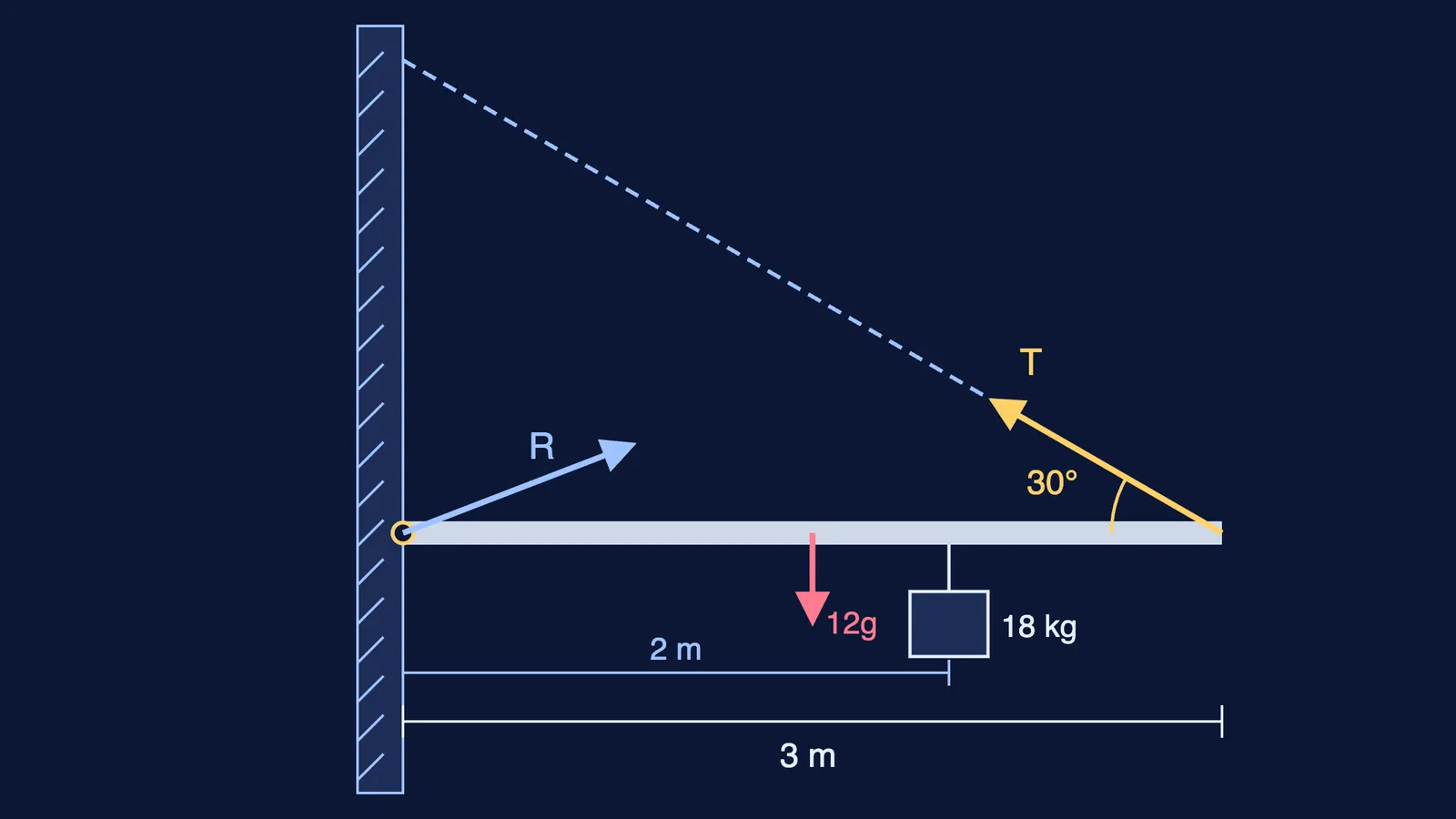
Q7 (hard). A uniform 12 kg beam, 3 m long, is hinged to a wall and held horizontal by a cable from its far end to the wall, making 30° with the beam. An 18 kg load hangs 2 m from the hinge. The magnitude of the hinge force is about
(A) 118 N (B) 306 N (C) 327 N (D) 353 N
Answer: (C). Moments about the hinge: T sin 30° × 3 = 12g(1.5) + 18g(2) = 54g, so T = 36g = 352.8 N. The hinge gives T cos 30° = 305.5 N horizontally and 30g − T sin 30° = 117.6 N vertically, so it is √(305.5² + 117.6²) ≈ 327 N. Trap: (B) and (A) give only one component; a hinge force has two.
Q8 (hard). A uniform 2 kg rod, 1.5 m long, hangs vertically from a frictionless pivot at its top. A 50 g bullet moving horizontally at 200 m/s hits the bottom end and stays in it. The rod's angular speed just after impact is about
(A) 3.3 rad/s (B) 9.3 rad/s (C) 10.0 rad/s (D) 30.8 rad/s
Answer: (B). Angular momentum about the pivot is conserved (the pivot's impulse has no moment there): mvL = 0.05 × 200 × 1.5 = 15 kg m²/s. After impact, I = ML²/3 + mL² = 1.6125 kg m², so ω ≈ 9.3 rad/s. Trap: (A) conserves linear momentum, ignoring the pivot's push. (D) uses ML²/12.
What should you do after set 2?
Group misses: centre of mass or cross product (Q1, Q2, Q6), the wrong axis or lever arm (Q3, Q4, Q7), or conserving the wrong quantity (Q8), and redo each after two days. Our linear and rotational motion analogues pair torque with force. For practice, the Fermi Problem Library has worked problems with a step-by-step solver that explains the reasoning rather than printing an answer.


