

On this page
Inhibin is a gonadal hormone whose main job is to tell the pituitary to make less FSH. It also explains a common exam trap: why losing one cell type in the testis raises FSH but not LH.
What is inhibin and where is it made?
Inhibin is a glycoprotein hormone made of an α-subunit and a β-subunit joined by a disulphide bridge, according to the historical review Inhibin at 90 in Endocrine Reviews by Makanji and colleagues. The same review explains that two forms of the β-subunit, βA and βB, give two versions of the hormone: inhibin A (αβA) and inhibin B (αβB). The review notes that D. Roy McCullagh introduced the word "inhibin" in 1932.
In males, the main source is the Sertoli cell, which lines the seminiferous tubules and supports developing sperm. In females, it is the granulosa cell, which surrounds the egg in a growing follicle. Ying and colleagues showed in a 1987 PNAS study that cultured rat granulosa and Sertoli cells release inhibin in proportion to the FSH they are given. If Sertoli and Leydig cells still blur together for you, our guide to Sertoli vs Leydig cells sets them side by side.
Inhibin also has uses in medicine: the Makanji review notes it is part of the quadruple test used in prenatal screening for Down syndrome and a marker used to assess ovarian reserve. Questions about a real test report belong with the doctor who ordered it.
What is the role of inhibin in males and females?
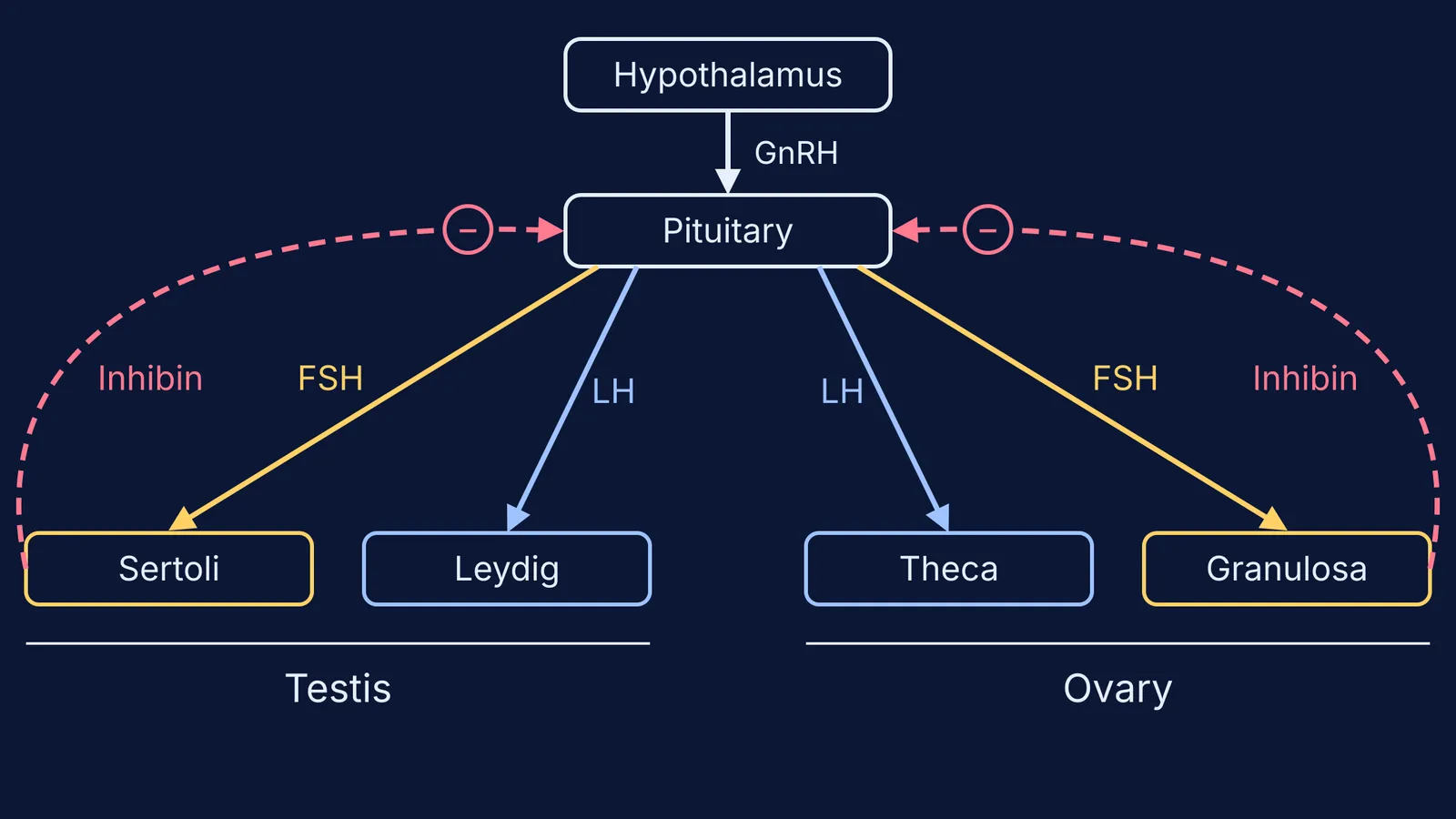
In both sexes the loop has the same shape:
The hypothalamus releases GnRH.
GnRH makes the anterior pituitary release FSH and LH.
FSH acts on Sertoli cells (males) or granulosa cells (females).
Those cells release inhibin into the blood.
Inhibin reaches the pituitary and lowers FSH output.
The 1987 paper put it plainly: inhibin from granulosa and Sertoli cells "specifically suppresses the secretion of pituitary FSH, and in turn FSH is primarily responsible for the inhibin production in these gonadal cells, as in a classical negative-feedback relationship" (Ying et al., 1987). When the team injected purified inhibin into rats whose ovaries had just been removed, serum FSH fell but LH did not.
In males, this keeps FSH-driven support of sperm production in check; see our explainer on FSH and LH in males.
In females, the two forms of inhibin peak at different times. Groome and colleagues measured both through the cycle in a 1996 study in the Journal of Clinical Endocrinology and Metabolism. Inhibin B rose in the early follicular phase to about 85 pg/mL the day after the FSH rise, fell through the rest of the follicular phase, and had a brief second peak two days after the LH surge. Inhibin A was low early, rose at ovulation and was highest in the mid-luteal phase. You can watch FSH and LH move across the cycle in our menstrual cycle hormone graph.
Why does inhibin lower FSH but not LH?
FSH and LH come from the same pituitary cells and share an identical α-subunit; what differs is their β-subunit, FSHβ or LHβ (Thompson and Kaiser, 2014). A 2022 review by Constantin, Bjelobaba and Stojilkovic describes LH secretion as GnRH pulses emptying stores of ready-made LH, while FSH secretion tracks how fast the FSHβ gene is expressed, which is controlled by GnRH, activin and inhibin (Current Opinion in Pharmacology).
Activin is the accelerator for FSH. Inhibin blocks activin by binding activin's receptor together with a co-receptor called betaglycan (Makanji et al., 2014). So inhibin presses on a control that FSH relies on and LH largely does not. That is the main explanation for the selectivity.
How do you use this in a NEET-style question?
Try this worked example: "A disease destroys Sertoli cells but spares Leydig cells. Predict what happens to blood FSH and LH."
Find the cell that makes inhibin: Sertoli. Inhibin falls.
Find what inhibin brakes: FSH only. With the brake gone, FSH rises.
Ask whether anything controlling LH changed. Leydig cells are intact, and inhibin never acted on LH, so LH has no new reason to move.
Answer: FSH up, LH roughly unchanged.
You did not memorise the answer; you traced one arrow in the diagram above.
Run this quick check before any hormone feedback question:
Which cell makes the hormone?
Which pituitary hormone does it act back on: FSH, LH, or both?
Is the arrow a brake (minus) or an accelerator (plus)?
Did you draw the loop for the right sex?
If the idea of brakes and loops still feels slippery, the Fermi Concept Library gives each concept its own lesson and its place in the map. For practice, the Fermi Problem Library has worked problems with a step-by-step solver that explains the reasoning rather than printing an answer.
Next time you revise human reproduction, redraw the two-sex loop from memory and check it against the diagram at the top of this page.


