

On this page
In a spinning mill, long rows of spindles wind cotton yarn onto bobbins, and on each one a steel clip smaller than your fingernail races round a ring at about 40 m/s. That clip is the ring traveller. It weighs tens of milligrams, yet the ring has to push on it with a few newtons. One JEE formula, F = mv²/r, explains why the traveller sets the yarn tension, why it gets hot and why it caps the speed of the whole machine.
What does a ring traveller do in ring spinning?
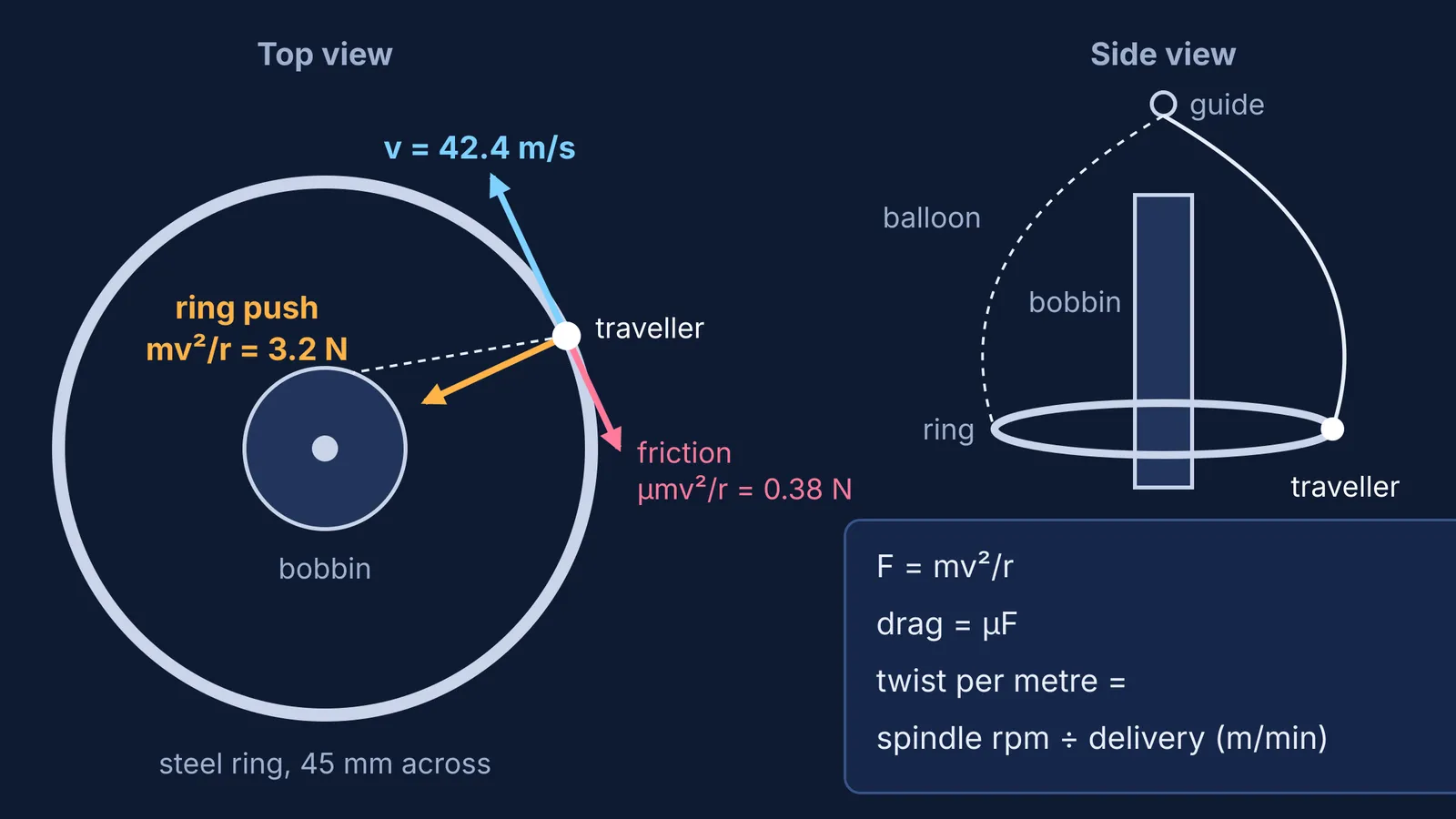
In a ring frame, the yarn comes down from a guide above the spindle, passes through the traveller and winds onto the bobbin. The bobbin sits on the spindle and turns at many thousands of rpm; the example below uses an illustrative 18,000 rpm. The traveller is a C-shaped steel clip hooked over the flange of a fixed steel ring that surrounds the bobbin.
Nothing drives the traveller. The yarn pulls it round. Because the traveller drags on the ring, it runs very slightly slower than the bobbin, and that small lag is what winds yarn on. Each turn also puts twist into the yarn, which turns a loose strand of fibres into yarn strong enough to weave.
The yarn between the guide and the traveller swings out into a curved surface called the balloon (side view, above).
Why does the traveller press so hard on the ring?
Anything moving in a circle needs a force towards the centre. For the traveller, the only thing that can supply it is the ring. So the ring pushes inward on the traveller with
F = mv²/r
and, by Newton's third law, the traveller presses outward on the ring with the same force. This is the normal force from the ring, not a mysterious "centrifugal force", and it is large because v is squared.
The textile industry uses exactly this formula. Bräcker, a maker of rings and travellers, writes the ring load as L = mv²/r and publishes the largest load each ring can take in its Bräcker short-staple spinning manual. The same manual lists traveller masses from under 6 mg to over 70 mg, gives traveller speed as ring diameter × π × spindle rpm ÷ 60,000, and sets a ring-load limit, for cotton on its 45 mm TITAN rings, of 4,000 mN.
The same idea appears in why a 30 g balancing weight matters on a car wheel: a small mass at high speed needs a large inward force.
How fast does the traveller move? A worked example
Take these illustrative values, which sit inside the ranges in the Bräcker manual: ring diameter 45 mm, spindle speed 18,000 rpm, traveller mass 40 mg, coefficient of friction between traveller and ring 0.12.
Radius. r = 45 mm ÷ 2 = 22.5 mm = 0.0225 m.
Revolutions per second. 18,000 rpm ÷ 60 = 300 rev/s.
Speed. v = 2πr × 300 = 2π × 0.0225 × 300 = 42.4 m/s. That is about 153 km/h.
Inward force. F = mv²/r = (40 × 10⁻⁶ kg) × (42.4 m/s)² ÷ 0.0225 m = 3.20 N.
Compare with its weight. mg = 40 × 10⁻⁶ × 9.81 = 3.92 × 10⁻⁴ N. So F/mg ≈ 8,150. Gravity can be ignored.
Friction. f = μF = 0.12 × 3.20 = 0.38 N, acting backwards along the ring.
Heat. Power = f × v = 0.38 × 42.4 ≈ 16 W, released at a contact patch a few square millimetres in area.
Check the units: kg × m²/s² ÷ m = kg m/s² = N, and N × m/s = W.
Now change one thing at a time:
Slower spindle, 12,000 rpm. v = 28.3 m/s and F = 1.42 N. A spindle running at two-thirds the speed gives (2/3)² = 4/9 of the force.
Lighter traveller, 20 mg. F halves to 1.60 N, because F is proportional to m.
The ring's limit. Setting mv²/r equal to Bräcker's 4,000 mN limit gives v = √(Fr/m) = √(4.0 × 0.0225 ÷ 40 × 10⁻⁶) = 47.4 m/s, a spindle speed of about 20,100 rpm for this traveller and ring.
For more circular motion numericals, the Fermi Problem Library has a step-by-step solver that explains the reasoning at each stage.
How does friction from the ring set the yarn tension?
At a steady speed, the forces along the traveller's path must balance. Friction pulls the traveller backwards with about 0.38 N. The yarn pulls it forwards. So the yarn tension near the traveller has to be of the same order as μmv²/r.
So spinners change the traveller mass to change the tension: too light and the bobbin winds soft; too heavy and ends break. The real tension also depends on the shape of the balloon and on air drag on the yarn, so μmv²/r gives the order of magnitude, not the exact value.
Why can't the spindle just run faster?
Two things grow with speed. The press grows as v², and the frictional heat, μmv³/r, grows as v³. Going from 12,000 to 18,000 rpm multiplies the heat by (1.5)³ ≈ 3.4, from 4.8 W to 16 W.
That heat has to leave the traveller fast enough. Bräcker's manual says the heat must be carried away quickly enough to avoid local temperatures above 300 °C in the wear zones, and that excessive traveller speed can damage synthetic fibres by heat. So the speed limit of a ring frame is set by the traveller and ring, not by the motor.
How much twist does each turn put in, and how far does the traveller lag?
Twist is the number of spindle turns per length of yarn delivered. If the front rollers deliver yarn at 18 m/min and the spindle turns at 18,000 rpm, the twist is 18,000 ÷ 18 = 1,000 turns per metre.
The traveller's lag winds that yarn on. On a bobbin 25 mm across, one turn holds π × 0.025 = 0.0785 m, so winding 18 m/min needs 18 ÷ 0.0785 ≈ 229 turns per minute of lag. The traveller runs at about 17,770 rpm, 1.3% slower than the spindle, so using the spindle speed made F about 3% too large (it is really about 3.1 N).
Compare the hand-turned machine in how the spinning jenny worked with one wheel and eight spindles, or a solid spinning disc, where the stress inside the material matters, as in why a grinder disc carries a speed limit.
If you are preparing for JEE and want practice with numericals like this, Fermi Test Prep offers personalised preparation for JEE Main & Advanced with an AI tutor, live classes, adaptive mocks, mentorship and a study plan that updates based on mastery.
Quick checklist
The yarn pulls the traveller round; the ring does not drive it.
The ring supplies the centripetal force: N = mv²/r = 3.2 N for 40 mg at 42.4 m/s on a 45 mm ring.
Friction μN sets the order of the yarn tension; heat μmv³/r grows as the cube of speed.
Twist per metre = spindle rpm ÷ delivery in m/min.
The traveller lags the spindle by delivery ÷ (π × bobbin diameter) turns per minute.
In any "object against a wall in a circle" problem, find N from mv²/r first.


