On this page
Before the 1760s, a spinner on a spinning wheel could make only one thread at a time. James Hargreaves, a weaver from Lancashire, built a hand-powered machine that spun several threads at once. It was the first machine to improve on the spinning wheel, according to the Science Museum Group, which also calls it one of the first steps in the development of cotton-spinning machinery.
What was the spinning jenny?
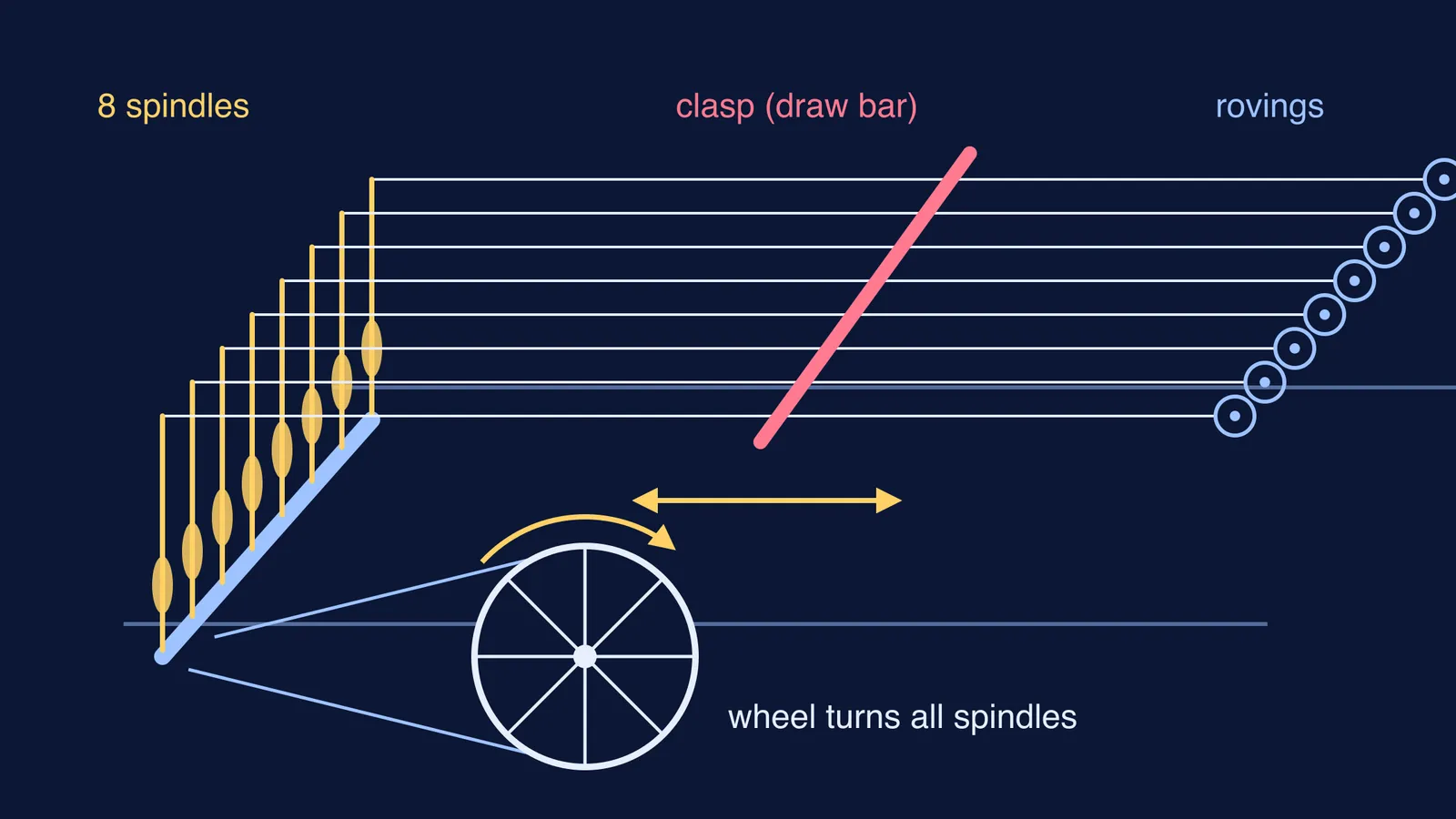
The spinning jenny was a hand-driven spinning machine with a row of upright spindles worked by one wheel. Hargreaves (c. 1720 to 1778) built it at Stanhill, near Oswaldtwistle in Lancashire, in about 1764 to 1765, and his first version had eight wooden spindles fed by eight rovings. A roving is a loose, slightly twisted rope of cotton fibres, the raw material that spinning turns into yarn.
The machine was patented in 1770, and the version in his patent application already had 16 spindles. Nobody is sure where the name 'jenny' came from; Mental Floss notes that even the Oxford English Dictionary calls the reason uncertain.
How does the spinning jenny work?
Spinning has three jobs: stretch the fibres thin (drafting), twist them so they hold together, and wind the yarn on to a spindle. The jenny did all three for every thread at once. The Science Museum Group describes it like this: the spinner turned the driving wheel with the right hand, so the spindles rotated, while working the draw bar with the left.
Here is one full cycle, step by step:
Load the rovings. Each roving runs from its bobbin, through a clamp of two wooden bars (the clasp or draw bar), to its own spindle at the end of the frame.
Close the clasp and draw it back. The left hand pulls the bar along the frame away from the spindles, drawing out a length of every roving and stretching it thin.
Turn the wheel. The right hand turns the wheel, which makes all the spindles revolve together, putting twist into every stretched thread.
Wind on. As the bar returns, a wire guide presses on the twisted yarn and forms it into cops on the spindles, and the cycle starts again.
What did eight spindles change?
A historian's summary of the old workflow says it usually took three carders to make roving for one spinner, and three spinners to keep one weaver supplied. Try the arithmetic yourself:
Old way: one weaver needs 3 spinners, each spinning 1 thread, so 3 threads are being spun at any moment.
Eight-spindle jenny: one spinner spins 8 threads at once.
So, on paper, one person on a jenny could keep up with three wheel spinners, with spare yarn left over.
This is an idealised estimate that assumes each spindle runs as fast as a spinning wheel. Real output was lower, because spinning with a jenny was not a continuous process: you stopped to wind on after every draw. The point of the exercise is the bottleneck: once spinning sped up, carding and weaving had to catch up.
Why did the spinning jenny take off in Britain?
Jennies grew larger, until one spinner could spin 120 threads at a time on a single machine. That museum record also says the jenny led directly to Crompton's mule. Not everyone welcomed jennies. Local spinners broke into Hargreaves' house and smashed his machines, and in 1768 he moved to Nottingham, where he worked with a joiner, Thomas James.
The jenny's yarn had a weakness: it was not very strong. Stronger yarn came with Richard Arkwright's water-powered water frame.
Why Britain and not France or India? The economic historian Robert Allen argued in a 2009 paper in The Journal of Economic History that wages in Britain were exceptionally high relative to the price of capital, so the jenny was profitable to use in Britain but not elsewhere. In his view, whatever the quality of their institutions or cultures, French and Indian producers would not have found it profitable to mechanise cotton production in the eighteenth century.
How do you explain a machine like the jenny in an exam answer?
For a history or a physics question, the same four-line plan works:
Input: what goes in? (rovings, plus human effort at the wheel and bar)
Motion: what moves, and how is it passed on? (wheel to all spindles at once)
Change: what happens to the material? (stretched, twisted, wound)
Limit: what could it not do? (weak yarn, stop-start cycle, still hand-powered)
Practise it on other machines. Try it on how Eli Whitney's cotton gin separated seeds from fibre, on the punched cards of the Jacquard loom, or on James Watt's separate condenser.
If the turning parts are hard to picture from a textbook drawing, the Fermi Simulation Lab has interactive simulations for ideas that are easier to see than to read. And when a belt-and-pulley numerical goes wrong, the Fermi Problem Library has a step-by-step solver that explains the reasoning rather than printing an answer.