

On this page
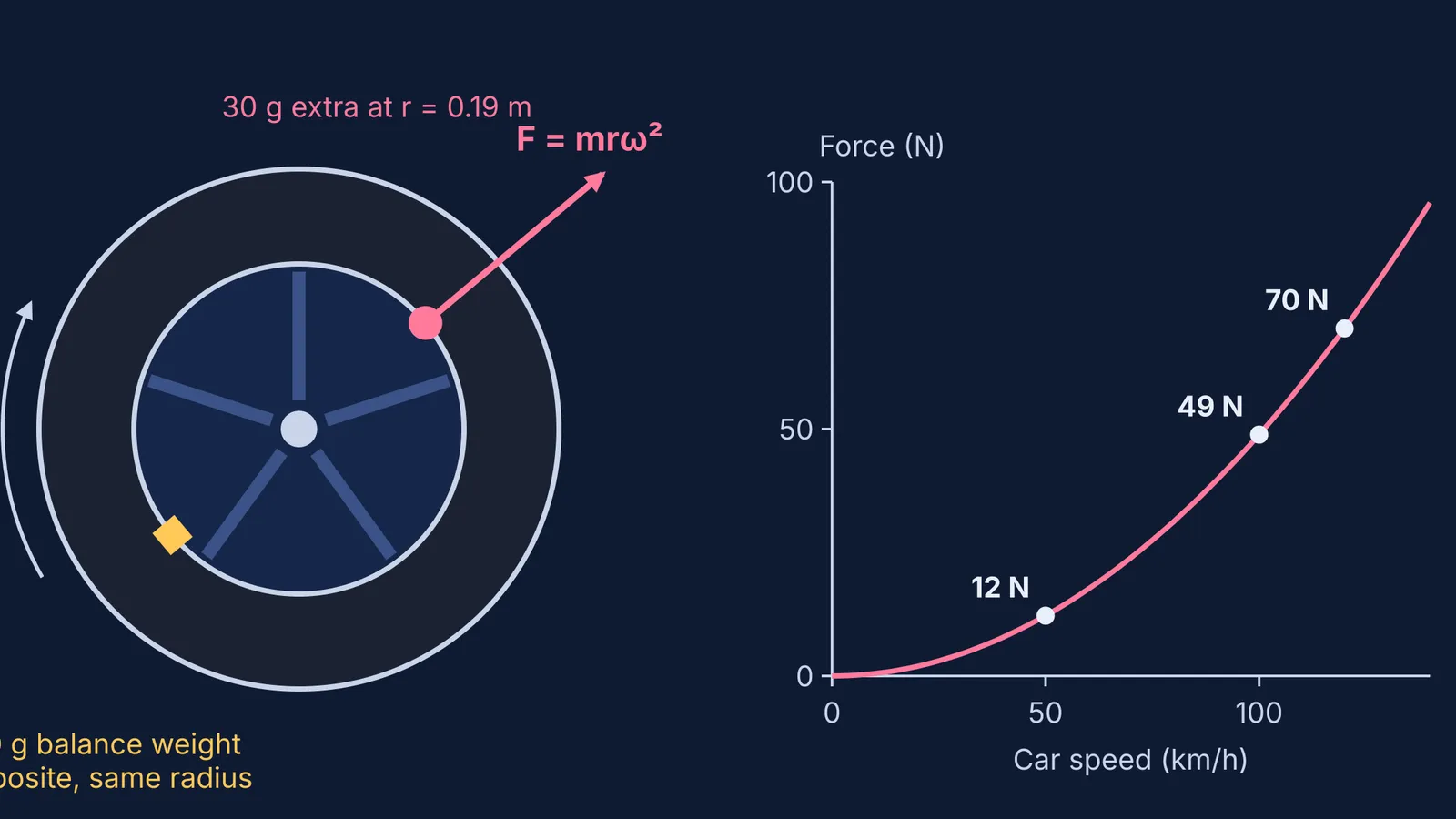
A car that rides smoothly in town can start shaking through the steering wheel at highway speed. Very often the cause is a wheel that is out of balance by a few tens of grams. That sounds too small to matter, until you work out the force. A 30 g lump on a rim spinning at highway speed needs a force of about 49 N, the weight of a 5 kg bag of rice, and the direction of that force goes round with the wheel nearly 15 times a second. This post works it out from F = mrω² and explains what a tyre shop actually does when it balances a wheel.
What does it mean for a wheel to be out of balance?
A wheel is balanced when its centre of mass lies exactly on the axle. Then each bit of mass on one side is matched by mass on the other, and the axle only has to carry the car's weight.
Tyres and rims are never perfectly uniform: the rubber is thicker in one place, or the valve sits on one side. Any of these shifts the centre of mass a tiny distance off the axle. Now, as the wheel spins, that extra mass moves in a circle. Anything moving in a circle needs a centripetal force towards the centre, m·r·ω². The only thing that can provide it is the axle, through the bearings. By Newton's third law the wheel pulls back on the axle with an equal force pointing outward, through the heavy spot.
How much force does a 30 g imbalance create at 100 km/h?
Take round illustrative values: a tyre with rolling radius R = 0.30 m, and an extra 30 g at the rim at r = 0.19 m (a 15-inch rim is 15 × 25.4 = 381 mm across, so its radius is about 0.19 m).
Speed. v = 100 km/h = 100 / 3.6 = 27.8 m/s.
Angular speed of the wheel. The tyre rolls without slipping, so ω = v / R = 27.8 / 0.30 = 92.6 rad/s.
Revolutions per second. f = ω / 2π = 14.7 rev/s, or 884 rpm.
Force. F = m·r·ω² = 0.030 × 0.19 × 92.6² ≈ 48.9 N.
Compare with a weight. F / g = 48.9 / 9.81 ≈ 5.0 kg.
Check units. kg × m × (rad/s)² = kg·m/s² = N. Radians are dimensionless.
Notice which radius goes where. The tyre's rolling radius R sets ω, because the tyre is what touches the road. The radius of the lump, r, goes into the force.
Why does the shaking appear only at highway speed?
Because ω = v / R, the force is F = m·r·v² / R², so it grows with the square of the speed:
50 km/h: ω = 46.3 rad/s, F ≈ 12.2 N.
100 km/h: F ≈ 48.9 N.
120 km/h: ω = 111.1 rad/s, F ≈ 70.4 N.
Doubling the speed from 50 to 100 km/h makes the force four times larger. At town speeds 12 N is lost in the noise of the road; at highway speeds 49 to 70 N gets through the suspension and steering to your hands. A bigger lump makes it worse in direct proportion: 60 g of mud or a lost weight doubles the force to about 98 N at 100 km/h.
There is a second reason. The force is a vibration, not a steady pull. Its direction turns with the wheel, so it pushes the axle up, forward, down and back in turn, 14.7 times a second at 100 km/h. Every mechanical system has natural frequencies. If the wheel's rotation frequency comes close to a natural frequency of the suspension or steering, the system resonates and the shake grows much larger than the force alone would suggest. That is why the shake can be worst in one band of speeds rather than simply growing with speed.
The same rotating out-of-balance force is what makes a washing machine walk across the floor when the clothes bunch up on one side; see how a washing machine spins clothes dry.
How does a tyre shop balance a wheel?
The fix follows from the physics. Put an equal mass at the same radius on the opposite side. Now the two outward forces are equal and opposite at every instant, the centre of mass is back on the axle, and the net force on the bearings is zero. A small clip-on or stick-on weight of 30 g fixed opposite the heavy spot does the job.
A balancing machine spins the wheel, measures how much it pushes on its shaft and where, and tells the technician what mass to fit and at which angle.
What is the difference between static and dynamic balance?
A wheel has width as well as radius, and that matters.
Static imbalance: the extra mass shifts the centre of mass off the axle. You can see it by letting the wheel turn freely on a stand: it settles with the heavy spot at the bottom. One weight opposite fixes it.
Dynamic imbalance: suppose 30 g sits at the top on the inner face of the rim and another 30 g at the bottom on the outer face. The centre of mass is on the axle, so the wheel sits still on a stand at any angle. But when it spins, the two 48.9 N forces point in opposite directions and act in different planes. That is a couple. If the two faces are, say, 0.15 m apart, the rotating couple is 48.9 × 0.15 ≈ 7.3 N·m, which keeps trying to tip the wheel's axle as it turns and, on a front wheel, shows up as shimmy in the steering.
A couple has zero net force but a non-zero torque; what is a couple explains why it rotates a body without moving its centre. This is why balancing machines fit weights on both the inner and outer edges of the rim: two weights in two planes cancel both the net force and the couple.
Balancing is not wheel alignment. Alignment sets the angles of the wheels; balancing fixes how mass is spread around each one.
Where else does m·r·ω² appear?
The same formula is behind banked roads, vertical circles and conical pendulums, all covered in circular motion problems on banking and vertical circles. The difference here is that the circling mass is part of a spinning body, so the force rotates with it. If centripetal force itself still feels shaky, the Concept Library covers it from the ground up.
Quick checklist
Out of balance means the centre of mass is off the axle.
Rolling wheel: ω = v / R with the rolling radius.
Force on the axle: F = m·r·ω², with r the radius of the extra mass.
30 g at 0.19 m: 12.2 N at 50 km/h, 48.9 N at 100 km/h, 70.4 N at 120 km/h.
F grows as v², so the shake shows up at highway speed.
The force rotates with the wheel: it is a vibration at the rotation frequency.
Static balance needs one plane; dynamic balance needs two, to cancel the couple.
Balancing is not alignment.


