

On this page
“Match the respiratory organ to the animal” is one of the quickest questions to lose marks on, because the answers are spread across two NCERT chapters. Below, we put the breathing chapter and the Animal Kingdom chapter together so you see the whole pattern at once.
Which phyla have no respiratory organ at all?
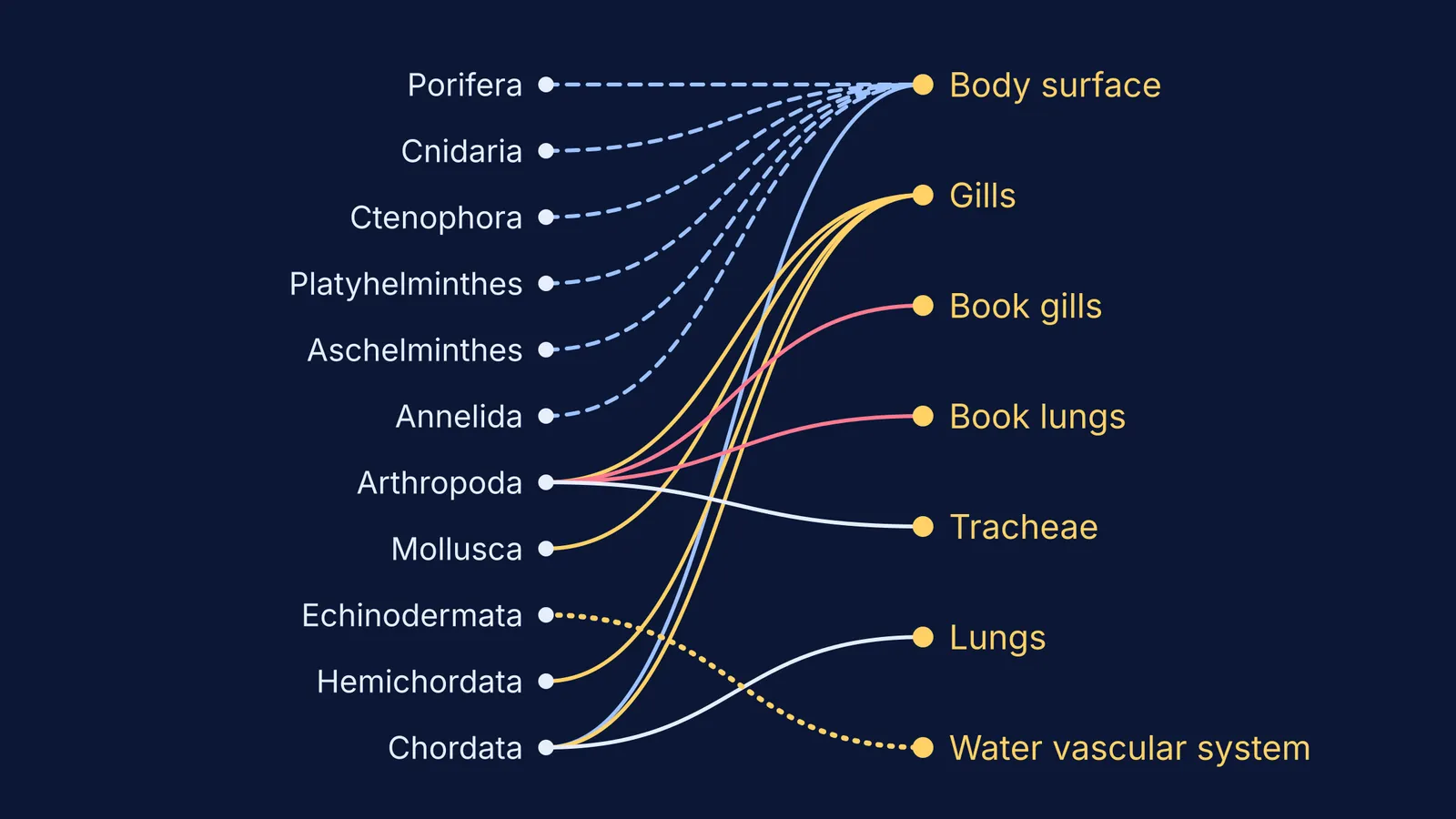
Six phyla have no respiratory system: Porifera, Coelenterata (Cnidaria), Ctenophora, Platyhelminthes, Aschelminthes and Annelida, according to Table 4.2 of NCERT Class 11 Biology, Chapter 4, Animal Kingdom.
These animals still breathe. The NCERT chapter on Breathing and Exchange of Gases says sponges, coelenterates, flatworms and similar lower invertebrates exchange oxygen and carbon dioxide “by simple diffusion over their entire body surface”. The same page says earthworms use their moist cuticle. So “no respiratory organ” means the whole body surface does the job.
For more, see our explainer on why an earthworm must keep its skin moist to breathe.
Which animals use gills, book lungs and tracheae?
Arthropoda is the phylum with the most options. NCERT's Animal Kingdom chapter says arthropod respiratory organs are “gills, book gills, book lungs or tracheal system”, and that over two-thirds of all named species on earth are arthropods.
Gills: aquatic arthropods such as prawns.
Book gills: the king crab (horseshoe crab) *Limulus*, the “living fossil” in NCERT's list.
Book lungs: spiders and scorpions.
Tracheae: insects such as the locust and honey bee.
A book lung is a stack of thin plates (lamellae), like the pages of a book, with air between them. Kamenz and colleagues (2008) describe trabeculae as tiny cuticular pillars that keep neighbouring lamellae apart and create a permanent air space. They studied fossil arachnid book lungs about 410 million years old and found the fine structure indistinguishable from that of modern arachnids.
A study of 47 spider species by Küntzel, Dunlop and Scholtz (2019) found one shared plan in every spider lung: a spiracle, an atrium, stacked lamellae with pillar cells, and trabeculae.
Book gills are the water version. In *Limulus*, Farley (2012) describes page-like lamellae on the appendages, each with a central channel for blood (hemolymph) and water channels between them, and calls book gills and book lungs organs “for gas exchange” in water and on land.
Tracheae are air tubes that carry air straight to the tissues. A review by Harrison, Kaiser and VandenBrooks (2010) describes this “blind-ended tracheal respiratory system” as a possible reason insects stay small compared with vertebrates. Our post on how insects breathe through spiracles and tracheae walks through the tubes step by step.
Three more non-chordate phyla, from the same NCERT chapter:
Mollusca: feather-like gills in the mantle cavity.
Hemichordata: “Respiration takes place through gills” (*Balanoglossus*).
Echinodermata: the water vascular system helps in respiration, as well as movement and feeding.
Which vertebrates breathe with lungs, and which with gills?
The NCERT breathing chapter says fishes use gills, while amphibians, reptiles, birds and mammals breathe through lungs. Frogs can also breathe through their moist skin, which NCERT calls cutaneous respiration.
The Animal Kingdom chapter adds the numbers examiners like:
Cyclostomes (lamprey, hagfish) have 6 to 15 pairs of gill slits.
Bony fishes have four pairs of gills, covered by an operculum on each side.
Cartilaginous fishes have separate gill slits with no operculum.
Amphibians breathe by gills, lungs and skin.
Birds breathe with lungs, and air sacs connected to the lungs supplement respiration.
The whole answer in one list
Body surface only (no respiratory organ): Porifera, Cnidaria, Ctenophora, Platyhelminthes, Aschelminthes, Annelida.
Gills: aquatic arthropods, Mollusca, Hemichordata, cyclostomes and fishes, amphibians.
Book gills: *Limulus*.
Book lungs: spiders and scorpions.
Tracheae: insects.
Water vascular system: Echinodermata.
Lungs: amphibians, reptiles, birds (with air sacs), mammals.
Skin as an extra route: frogs.
How do you answer “match the organ” questions quickly?
Ask three questions, in this order, about any animal in the option list.
Is it in one of the six phyla with no respiratory system? Then the answer is the body surface.
Is it an arthropod? Then decide by habitat and group: water means gills, *Limulus* means book gills, spider or scorpion means book lungs, insect means tracheae.
Is it a vertebrate? Then fishes mean gills, everything else means lungs, and a frog adds skin.
Worked example: “Book lungs are found in (a) cockroach (b) scorpion (c) prawn (d) earthworm.” The cockroach is an insect (tracheae), the prawn is aquatic (gills), the earthworm is an annelid (skin). The answer is (b) scorpion.
To practise more pairings like this, the Fermi Problem Library has worked problems with a step-by-step solver that explains the reasoning rather than printing an answer. If a term such as “trabeculae” or “operculum” is still fuzzy, look it up in the Fermi Concept Library, which covers every concept in biology with its own lesson.
Once the organs are clear, move on to the human side in our Class 11 guide to Breathing and Exchange of Gases.


