On this page
Respiration in Plants is Chapter 12 of NCERT Class 11 Biology (Reprint 2026-27), and the NMC syllabus for NEET (UG) 2026 lists it under Unit 4, Plant Physiology. On this chapter, a wrong answer often comes from one swapped place, direction or word.
Below are eight frequent slips, grouped by type. Each has why it tempts you, what NCERT says (with its section number), a quick check we wrote, and a habit that blocks it.
Where does each step happen?
"Leaves send their oxygen down the stem to the roots."
Why it tempts you: in animals, blood carries oxygen to every organ, so you expect plants to share gas between parts too.
What NCERT says: each plant part handles its own gas exchange, and gases hardly travel from one part to another. Plant organs respire slowly, and loosely packed parenchyma in leaves, stems and roots forms connected air spaces (NCERT 12.1).
Check: a living root cell sits beside an air space. Does its O₂ come mainly from the leaf above or from air around the root? (The root's own surroundings.)
Habit: when asked how a plant organ gets O₂, answer for that organ alone.
"Pyruvate becomes acetyl CoA in the cytoplasm, right where glycolysis ends."
Why it tempts you: flowcharts draw glycolysis and the pyruvate step one under the other, so they look like neighbours.
What NCERT says: glycolysis runs in the cytoplasm. Pyruvate is first moved into the mitochondria, and only in the matrix does pyruvic dehydrogenase remove CO₂ and form acetyl CoA, with NAD⁺ and coenzyme A taking part (NCERT 12.2, 12.4).
Check: in a eukaryotic cell respiring aerobically, in which compartment does the first carbon from glucose leave as CO₂? (The mitochondrial matrix.)
Habit: write C (cytoplasm), M (matrix) or IM (inner membrane) beside every step you draw.
Where do the CO₂ and water come from?
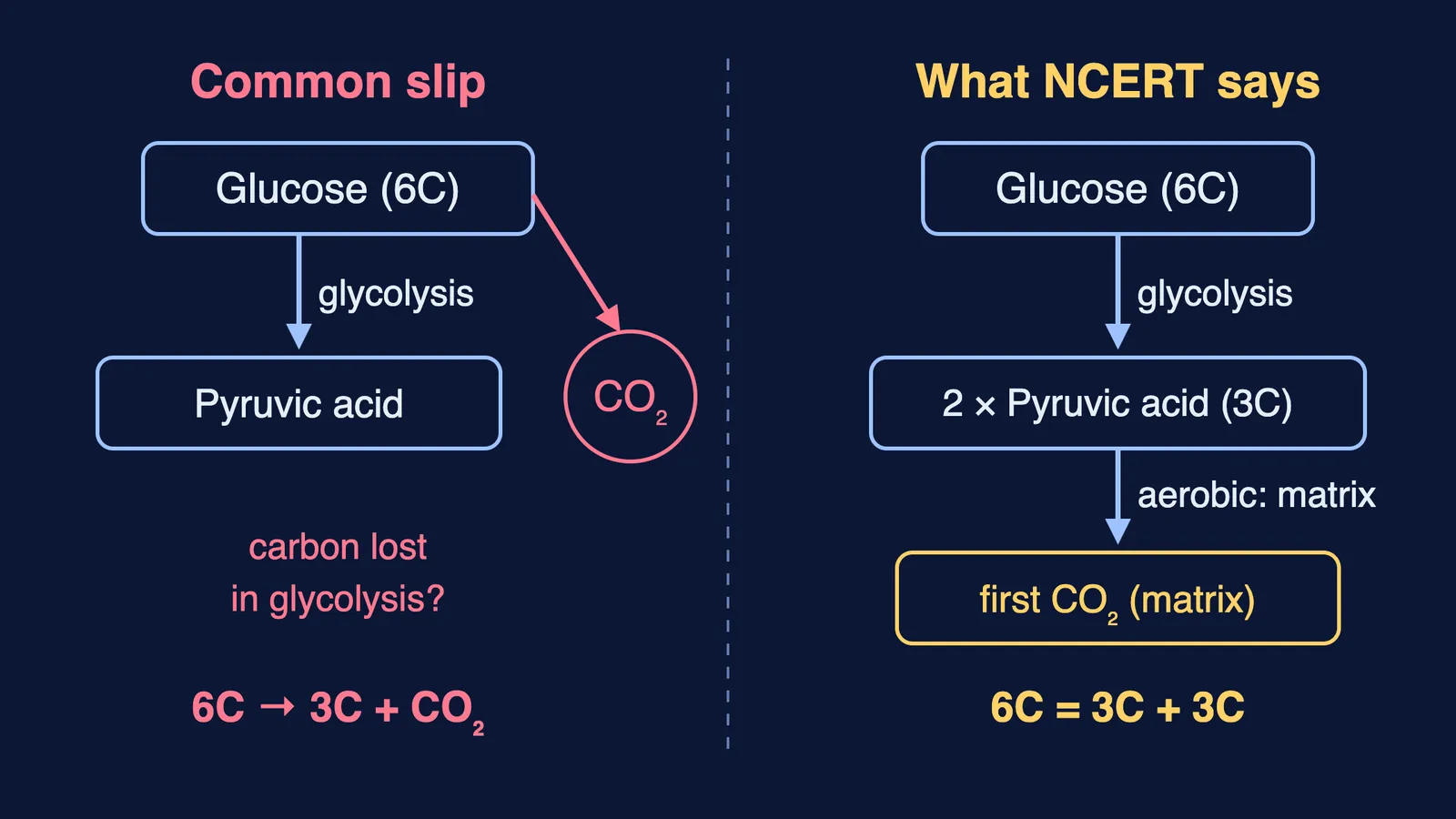
"Glycolysis gives off CO₂."
Why it tempts you: glucose is being broken down, and breakdown sounds like it should release gas.
What NCERT says: glycolysis partly oxidises one 6-carbon glucose into two 3-carbon pyruvic acid molecules, so all six carbons are still there (NCERT 12.2, Figure 12.1).
Check: in yeast fermentation, which enzyme releases the first CO₂? (Pyruvic acid decarboxylase, after glycolysis has finished; NCERT 12.3.)
Habit: count carbons at every arrow. If 6 = 3 + 3, no CO₂ left.
"Every kind of fermentation bubbles out CO₂."
Why it tempts you: yeast and rising dough are the usual picture of fermentation.
What NCERT says: yeast converts pyruvic acid to CO₂ and ethanol, but some bacteria make lactic acid instead. On the lactic route, pyruvic acid is reduced, with NADH + H⁺ as the reducing agent, and no CO₂ is given off (NCERT 12.3, Figure 12.2).
Check: one sealed flask holds yeast, another holds lactic-acid bacteria, both fed glucose. Which flask collects CO₂? (The yeast flask; pyruvic acid, 3C, becomes lactic acid, 3C, losing no carbon.)
Habit: before you write CO₂, name the step that removes a carbon.
"The O₂ taken in during respiration is what leaves as CO₂."
Why it tempts you: O₂ goes in and CO₂ comes out, so the two look like the same thing swapped.
What NCERT says: in the matrix, each pyruvate loses all its hydrogen atoms step by step, leaving three CO₂. O₂ acts only at the end of the electron transport system, as the final hydrogen acceptor, and is reduced to water (NCERT 12.4, 12.4.2).
Check: look at NCERT's summary equation for the TCA phase. Which side is H₂O on, and where is O₂? (H₂O is an input on the left; O₂ is absent, yet 3 CO₂ come out; NCERT 12.4.1.)
Habit: track two exits separately. Carbon leaves as CO₂ in the matrix; O₂ ends up as water at the inner membrane.
Which words and yields get mixed up?
"Amphibolic means respiration can run with or without oxygen."
Why it tempts you: "amphi" means both, and aerobic versus anaerobic is the chapter's most familiar pair.
What NCERT says: the "both" is breaking down and building up. Fatty acids enter as acetyl CoA when they are respired, and acetyl CoA is pulled out when the cell makes fatty acids, so the pathway serves catabolism and anabolism (NCERT 12.6).
Check: which fact shows the pathway is amphibolic: yeast switching to ethanol when O₂ runs out, or a cell drawing off acetyl CoA to build fatty acids? (The second.)
Habit: expand amphibolic as "anabolic plus catabolic" every time you read it.
"In fermentation, the steps after pyruvate earn extra ATP."
Why it tempts you: in aerobic respiration, the steps after pyruvate make most of the ATP, so you expect the same here.
What NCERT says: whether yeast makes ethanol or bacteria make lactic acid, the NADH + H⁺ from glycolysis is turned back into NAD⁺. Fermentation nets only two ATP per glucose and frees under 7% of glucose's energy (NCERT 12.3, 12.5). Glycolysis needs that NAD⁺ again at the PGAL step (NCERT 12.2).
Check: how many ATP does the pyruvic-acid-to-ethanol part add in yeast? (None; it hands back NAD⁺.)
Habit: for each step, ask what it gives back. In fermentation the answer is NAD⁺, not ATP.
Which way do the arrows point?
"Protons leave the matrix through ATP synthase to make ATP."
Why it tempts you: you remember that protons cross the inner membrane but not which way they go at complex V.
What NCERT says: F1 carries the ATP-making site, while F0 sits in the membrane as the channel for protons. Protons move through that channel inward, out of the intermembrane space and into the matrix, running down their electrochemical gradient; that flow powers ATP synthesis (NCERT 12.4.2).
Check: sketch the inner membrane with the matrix below it. Does the arrow through F0 point into the matrix or out of it? (Into.)
Habit: think "ATP is made as protons run downhill, back into the matrix."
A 60-second self-check before you mark
If a check caught you, reread its NCERT section and redraw that figure from memory. For the full chapter plan, see our Plant Physiology for NEET preparation guide; for rule-and-exception practice on this chapter, try our odd-one-out and exceptions set for this chapter.
Not sure which of these slips is yours? Fermi's AI tutor works out what you already know and builds a plan for the session.